Get your free ETF data sample from our comprehensive offerings. Start your free trial→
Help us improve your experience. Please confirm your investor type:
The Ultimate ETF Comparison Tool - Try Now!
Analyze up to 5 ETFs side-by-side and gain instant insights on performance, fees, holdings, and more to make data-driven investment decisions.
Tariff Concerns Push Nasdaq into Bear Market
Nasdaq tumbles from highs as Trump's tariffs, inflation, and Fed policy shifts rattle markets and spark volatility fears.


By Leverage Shares
April 17, 2025
- Leverage Shares
- Nasdaq
- Information & Technology
Advertisement
Nasdaq’s Fast Turn from Roaring Gains to Massive Pain
A roaring bull market propelled the Nasdaq 100 to gains of over 50% in 2023 and 24% in 2024. The rally was fuelled by optimism that the Federal Reserve would start to cut interest rates as inflation cooled, marking a reversal of its aggressive tightening cycle that began in 2022.
Investor enthusiasm was further boosted by a surge in artificial intelligence spending, as companies scrambled to develop AI applications. However, those bullish catalysts are far behind us now.
📊 Share your ETF outlook
From AI infrastructure to active strategies, the ETF landscape is shifting. Share your perspective in the 7th Annual Global ETF Survey and get exclusive early access to the final report.
After cutting rates in September, November, and December, at the beginning of 2025, inflation and inflation expectations spiked up and the Federal Reserve signalled a pause in monetary easing due to uncertainties arising from President Donald Trump policies.
The Fed’s change in stance in January, with the central bank signalling just one rate cut in 2025, has dampened hopes that lower borrowing costs would fuel business investment and ease corporate debt burdens.
In January, China's Deepseek-R1 stunned the tech world by matching the capabilities of ChatGPT and Google Gemini for just $6 million, using older-generation chips instead of Nvidia’s cutting-edge GPUs.
While AI investments are still projected to grow this year, mounting macroeconomic uncertainty may prompt major players like Amazon, Google, and Microsoft to scale back. Reports already suggest Microsoft is reassessing its data centre expansion plans.
These headwinds were already putting pressure on the Nasdaq 100, with the Magnificent 7 leading the selloff in February, before fears of the impact of tariffs on the economy started to shake off the market.
Liberation Day Pushed Nasdaq into a Bear Market
On the 2nd of April, President Donald Trump announced sweeping new tariffs, marking a significant escalation in his ongoing trade war. Framing the move as a bold effort to combat unfair trade practices, Trump imposed a 10% tariff on all imports into the United States, alongside steeper duties on goods from around 60 countries or trading blocs with substantial trade surpluses with the U.S.
This aggressive move represents the most substantial expansion of U.S. tariff policy over the past 100 years. Several nations, including long-standing U.S. allies, have signalled their intention to retaliate, raising the spectre of a full-scale global trade war.
President Trump's tougher than expected “Liberation Day” tariffs announcement, triggered a meltdown in global equity markets. Stocks have slumped amid growing concerns that a wave of retaliatory tariffs could trigger severe economic fallout, fuelling inflation, curbing consumer spending, and dragging down growth.
Advertisement
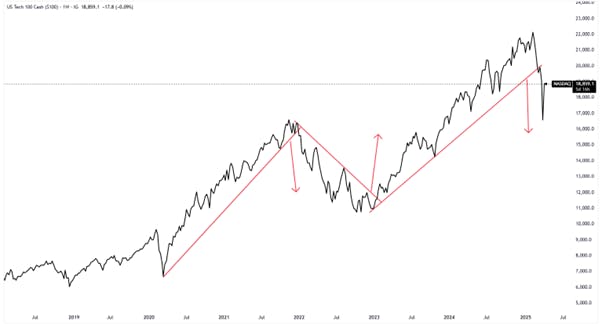
The Nasdaq 100 took the biggest hit among the major U.S. benchmarks, plunging over 25% from its all-time high on the 19th of February to its low of 16,542 on the 7th of April. This sharp decline firmly placed the index in bear market territory, typically defined by a drop of 20% or more.
U.S. markets have just endured one of their most turbulent periods in recent memory, with the sharp spike in long-term Treasury yields standing out as yet another sign of the unusual trading unleashed in the wake of President Trump’s tariff-driven “Liberation Day”.
Trump Pauses Broad Tariff Hike, Escalates Trade Tensions with China
Last week U.S. President Donald Trump unexpectedly halted a significant portion of his wide-ranging tariff campaign, temporarily suspending import duties on goods from numerous global trading partners. The 90-day pause is intended to facilitate negotiations aimed at reducing trade imbalances with the U.S. However, this move came alongside a sharp escalation in the trade conflict with China, as the administration raised tariffs on Chinese imports to 145%.
In response, China increased its tariffs on U.S. goods to 125%, a steep jump from the previous 84%, following the U.S. hike. These retaliatory tariffs took effect last Thursday.
The elevated tariffs on Chinese goods are expected to intensify supply chain disruptions. With the cost of Chinese imports surging, U.S. importers are likely to seek alternative suppliers from other regions, granting those foreign companies greater pricing leverage. These tariffs are likely to feed into broader inflationary pressures in the months ahead.
The decision comes after a tumultuous week in U.S. equity markets, which saw trillions in value wiped out. It also marks another dramatic change in the administration’s volatile tariff policy. Under the new framework, most goods from 57 trading partners, including the European Union, Japan, and South Korea, will face a standard 10% U.S. import tariff for the next 90 days, replacing the previously announced higher "reciprocal" rates.
The 90-day suspension also does not extend to the 25% tariffs on steel and aluminium that took effect in March, nor to the auto tariffs introduced on the 3rd of April. Additionally, the 25% duty on auto parts is still slated to take effect on the 3rd of May.
Nasdaq Soars as Tariff Policy Reverses, But Caution Prevails
The 9th of April 2025 will be remembered as one of the most dramatic days in recent market history, where both investor sentiment and U.S. trade policy changed course in tandem. The Nasdaq 100 surged over 12%, refreshing memories of the sharp rebound seen during the early COVID-19 rally in March 2020.
Advertisement
Yet, despite the 90-day suspension of broad tariffs, the rally is quickly losing momentum. Markets remain uneasy, as underlying concerns about inflation, growth, and geopolitical risk continue to cast a shadow over the outlook for the market. Investors are still processing the implications of President Trump’s unpredictable and changing trade stance, making it difficult to estimate their overall impact.
Tariffs Complicate Rate Cut Outlook Amid Softening Growth
While the latest economic data offers a glimmer of hope, giving the Federal Reserve some flexibility should growth continue to weaken, policymakers remain cautious. Tariff-induced inflationary pressures and ongoing supply chain disruptions are expected to push inflation back toward 4% in the second half of 2025.
Interest rate cut expectations have fluctuated wildly, given Trump’s daily change in stance in regard to tariffs. In a week, markets were pricing in 107 basis points of cuts for 2025. That figure plummeted to 75 basis points following Trump's backtrack on certain tariffs, only to rebound to 89 basis a day after. Given the deteriorating economic outlook, a range of three to four rate cuts this year appears increasingly plausible.
Source: TradingView
Tariffs on Imported Semiconductor Chips Imminent, as Trump Targets Tech Supply Chain
Despite Friday’s exclusion of smartphones and laptops from the initial round of reciprocal tariffs on China, the reprieve appears fleeting. Commerce Secretary Howard Lutnick confirmed that additional duties on smartphones, computers, and pharmaceuticals are expected within the next two months. These new levies will fall outside the 125% reciprocal tariffs.
President Trump also announced plans on Sunday to unveil new tariffs on imported semiconductors within the coming week, signalling a broader crackdown on critical technology imports. While allowing for some industry flexibility, the President hinted that exemptions for consumer electronics like smartphones and computers may be temporary.
Trump’s changing stance on tariffs has fuelled extreme market volatility, triggering the wildest swings on Wall Street since the pandemic crash in 2020. Despite its recent rebound the Nasdaq 100 has fallen over 10% YTD and the sustainability of the current rebound remains in question.
Conclusion
The U.S. economy is on the brink of recession, with the unpredictable and sweeping nature of the White House's trade actions. Last week’s 90-day tariff suspension for most nations excluding China, did little to calm fears, as the back-and-forth continues to disrupt investment and planning, which could undermine productivity and long-term growth.
Tariffs, rising inflation, slowing economic growth, surging national debt, a widening fiscal deficit, mounting geopolitical instability, and superpowers rivalry could tip the U.S. economy into a recession.
Professional investors looking for magnifies exposure to the Nasdaq 100 index may consider Leverage Shares +5x Long Nasdaq 100 or -5x Short Nasdaq 100 ETPs.
About Leverage Shares
Leverage Shares is the largest European issuer of single stock ETPs by AUM & trading volume. It is the only provider of physically-backed leveraged ETPs on single stocks, ETFs and commodities.
The opinions expressed in this publication are those of the authors and are subject to change. They do not purport to reflect the opinions or views of Trackinsight or its members. Trackinsight does not guarantee the accuracy, completeness, or reliability of the information provided.
More articles


About Trackinsight
Since our founding in 2016, we have been at the forefront of the industry, delivering accessible, comprehensive, and reliable tools to support the evolving needs of investors.
Over the past decade, Trackinsight has expanded its operations across six countries, serving thousands of professional investors. We’ve consistently innovated to provide cutting-edge solutions that meet the changing demands of the ETF market.
In 2024, Kepler Cheuvreux, a leading independent European financial services firm, acquired a majority stake in Trackinsight, becoming the company's principal shareholder.
This strategic partnership solidifies Trackinsight's position as a premier provider of ETF selection and analysis tools, while strengthening Kepler Cheuvreux’s commitment to becoming a leading player in the ETF sector.
Together, we are committed to offering advanced services that empower professional investors, advisors, institutions, and issuers. This new step enables us to deliver even more comprehensive and innovative technological solutions, driving ETF investing to new heights.
More about TrackinsightETF TOOLS
PLATFORM
ETF NEWS & RESEARCH
Privacy policy | Cookie policy | | Terms of use | Imprint