Trackinsight is part of ETF One, the fully integrated ETF platform of Kepler Cheuvreux. Learn more →
Help us improve your experience. Please confirm your investor type:
Don’t Miss a Move in the ETF Market
Sign up and keep track of everything that moved the ETF industry this week. From new launches to regulatory shifts across the Atlantic.
Opportunity in high yield debt for 2023
Strategies that outperformed in 2022 may be showing signs of exhaustion, while last year’s ugly ducklings could transform into swans over the next 8-12 months.


By Daniel Chivu
January 10, 2023
- Bonds
Advertisement
Is high yield finally deserving of its name again? For much of the last 3 years, corporate debt has been overshadowed by the white-hot performance of equity investments, buoyed by the near-zero interest rates prevalent in most developed markets. However, as 2022 taught most investors, these conditions were anything but permanent, and both bonds and equities began a downtrend as of March 2022 which has only recently shown signs of flattening out.
Below, we compare the relative performance of 3 ETFs focusing on High Yield Debt, the core S&P 500 Index, and High Dividend Equities, over the last year:
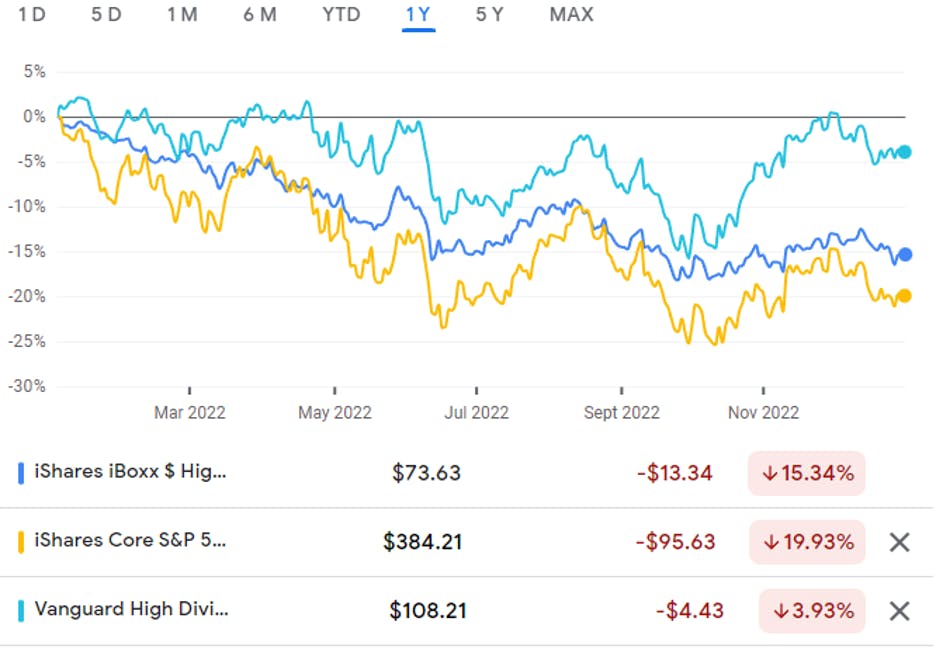
Immediately we notice that high yield bonds performed considerably worse than high dividend equities over this period of time, although they did beat the broad S&P Index by about 4.5%. And so, over the past year we have a clear winner in high dividend equities.
But as investors know, past performance is not indicative of future results, particularly when underlying macroeconomic conditions are projected to be vastly different over the next 12 months and talks of an incoming earnings recession are gaining popularity.
ETF Data Built for Precision
Trackinsight delivers reliable and comprehensive coverage on 14,000+ ETFs
The importance of Capital Structure and Bond Ratings in 2023
Consideration of the capital structure of publicly traded companies is a primary factor used by analysts and investment managers when attempting to calculate the intrinsic value of a particular equity, but its usefulness extends beyond the specialized field of valuations.
Savvy investors know that capital structure plays an extremely important role in the distribution of income by the underlying business, where securities that rank higher in the structure have priority over those ranking lower.
The Capital Structure pyramid below shows the ranking of High Yield Bonds being above that of common equities, thus assigning priority to the income provided by high yield bonds, and making them a safer choice compared to high dividend equities from this standpoint.
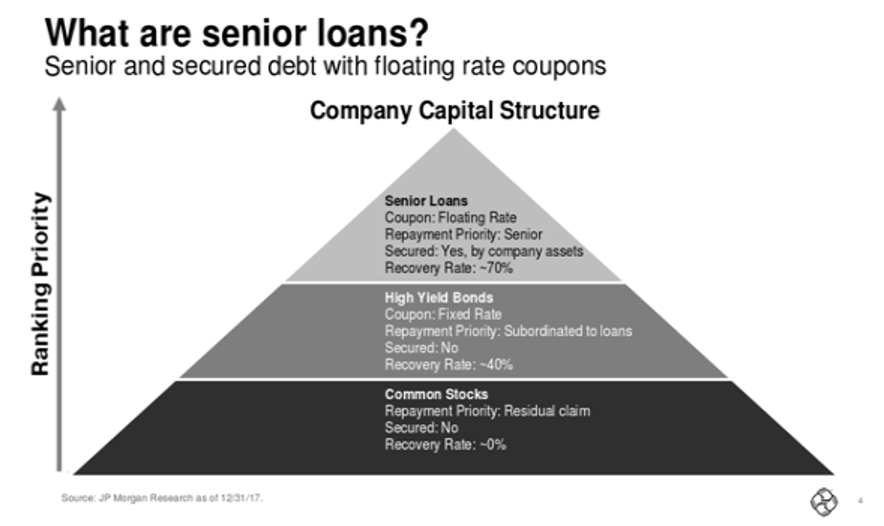
With an economic background that is projected to weaken in 2023, and a potential earnings recession being predicted in Q1, investors have a choice between the relative safety of the fixed coupon provided by high yield bonds, and the dividend income earned from common equities.
In the face of economic uncertainty and significant earnings risks, high yield bond ETFs could provide an attractive opportunity to investors looking to add some risk, while at the same time limiting their exposure to the risk of dividend cuts or capital losses resulting from further compression in valuations.
Similar to the Capital Structure pyramid however, high yield bonds also have hierarchy of payments in the event of default, with the higher ranked bonds more likely to receive payment:
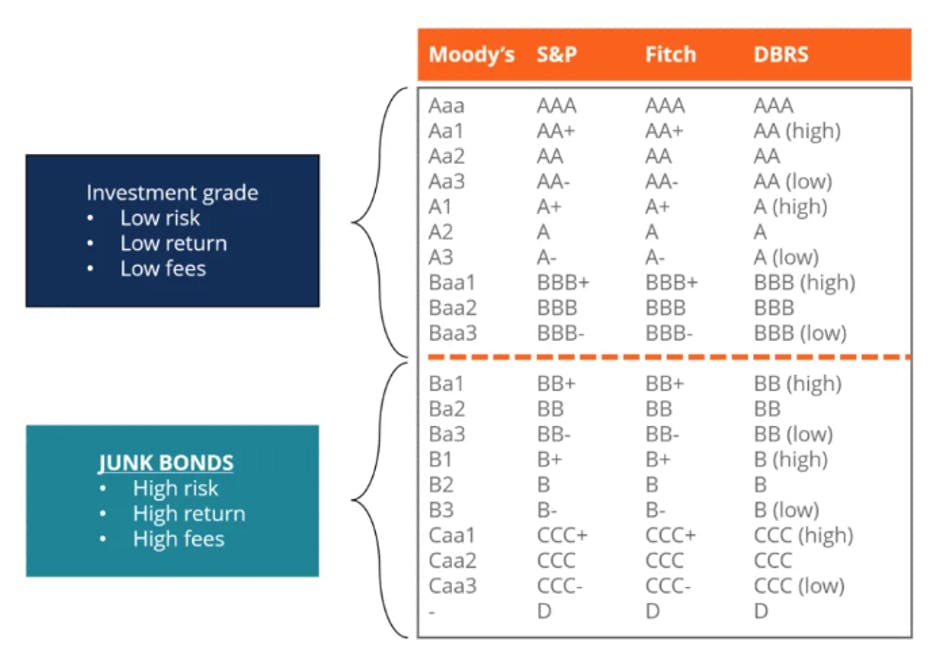
Investors looking to gain exposure to this asset class must pay close attention to the credit ratings of the bonds included in the ETF, and should potentially avoid ETFs with a large allocation to bonds rated B and lower which have a much higher risk of default.
Luckily, most ETFs avoid these bonds as they are considered highly speculative, or allocate a fraction of a percent to them, for the extra yield. Investors should still review the ETF holdings however, and make sure that they are comfortable with the allocation to bonds rated lower than B.
A typical high-quality ETF will allocate a minimum of 70-80% of their assets to bonds rated B or above, with the remaining balance allocated among hundreds of B-, and occasional CCC+ for short periods of time.
Gaining exposure to high yield bond ETFs
The main consideration when dealing with a riskier asset class, beyond the potential returns, is the risk undertaken to generate those returns, and the reputation and track record of the managers.
Many investors associate the size or longevity of the firm with quality, which is a natural human instinct. After all, the manager has seen many market cycles and is clearly popular, therefore they must be better right?
Well perhaps, but that is not always the case.
It is important for investors to try and set such biases aside and look at the underlying allocations, the track records, and the comparative performance among large and small ETF managers. It could be the size of the manager has more to do with having a better sales team rather than better performance!
Using the Trackinsight ETF Screener, investors can explore various options, such as the ETFs listed below. These ETFs are size and manager agnostic, and have allocated a minimum of 70% to higher quality bonds in the high yield space, prioritizing safety over short term returns. They are not listed in any particular order nor do they constitute a recommendation, as their strategies and maturities are different.
- Horizons Active High Yield Bond ETF (HYI)
- XTrackers Short Duration High Yield Bond ETF (SHYL)
- Invesco BulletShares 2024 High Yield Corporate Bond ETF (BSJO)
Please note this article is for information purposes only and does not in any way constitute investment advice. It is essential that you seek advice from a registered financial professional prior to making any investment decision.
More articles


About Trackinsight
Since our founding in 2016, we have been at the forefront of the industry, delivering accessible, comprehensive, and reliable tools to support the evolving needs of investors.
Over the past decade, Trackinsight has expanded its operations across six countries, serving thousands of professional investors. We’ve consistently innovated to provide cutting-edge solutions that meet the changing demands of the ETF market.
In 2024, Kepler Cheuvreux, a leading independent European financial services firm, acquired a majority stake in Trackinsight, becoming the company's principal shareholder.
This strategic partnership solidifies Trackinsight's position as a premier provider of ETF selection and analysis tools, while strengthening Kepler Cheuvreux’s commitment to becoming a leading player in the ETF sector.
Together, we are committed to offering advanced services that empower professional investors, advisors, institutions, and issuers. This new step enables us to deliver even more comprehensive and innovative technological solutions, driving ETF investing to new heights.
More about TrackinsightETF TOOLS
PLATFORM
ETF NEWS & RESEARCH
Privacy policy | Cookie policy | | Terms of use | Imprint