Global ETF Survey 2026: Answer now →
Help us improve your experience. Please confirm your investor type:
The Ultimate ETF Comparison Tool - Try Now!
Analyze up to 5 ETFs side-by-side and gain instant insights on performance, fees, holdings, and more to make data-driven investment decisions.
Navigating ETF sustainability with ESG scores
Many investors might be surprised to find out that not all ESG ETFs have good ESG scores – and vice-versa, some non-ESG ETFs have excellent ESG scores.

By Thomas Paratore
April 15, 2021
- Climate Change
Advertisement
Investor appetite for sustainable investing boosted the growth of ESG ETFs in 2020 and allowed them to triple in assets. Thanks to a continuous stream of inflows, assets invested in ESG ETFs grew at a 92.6% CAGR over the past three years. Investors selecting ESG ETFs might find ESG scores helpful. With a single letter from A to D, ESG scores sum up all available information on the ETF’s sustainability characteristics and help investors save time and make the right investment decision.
ETF Data Built for Precision
Trackinsight delivers reliable and comprehensive coverage on 14,000+ ETFs
Not all ESG ETFs have good ESG scores
At Trackinsight, we have developed ESG Observatory where investors can find all our ESG ETF data, including the funds’ sustainability ratings – a score calculated by our partner, Swiss sustainability expert, Conser.
Many investors might be surprised to find out that not all ESG ETFs have good ESG scores – and vice-versa, some non-ESG ETFs have excellent ESG scores!
If you buy an ESG ETF, you might expect it to have a better score than other similar non-ESG ETFs. We take a look at the data to answer the million-dollar question: do ESG ETFs manage to score better than their non-ESG peers?
ESG ETFs score better on average but there are exceptions
We looked at more than 200 ESG ETFs and assessed their ratings versus their closest peers. We identified similar funds using our novel peer-finder tool (coming soon for all Trackinsight users!). On average, we managed to identify more than 100 peers for each ESG ETF.
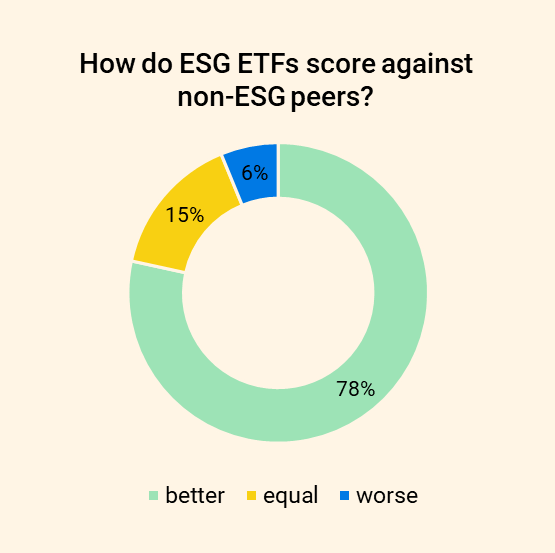
And we found that, on average, ESG ETFs rate better than 78% of non-ESG peers , while 15% of ESG ETFs rank the same.
However, like investors, we worry about greenwashing. So, we looked at the fine print of our study. If the average data is generally representative of the group, there are still some specific ETFs that need to be investigated separately.
Among the ten largest ESG ETFs, there are two US equities ETFs scoring C+. This score is rather average and perhaps below what investors would expect of their ESG ETFs. Among their peers, some ETFs have a B+ score (better by three ranks). Interestingly, those ETFs focus on style factors such as Quality or Growth. As intriguing as it is, this remains anecdotal evidence and we cannot conclude that factor ETFs are inherently scoring better in terms of ESG criteria.
Advertisement
Some ESG strategies score better than others
As our study finds, not all ESG strategies are made equal. Different types of ESG ETFs get different sustainability scores. Once again, we compare ESG ETFs with their non-ESG peers. This time though, we are looking to assess grade improvement by type of ESG strategy.
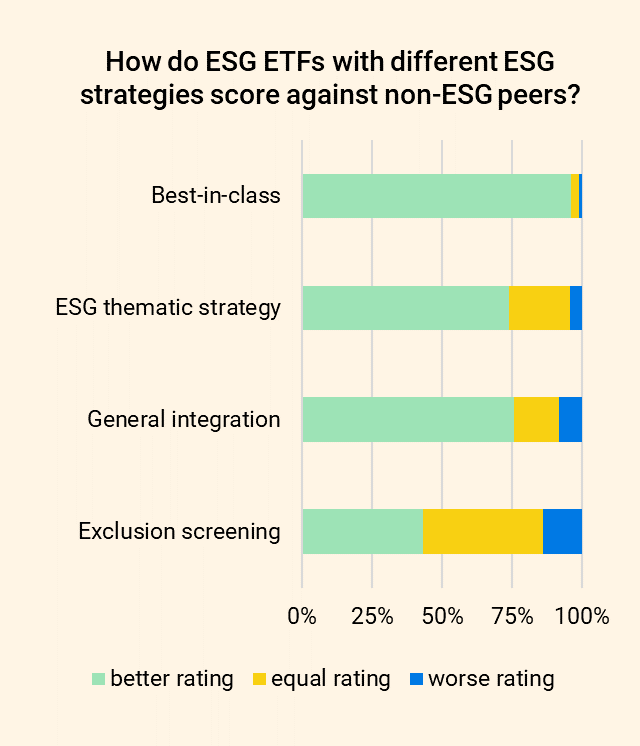
As shown in the chart below, on average all ESG strategies yield better ESG scores than non-ESG peers. Still, one ESG strategy is lagging behind the group. With ratings equal or worse to close to more than half of their peers on average, exclusion screening seems to be a less effective strategy in terms of mitigating ESG risks.
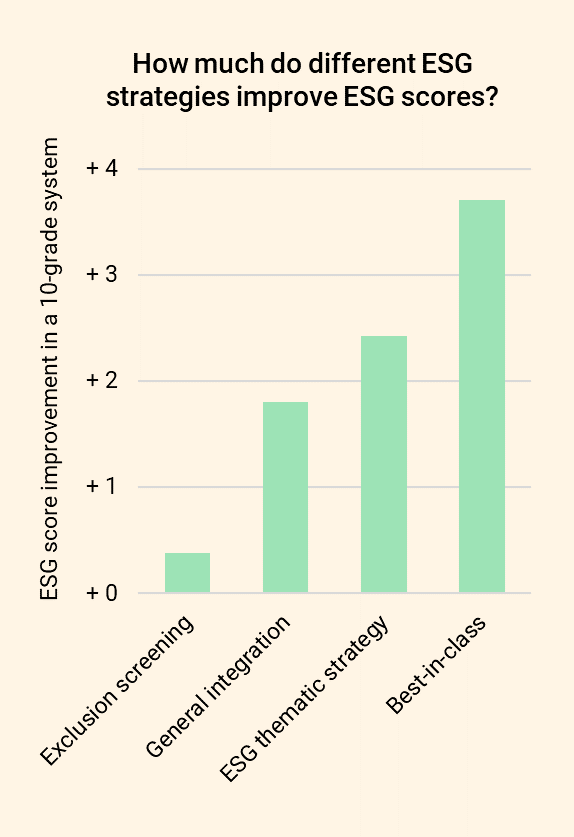
This difference between strategies is also illustrated when looking at ESG scores improvement.
Funds adopting the exclusion screening barely improve ratings versus their non-ESG peers. This makes sense as the strategy is the one with least modifications in portfolio holdings. This “soft” approach to ESG, merely removing the ESG laggards, cannot match shifting the investment approach to fully fulfil ESG principles.
By contrast, the best-in-class strategy seems to be the approach that delivers the most difference in terms of ESG scores. Not only do ESG ETFs with this strategy have a better rating, on average, than 95% of their peers, but they also see the largest increase in ESG scores. This means they score better than most peers, and by a significant amount. While their peers score C+ on average (corresponding to a grade of 6 on the graph below), best-in-class ESG ETFs rank A- on average. That is a four-rank improvement!
Conclusion
Claiming to be ESG is no longer enough. Investors deserve to get what they pay for and funds that are engaging in greenwashing deserve to be called out. Fortunately, investors now have the tools and information needed to evaluate, compare and see for themselves which fund best suits the sustainable goals they are aiming for.
Browse our ESG Observatory to find out more on ESG ETFs.
More articles


About Trackinsight
Since our founding in 2016, we have been at the forefront of the industry, delivering accessible, comprehensive, and reliable tools to support the evolving needs of investors.
Over the past decade, Trackinsight has expanded its operations across six countries, serving thousands of professional investors. We’ve consistently innovated to provide cutting-edge solutions that meet the changing demands of the ETF market.
In 2024, Kepler Cheuvreux, a leading independent European financial services firm, acquired a majority stake in Trackinsight, becoming the company's principal shareholder.
This strategic partnership solidifies Trackinsight's position as a premier provider of ETF selection and analysis tools, while strengthening Kepler Cheuvreux’s commitment to becoming a leading player in the ETF sector.
Together, we are committed to offering advanced services that empower professional investors, advisors, institutions, and issuers. This new step enables us to deliver even more comprehensive and innovative technological solutions, driving ETF investing to new heights.
More about TrackinsightETF TOOLS
PLATFORM
ETF NEWS & RESEARCH
Privacy policy | Cookie policy | | Terms of use | Imprint