All you need to get started with ETF selection and analysis. Create your account now →
Help us improve your experience. Please confirm your investor type:
The ETF Industry Is Evolving Fast
From AI infrastructure to active strategies, the ETF landscape is shifting. Share your perspective in the 7th Annual Global ETF Survey.
MOON ETF: Not an ARKK copycat
The Direxion Moonshot Innovators ETF (MOON ETF) has caught investors' interest and could be a serious competitor to ARKK.

By Pierre Laget
March 25, 2021
- Active
- MOON
- ARKK
- BUZZ
- Technology
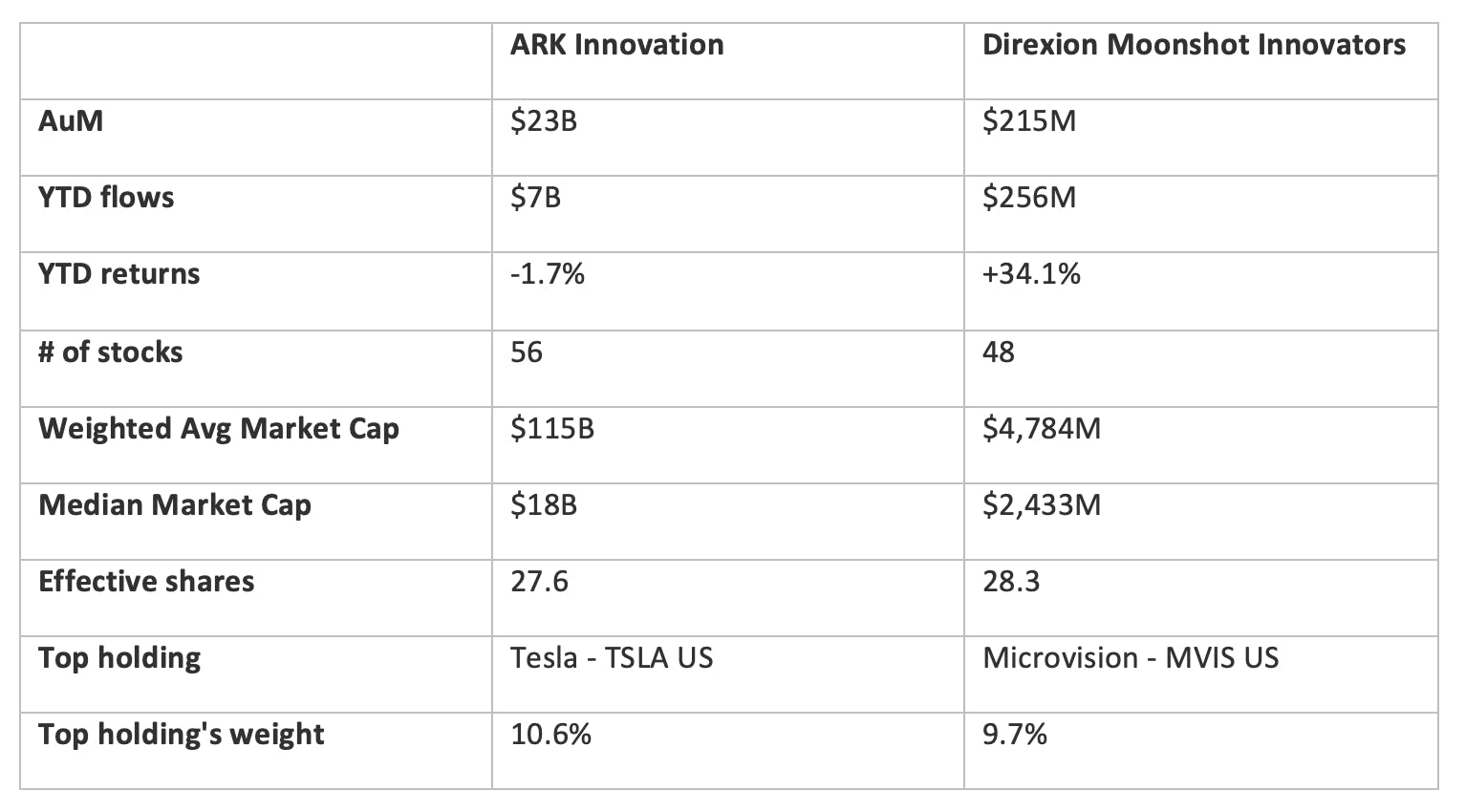
The success of Cathie Wood’s ARK Innovation ETF (ARKK) has seen its assets shoot up to $23bn, turning it into the largest Active ETF today. ARKK already topped the charts last year, with a three-digit performance (+153%) over 2020. Investors have been rushing to get a piece of the pie and the ETF is seeing record inflows of $7.1bn year-to-date. Meanwhile, other ETF issuers competing for the wave of investment inflows are searching for a new strategy that may deliver great performance and rich rewards. Recently, the Direxion Moonshot Innovators ETF (MOON) has caught their interest – and the $324m ETF could turn out be a serious competitor to ARKK.
ETF Data Built for Precision
Trackinsight delivers reliable and comprehensive coverage on 14,000+ ETFs
ARKK and MOON ETF: Investing in innovation
Both ARKK and MOON share a similar investment theme: companies developing cutting-edge technologies which have the potential to disrupt their industry.
ARK defines innovation as “the introduction of a technologically enabled new product or service that potentially changes the way the world works”. This includes sectors such as DNA technologies, energy, automation and manufacturing as well as Fintech.
The MOON ETF invests in the same sectors, even though it is focusing on smaller firms which are still in the early stage of their development.
So both ARKK and MOON invest in innovation. The real difference is how they do it.
ARKK and MOON ETF: Active and passive strategies
ARKK is an actively managed ETF. It follows a discretionary approach. All investment decisions, such as to include or exclude securities but also changing the weights of the portfolio and rebalancing are taken by the ETF’s management. ARKK is therefore relying on the convictions of the research team to find the best prospects for bringing disruptive innovations to the market.
Being active allows the ETF to be nimbler, potentially being swifter to find innovative companies and adapt to markets’ conditions. But it is also at the risk of overtrading and greater concentration in a few securities.
On the other hand, the MOON ETF implements a passive strategy. It is tracking an index developed in partnership with S&P. The investment decision here relies on the index’s systematic quantitative rules – which include for example the equal weighting of all stocks in the index. There are no discretionary decisions taken by S&P or Direxion here. This approach provides greater transparency for investors that are wary of over trading or human bias.
To illustrate their different strategies, we take a look at their latest holdings.
50 holdings and similar concentration
Both ARKK and MOON invest in approximately 50 stocks and the proportions invested in those holdings are quite similar for the two ETFs. Both ETFs’ largest allocation represents around 10% of the portfolio.
You might wonder how MOON’s equal-weighted strategy can result in a 10% position in a stock, with 50 stocks invested in total – which should land a 1/50 or 2% allocation to each stock. Here’s why: MOON’s top holding, Microvision, quadrupled its value between now and the most recent fund rebalancing.
So, despite tracking an equal-weighted index, MOON is as concentrated as ARKK. We find that their effective number of holdings, as measured by the HHI index, are both around 27. This means that their diversification level corresponds to 27 stocks if they were equal-weighted.
Yet an almost completely different basket of stocks
Nonetheless, the similarities stop there. Despite both targeting disruptive innovation, they only hold one security in common: Fate Therapeutics, a company focusing on developing new therapies for cancer.
Also, ARKK and MOON’s holdings are not similar in terms of market capitalization. The median stock held by ARKK has a $18bn market cap, compared with less than $2.5bn for MOON. Aside from their different investment universe and definitions for what is innovation, this difference could be explained by the sheer size of ARKK. Being a $23bn fund, ARKK would have a hard time investing in small cap stocks without its trades moving the price of the stocks.
Thematic investing leaves room for interpretation
The media talks about MOON as an ARKK copycat but the two funds share little outside their investment theme. The general confusion between the two ETFs highlights how difficult thematic ETFs selection is. It shows that relying on the investment objective of the fund may not be enough. Investors should take a dive into the fund methodology and ETFs’ holdings, where they might find some interesting insights and some surprises as well.
Did you know that the BUZZ ETF, which invests in stocks trending on social media, does not actually hold GameStop?
More articles


About Trackinsight
Since our founding in 2016, we have been at the forefront of the industry, delivering accessible, comprehensive, and reliable tools to support the evolving needs of investors.
Over the past decade, Trackinsight has expanded its operations across six countries, serving thousands of professional investors. We’ve consistently innovated to provide cutting-edge solutions that meet the changing demands of the ETF market.
In 2024, Kepler Cheuvreux, a leading independent European financial services firm, acquired a majority stake in Trackinsight, becoming the company's principal shareholder.
This strategic partnership solidifies Trackinsight's position as a premier provider of ETF selection and analysis tools, while strengthening Kepler Cheuvreux’s commitment to becoming a leading player in the ETF sector.
Together, we are committed to offering advanced services that empower professional investors, advisors, institutions, and issuers. This new step enables us to deliver even more comprehensive and innovative technological solutions, driving ETF investing to new heights.
More about TrackinsightETF TOOLS
PLATFORM
ETF NEWS & RESEARCH
Privacy policy | Cookie policy | | Terms of use | Imprint