Global ETF Survey 2026: Answer now →
Help us improve your experience. Please confirm your investor type:
Don’t Miss a Move in the ETF Market
Sign up and keep track of everything that moved the ETF industry this week. From new launches to regulatory shifts across the Atlantic.

Investing in high yield bonds
For investors wishing to increase their risk-return profile, but not yet comfortable with allocating to equities, high-yield bonds may have a place as part of a well-diversified portfolio.


By Daniel Chivu
November 23, 2022
Advertisement
High yield bonds, also known as junk bonds, are corporate debt instruments that usually pay a higher interest rate due to their lower credit rating and increased risk, as compared to investment grade bonds. A lower credit rating typically means a higher chance that the issuing company will not be able to pay the coupon, which results in higher overall yields for investors, in order to compensate for the risk of default.
Fallen angels
Fallen angel bonds are bonds whose credit rating has been downgraded to junk bond status, as a result of the company’s poor credit quality. They’ve exhibited a recent downward trajectory in their credit quality and are often avoided by high yield investors, or only bought and sold opportunistically.
📊 Share your ETF outlook
From AI infrastructure to active strategies, the ETF landscape is shifting. Share your perspective in the 7th Annual Global ETF Survey and get exclusive early access to the final report.
Rising Stars
Rising star bonds are bonds whose credit quality has been upgraded recently but has not yet passed the threshold to be considered investment grade. These bonds are usually the preferred option for high yield bond investors, as the recent upgrades show strength in the company’s underlying fundamentals.
Advantages of High Yield bonds
Significantly higher yields
High yield bonds pay much higher interest rates than treasuries or investment grade debt, to compensate investors for the significantly higher risk of default associated with the issuing companies. For comparison purposes:
Yield to Maturity on the S&P U.S. HIGH YIELD CORPORATE BOND INDEX as of Oct 31: 8.96% associated ETF: iShares Broad USD High Yield Corporate Bond ETF
Yield to Maturity on the S&P 500 Investment Grade Corporate Bond Index as of Oct 31: 5.73% associated ETF: iShares iBoxx Investment Grade Corporate Bond ETF
Yield to Maturity on the S&P U.S. TREASURY BOND CURRENT 10-YEAR INDEX as of Oct 31: 4.08% associated ETF: iShares 7-10 Year Treasury Bond ETF
As per the above data, high yield bonds yield significantly higher than investment grade bonds, and more than double the yield of the 10 Year Treasury index. This pattern makes sense in the context of Modern Portfolio Theory, which states that investors request higher compensation for higher risk.
Interest Rate Risk
One would assume that due to their inherently riskier nature, high yield bonds would have a higher sensitivity to interest rate changes (a concept also known as 'duration’), however, that is not the case in practice. Duration is a measure of the expected % change in the bond’s price, for a 1% change in interest rates. Using the previous three indexes as examples, we observe the following:
Duration of the S&P 500 Investment Grade Corporate Bond Index as of Oct 31: 6.78%
Advertisement
Based on the above comparison, we notice a surprising relationship: high yield bonds are less sensitive to changes in interest rates, as a result of their significantly higher yield payments.
Risks Associated with High Yield bonds
Credit Risk
Although high yield bonds provide significantly higher yields than corporate and treasury bonds, they do so at the cost of a significant increase in the probability that the underlying company will not be able to pay back the principal, or even the regular payments. This is a concept known as Default, and it is the main risk associated with high yield bonds.
Therefore it is important for high yield bond ETF investors to understand the risks associated with the ETF’s top holdings, and to ensure the top 10 holdings are in a healthy financial position. This can be done easily by checking certain financial metrics such as their Debt Service Coverage Ratio, Debt to Equity Ratio, and Debt to Total Assets.
Yield curve risk
Perhaps a more challenging concept to analyze, yield curve risk simply looks at the relative yields provided by short-term treasuries relative to long-term treasuries. The yield curve can have 3 possible shapes:
Upward sloping – this means longer-term debt pays more than shorter-term debt and signals future economic strength
Flat – short-term debt and long-term debt pay roughly the same yields, and usually signals uncertainty about economic conditions
Inverted – short-term debt pays higher than long-term debt and reflects economic weakness in future years, where interest rates will have to decline.
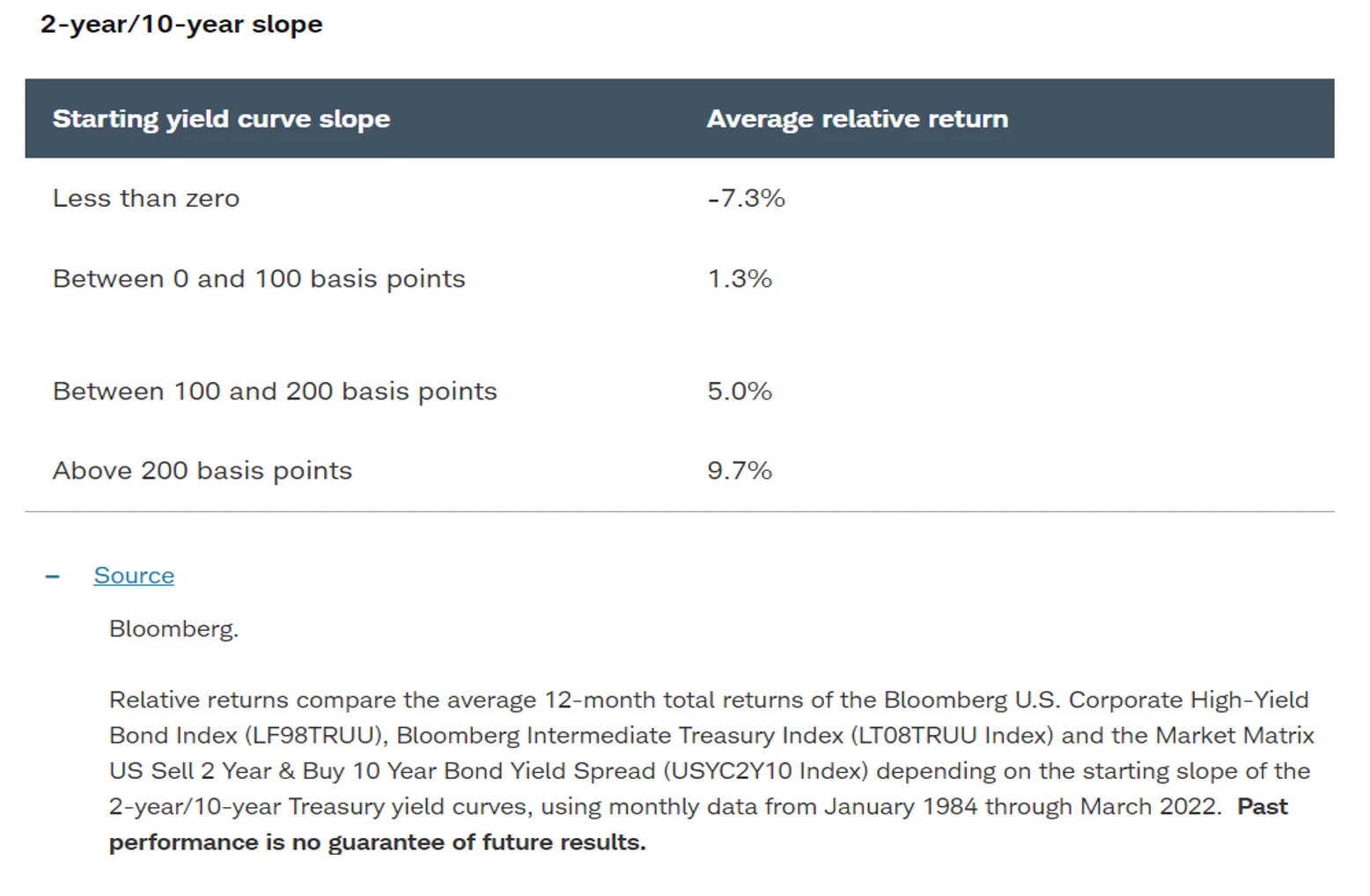
Studies have found that high yield bonds perform exceptionally well in a normal, upward sloping yield curve environment, which is indicative of most risk assets. The performance relative to the 10-year treasury decreases as the curve gets flatter - and eventually negative - and as the risk of economic troubles increases:
Conclusion
Investors who wish to gain exposure to high yield bonds can do so through various ETFs such as the HYG, EMB, or JNK, although it’s important to note that each ETF comes with its own specific risks and advantages.
Studies have shown that high yield bonds perform well relative to the risk-free treasury index during periods where risky assets are preferred, although investors can still make use of higher yielding debt even in an inverted or flat yield curve environment, so long as they are aware of the higher default risks.
More articles


About Trackinsight
Since our founding in 2016, we have been at the forefront of the industry, delivering accessible, comprehensive, and reliable tools to support the evolving needs of investors.
Over the past decade, Trackinsight has expanded its operations across six countries, serving thousands of professional investors. We’ve consistently innovated to provide cutting-edge solutions that meet the changing demands of the ETF market.
In 2024, Kepler Cheuvreux, a leading independent European financial services firm, acquired a majority stake in Trackinsight, becoming the company's principal shareholder.
This strategic partnership solidifies Trackinsight's position as a premier provider of ETF selection and analysis tools, while strengthening Kepler Cheuvreux’s commitment to becoming a leading player in the ETF sector.
Together, we are committed to offering advanced services that empower professional investors, advisors, institutions, and issuers. This new step enables us to deliver even more comprehensive and innovative technological solutions, driving ETF investing to new heights.
More about TrackinsightETF TOOLS
PLATFORM
ETF NEWS & RESEARCH
Privacy policy | Cookie policy | | Terms of use | Imprint