Trackinsight Enterprise, a unified platform for institutional ETF research, analytics, and compliance, is now live. Explore Trackinsight Enterprise →
Help us improve your experience. Please confirm your investor type:
The ETF Industry Is Evolving Fast
From AI infrastructure to active strategies, the ETF landscape is shifting. Share your perspective in the 7th Annual Global ETF Survey.
Introducing the three largest ESG ETFs
In this article, we look at the three largest ESG ETFs allowing investors to align their values with their investment decisions.

By Eddie Barrak
June 17, 2022
- Sustainability
Advertisement
Investors are increasingly gravitating towards ESG investing in an attempt to align their priorities and values with their investments. ESG investing provides a set of extra lenses to go beyond performance, allowing financial professionals to integrate non-financial metrics into the analysis process. Furthermore, it benefits investors looking to drive positive change by prioritizing environmental, social, and governance attributes while mitigating risk by providing a holistic view of the underlying firms and businesses.
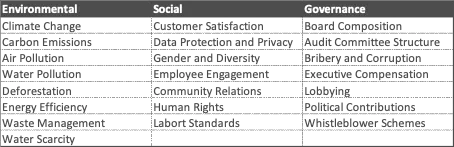
For instance, the environmental pillar focuses on the natural world and the preservation of its resources. Similarly, the social pillar puts people and relationships at the center of investments. The third pillar, governance, addresses the standards of running and managing businesses. Typical considerations for each pillar are summarized in the table below.
📊 Share your ETF outlook
From AI infrastructure to active strategies, the ETF landscape is shifting. Share your perspective in the 7th Annual Global ETF Survey and get exclusive early access to the final report.
It is fair to say that ESG investing has taken the world by storm, and the exchange-traded funds universe is no exception. There are 1281 ESG ETFs currently available to investors in America, Europe, and Asia Pacific. Together they manage a combined USD$384.5 billion of assets under management. These pooled investments are gaining popularity, attracting USD$31.1 billion CAD of inflows year-to-date. Learn more on ESG ETFs.
Four ESG investing strategies
According to Trackinsight, ESG ETFs operate under at least one of the four strategies: Best-in-class, Exclusion, Full Integration, and ESG Thematic. These strategies differ in the mechanism employed when selecting the funds' assets. Click here for an in-depth look at ESG ETFs Strategies. Click here for an in-depth look at ESG ETF Strategies.
Below is a review of the three largest ESG ETFs available in these regions.
iShares ESG Aware MSCI USA ETF (ESGU)
- Return: -19.21%
- TER: 0.15%
- AUM: USD$21.6 billion
- Inflows: USD$1.3 billion
- Strategy: General Integration
ESGU seeks to replicate the MSCI USA Extended ESG Focus Index. The index uses an optimization process to select constituent securities from the MSCI USA Index, its parent index, while maximizing exposure to environmental, social, and governance factors. The tracking error between the index and its parent is capped at 50 basis points under certain constraints. The ETF follows a holistic approach incorporating ESG considerations in every step of the investment decision-making process and excludes exposure to tobacco, controversial weapons, producers of or ties with civilian firearms, controversial weapons, thermal coal, and oil sands. ESGU holds 307 companies selected from the MSCI USA Index, including large and mid-cap U.S. companies totaling USD21.6 billion of assets under management.
As with many ESG funds, ESGU has a substantial weighting towards the technology sector, with 28% of the fund allocated to Information Technology securities. Three of the top ten holdings are technology giants, including Apple Inc, Microsoft Corp, Alphabet Inc. (Google’s parent company), and Nvidia Corp. Despite that, the ETF remains diversified, holding 14.00% of its assets in the Healthcare sector, 10.75% in Financials, and 10.44% in Consumer Discretionary, while the remaining assets are spread across seven different sectors.
iShares MSCI USA SRI UCITS ETF (SUAS)
- Return: -19.04%
- TER: 0.20%
- AUM: USD$7.9 billion
- Inflows: USD$327 million
- Strategy: Best-In-Class
SUAS seeks to replicate the MSCI USA SRI Select Reduced Fossil Fuels Index. This is an index providing exposure to US large and mid-cap companies exhibiting high minimum levels of environmental, social and governance performance relative to their peers. The index, and inherently the fund, follows a Socially Responsible Investing (SRI) approach while positively screening for companies with strong sustainability profiles from the parent MSCI USA Index. It avoids companies incompatible with the values screen or those with exposure to fossil fuels through extraction and production activities, power generation activities, or reserves ownership. SUAS invests in 161 holdings totaling USD7.9 billion of assets under management spread across 11 sectors. The fund invests 18.26% of its assets in the Healthcare sector, 14.86% in Information Technology, 14.85% in Financials, and 14.12% in Consumer Discretionary. The fund applies a 5% cap on each individual issuer’s weight while screening out businesses involved in tobacco, alcohol, gambling, adult entertainment, nuclear power and weapons, conventional and controversial weapons, civilian firearms, and genetically modified organisms.
SUAS is aligned with the 13th Sustainable Development Goal (SDG) and considered an article 8 Fund under the Sustainable Finance Disclosure Regulation (SFDR) – a European regulation where an article 8 fund promotes, among other characteristics, environmental or social characteristics, or a combination of those characteristics, provided that the companies in which the investments are made follow good governance practices.
iShares ESG Aware MSCI EAFE ETF (ESGD)
- Return: -16.77%
- TER: 0.20%
- AUM: USD$6.6 billion
- Inflows: USD$507 million
- Strategy: General Integration
ESGD follows a holistic approach similar to that of ESGU while seeking to replicate the performance of the MSCI EAFE Extended ESG Focus Index. An optimization process is employed to select constituent securities belonging to the parent index (MSCI EAFE Index) with a budgeted tracking error of 50 basis points. Companies operating in tobacco, civilian firearms, thermal coal, oil sands, and controversial weapons are not eligible for inclusion. The fund invests in developed market securities, excluding the United States and Canada.
Advertisement
Most of ESGD’s assets are in the Financials sector with a weight of 17.33%, followed by 14.94% in Industrials and 12.90% in Healthcare.
Top 10 best performing ESG ETFs 2022:
- Xtrackers MSCI Europe Energy ESG Screened UCITS ETF (XSER): 18.81%
- Global X Solar UCITS ETF (RAYZ): 29.42%
- Xtrackers MSCI AC Asia ex Japan ESG Swap UCITS ETF (XAXJ): 9.56%
- Xtrackers MSCI EM Asia ESG Screened Swap UCITS ETF (XMA1): 8.96%
- Xtrackers MSCI EM Asia ESG Screened Swap UCITS ETF (XMAS): 8.94%
- iShares MSCI World Energy Sector ESG UCITS ETF (WENE): 8.11%
- iShares Indice Carbono Eficiente (ICO2) Brasil ETF (ECOO11): 7.75%
- It Now ISE ETF (ISUS11): 7.35%
- iShares Ultrashort Bond ESG UCITS ETF (EUEMX): 5.49%
- VanEck Vectors Morningstar Developed Markets Dividend Leaders UCITS ETF (XAMS:TDIV): 5.48%
More articles


About Trackinsight
Since our founding in 2016, we have been at the forefront of the industry, delivering accessible, comprehensive, and reliable tools to support the evolving needs of investors.
Over the past decade, Trackinsight has expanded its operations across six countries, serving thousands of professional investors. We’ve consistently innovated to provide cutting-edge solutions that meet the changing demands of the ETF market.
In 2024, Kepler Cheuvreux, a leading independent European financial services firm, acquired a majority stake in Trackinsight, becoming the company's principal shareholder.
This strategic partnership solidifies Trackinsight's position as a premier provider of ETF selection and analysis tools, while strengthening Kepler Cheuvreux’s commitment to becoming a leading player in the ETF sector.
Together, we are committed to offering advanced services that empower professional investors, advisors, institutions, and issuers. This new step enables us to deliver even more comprehensive and innovative technological solutions, driving ETF investing to new heights.
More about TrackinsightETF TOOLS
PLATFORM
ETF NEWS & RESEARCH
Privacy policy | Cookie policy | | Terms of use | Imprint