Trackinsight is part of ETF One, the fully integrated ETF platform of Kepler Cheuvreux. Learn more →
Help us improve your experience. Please confirm your investor type:
The ETF Industry Is Evolving Fast
From AI infrastructure to active strategies, the ETF landscape is shifting. Share your perspective in the 7th Annual Global ETF Survey.
How to invest in carbon credits
Discover what are carbon credits and how you can get a piece of the pie by investing in Carbon Credit ETFs.

By Rony Abboud
March 15, 2022
- Energy
Advertisement
Climate change is “the biggest threat to security that modern humans have ever faced”, said legendary broadcaster and naturalist David Attenborough. Echoing his concerns in actions, governments, companies, and non-governmental organizations have increasingly allocated more resources to reduce the rate of environmental damage across the planet. While there has been scientific innovation such as renewable energy and carbon capture technologies, financial incentives and penalizations were found as great tactics to reduce greenhouse gas (GHG) emissions. One of these tactics involved "carbon credits". In this article, we dive into the topic of carbon credits and share with you Carbon Credit ETFs you can invest in.
What are carbon credits?
A carbon allowance or carbon credit is a permit giving the holder the right to emit one ton of carbon dioxide or carbon dioxide equivalent. Carbon credits are created to curb greenhouse gas emissions.
📊 Share your ETF outlook
From AI infrastructure to active strategies, the ETF landscape is shifting. Share your perspective in the 7th Annual Global ETF Survey and get exclusive early access to the final report.
Companies get a set number of credits, which declines over time. If the companies emit less carbon dioxide than the set limit, they can sell the surplus credits to other companies that need them to cover their emissions. If they emit more polluting gases than their set limit, they get fined. When demand for credits goes up, they become more expensive. This would prompt companies to focus their efforts on reducing their carbon emissions.
Who created the carbon credits?
Carbon credits were brought to life after nations reached an agreement known as the ‘Kyoto Protocol’ that would set carbon emissions for all participating countries to reduce greenhouse gas emissions. At this meeting, a mechanism called Certified Emission Reduction was developed allowing a company to buy sufficient Carbon Credits to enable it to continue emitting greenhouse gases up to a set limit. Countries that have signed up for the Kyoto Protocol are allotted CERs (also known as Assigned Amounts) according to their pollution level.
Types of carbon markets
Jennifer McIsaac, the director of market analysis at ClearBlue Markets (carbon market experts), explained that there are two types of carbon markets: compliance and voluntary.
"The compliance markets are created by governments, who set a cap on emissions. The cap is enforced by requiring covered entities to turn in allowances for each ton of carbon emitted. The allowances can be traded, and project-based offsets may be allowed in compliance markets as well. Examples of the longest-standing and most successful compliance markets are the EU ETS, WCI which is a linked market between California and Quebec, and the RGGI power sector program among a group of Eastern US states. Meanwhile, voluntary markets are just that; the offsets being traded come from projects undertaken to drive emissions reductions above and beyond what is required. Companies can use these offsets to make GHG reduction claims as part of their net-zero strategies. There are different options for investing in the markets. For compliance markets, investors can directly invest by opening accounts and can trade in the secondary market. As you know, compliance market ETFs are gaining popularity. On the voluntary side, bilateral transactions have been dominant, but we are also increasingly seeing volumes associated with standardized contracts on exchanges”, McIsaac added.
What drives the price of carbon credits?
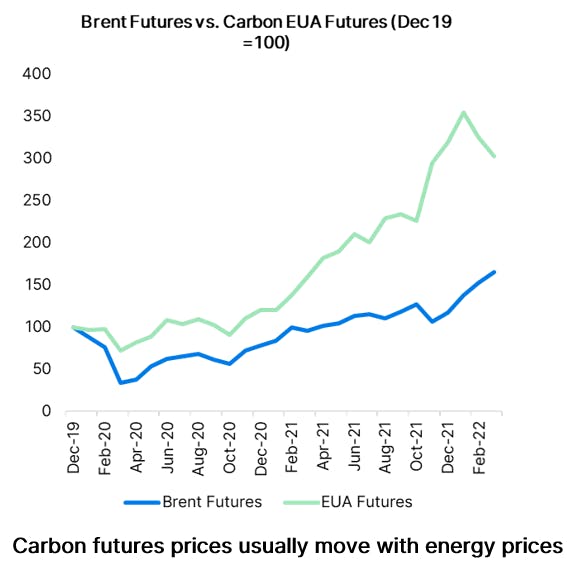
John Wilson, Co-CEO, Managing Partner, and Senior Portfolio Manager at Ninepoint Partners, said: "Just like any other market, the price of carbon credits is driven by carbon credit supply and demand. On the supply side, the cap set by the government is the key determining factor. The lower the cap, the lower the supply, which drives up the carbon credit price. The use of compliant carbon offset projects and international trading also play a role in the supply of carbon credits. On the demand side, economic activity, energy price, weather conditions, and many other factors can have an impact on the demand for carbon credits."
Why invest in carbon credits? (Not investment advice)
1 - Carbon credits is a multi-trillion-dollar market
According to financial market data provider Refinitiv, the total value of the global carbon market reached US$851 billion in 2021. Energy consulting firm Wood Mackenzie estimates that the global emissions trading market could be worth as much as $22 trillion by 2050.
2 - Lucrative demand-supply dynamics
Legislation automatically reduces the supply of allowances each year, decreasing emissions over time and increasing the scarcity value of allowances. When the supply of carbon allowances diminishes, their scarcity value is increasing, creating the potential for an attractive return profile.
3 - Historically low correlation to equity markets
The low correlation of carbon credit futures to the broader financial market could provide a natural hedge for any diversified portfolio while potentially improving the resilience of portfolios against climate transition risks (Ninepoint Partners).
Advertisement
4 - Shared vision for decarbonization
Decarbonizing the economy is a major target for all economies and is repeatedly highlighted during climate events. Most recently, a deal was reached on the Glasglow COP26 to standardize an international carbon trading market.
Why did EUA Futures gain traction in 2021?
1 - Post-pandemic recovery and energy crunch
During the pandemic's first peak, people witnessed one of the worst economic downturns since the 2008 financial crisis. Lockdown measures forced businesses to shut down, leading to lower energy consumption.
In 2021, vaccines emerged, and economic activities normalized in developed countries. The fast turnaround spiked European energy demand for natural gas beyond suppliers' capacities.
Europe had to scramble for energy resources, regardless of their cleanliness. Utilities consumed oil or coal. Hence, they had to buy carbon credits to continue to emit harmful gases into the atmosphere. The rush to purchase EUAs (European Union Allowance – i.e. tradable unit under the European Union Emissions Trading Scheme) lifted the prices to record highs.
Wilson added that EUAs reached another record high on concerns that the Russia-Ukraine war could further increase the region's gas prices, encouraging power companies to switch to more polluting coal-fired power generation and increase demand for carbon credits.
2 - Renewed decarbonization vows in COP26
Participating nations at the annual UN Climate Change Conference (COP26) vowed to ramp up their efforts in decarbonizing their economies and boosting nations' climate targets. Making polluters pay for carbon permits is seen as crucial to reducing emissions in Europe. The European Union plans to extend the bloc’s trading scheme to more sectors.
Investing in Carbon Credits ETFs
Carbon Exchange-traded funds represent an easier path to gain exposure to carbon credits. Domiciled in North America, KraneShares Global Carbon Strategy ETF (KRBN) invests in European and North American cap-and-trade programs: European Union Allowances (EUA), California Carbon Allowances (CCA), the Regional Greenhouse Gas Initiative (RGGI), and United Kingdom Allowances (UKA) futures. Meanwhile, the KraneShares European Carbon Allowance ETF (KEUA) focuses solely on EUAs, and the KraneShares California Carbon Allowance Strategy ETF (KCCA) on CCAs. KRBN, KEUA, and KCCA have an expense ratio of 0.78%, 0.79%, and 0.79% respectively, and trade primarily on the New York Stock Exchange.
Canadian investors have recently gained access to carbon credits futures through Horizons Carbon Credits ETF (CARB) and Ninepoint Carbon Credit ETF (CBON) — the first Carbon Credit ETFs in the Canadian market.
Advertisement
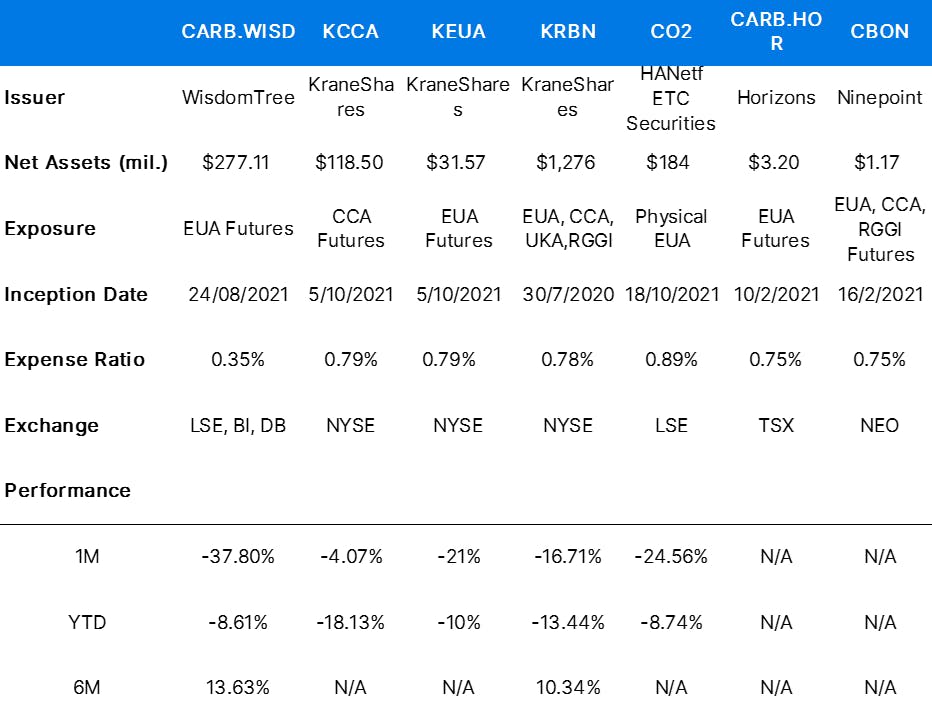
European investors can obtain exposure to the carbon permits through SparkChange Physical Carbon EUA ETC (CO2) and WisdomTree Carbon (CARP). CARP provides exposure to EUA Futures. It has a total expense ratio of 0.35% and trades on multiple European exchanges, including the London Stock Exchange (CARB, USD; CARP, GBx), the Borsa Italiana (CARB, EUR), and the Deutsche Boerse (WCO2, EUR). On the other hand, the SparkChange CO2 offers investors exposure to physical EUAs instead of futures. Each SparkChange CO2 is physically backed by one EUA. The EUAs held within the ETC structure cannot be used by polluters, ensuring direct and positive environmental impact. The ETC has a total expense ratio of 0.89% and trades on the London Stock Exchange (CO2 LN, EUR; CO2P LN, GBP; CO2U LN, USD).
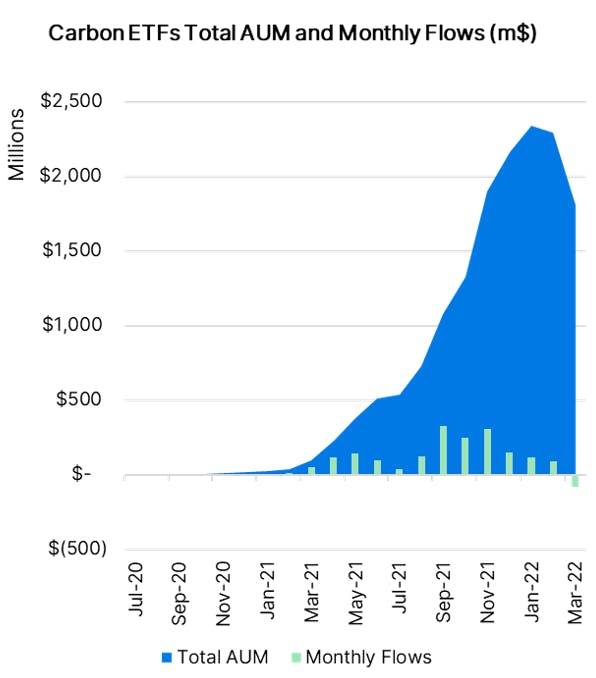
In less than two years, Carbon ETFs have amassed over $1.77 billion from investors and saw their combined assets reach $2.33 billion in January 2022 — mainly due to the rising prices of EUAs.
Why did EUA prices dip during the first two weeks of the Russia-Ukraine war?
EUA prices crashed when the war broke out in Ukraine on February 24th, falling from EUR 94.74 per ton to EUR 56 per ton on March 7th. According to Alessandro Vitelli, an independent reporter in energy and carbon markets, traders might have sold their permits to raise funds for natural gas positions. He also speculated Russian investors could be pulling their money out to avoid stiff sanctions.
FIND AND COMPARE OVER 8,000 ETFS WITH OUR FREE TOOLS:
INTERESTED IN SEEING LISTS OF TOP-PERFORMING ETFS? CHECK OUT OUR NEW INVESTING GUIDES:
- Investing in Gold ETFs
- Investing in Silver ETFs
- Investing in Commodity ETFs
- Investing in Oil ETFs
- Investing in ESG ETFs
More articles


About Trackinsight
Since our founding in 2016, we have been at the forefront of the industry, delivering accessible, comprehensive, and reliable tools to support the evolving needs of investors.
Over the past decade, Trackinsight has expanded its operations across six countries, serving thousands of professional investors. We’ve consistently innovated to provide cutting-edge solutions that meet the changing demands of the ETF market.
In 2024, Kepler Cheuvreux, a leading independent European financial services firm, acquired a majority stake in Trackinsight, becoming the company's principal shareholder.
This strategic partnership solidifies Trackinsight's position as a premier provider of ETF selection and analysis tools, while strengthening Kepler Cheuvreux’s commitment to becoming a leading player in the ETF sector.
Together, we are committed to offering advanced services that empower professional investors, advisors, institutions, and issuers. This new step enables us to deliver even more comprehensive and innovative technological solutions, driving ETF investing to new heights.
More about TrackinsightETF TOOLS
PLATFORM
ETF NEWS & RESEARCH
Privacy policy | Cookie policy | | Terms of use | Imprint