Get your free ETF data sample from our comprehensive offerings. Start your free trial→
Help us improve your experience. Please confirm your investor type:
Don’t Miss a Move in the ETF Market
Sign up and keep track of everything that moved the ETF industry this week. From new launches to regulatory shifts across the Atlantic.

Healthy Yields from Healthcare REITs


By Daniel Chivu
November 16, 2022
- Healthcare
Advertisement
It seems everywhere we turn, we hear cries of overpopulation and an incoming crisis of resources, reminiscent of a Mad Max scenario. There is certainly substance to some of the concerns, particularly those focused on the availability of water and affordable energy, as Europe knows all too well at present.
The concerns about overpopulation ring true in certain areas of the world, but perhaps not so much in Europe and North America, which are facing a different demographic crisis: the aging population. As per data from Statista, the current percentage of the U.S population that is 65 years or older is sitting at 16.9% and is projected to increase to +20% in the next 10 years.
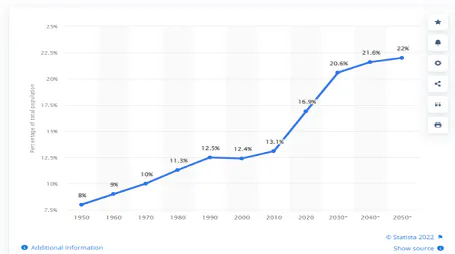
In the EU, the situation is even more urgent, with roughly 26% of the population over the age of 60 as of 2021.
📊 Share your ETF outlook
From AI infrastructure to active strategies, the ETF landscape is shifting. Share your perspective in the 7th Annual Global ETF Survey and get exclusive early access to the final report.
But why is this important to fixed income investors?
Well as it turns out, the aging population demographic across Europe and North America is starting to have a noticeable effect on healthcare spending, a trend that savvy investors could capitalize on through Healthcare REIT ETFs, to generate a growing and predictable stream of income in their portfolios.
Diving into Healthcare REITs
Real Estate Investment Trusts (REITs) are a form of hybrid security with equity-like features, that are designed to provide a steady stream of cashflow to investors’ portfolios. REITs play a vital role in the healthcare sector, as many of the facilities and hospitals that are critical to a smoothly operating healthcare system are owned and operated by Healthcare REITs.
The REITs make money by leasing space in their facilities to tenants, which often include hospitals, laboratories, and even senior living communities. The leases are usually structured as triple net leases, which require the tenants to be responsible for maintenance, taxes, and building insurance, leaving the REIT with very few expenses and a predictable stream of income to distribute to investors.
This income may vary based on the occupancy level and prevailing rates; however, REITs are compelled to pay out a minimum of 90% of earnings to investors, making them high-yielding fixed income investments, which are often used to replace corporate bonds in certain portfolios.
The Advantages of Healthcare REITs
Taking advantage of long-term trends:
As governments become increasingly aware of the change in age demographics taking place in much of the Western world, the % of GDP allocated to healthcare spending has seen a steady increase over the last 20 years.
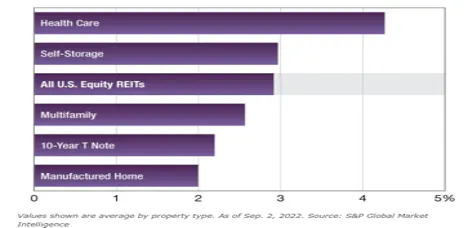
Along with this increase in spending, the performance of Healthcare REITs has also had an upward trajectory since their inception, with their expansion leading to higher revenues and payouts to their investors. In fact, as per the latest S&P Global Market Intelligence data, Healthcare REITs have the highest average dividend yield among their asset class, yielding 4.26% and beating the 10-Year Treasury by a full 2%!
Dividend growth outpacing inflation
Inflation has certainly been the topic of the year, although it was not so long ago that central banks were facing the exact opposite problem! The days of 0-1% inflation may well be over, considering current global events, yet some level of normalcy is to be expected with inflation coming down to its long-term target of 2% over the next 2 years. While some inflation is healthy for the economy, investors still risk losing 2% of their purchasing power every year…unless, of course, their dividend growth keeps up with the long-term rate of inflation.
Once again, Healthcare REITs could offer an attractive option, as the average 3-year annualized growth rate of their dividends is 2.43%. On a yearly basis, this works out to approximately 0.8% growth, which prior to 2020 would have been equivalent to almost half the rate of inflation over the last decade.
Risks associated with Healthcare REITs
As with any investment, there are risk factors that must be carefully considered. Although the western world is facing an aging demographic which will no doubt increase the demand for medical services and facilities, there are many other variables at play.
Use of debt or leverage
As is the case with virtually all real estate projects, building or acquiring long-term care facilities, hospitals, or specialized laboratories requires significant cash expenditure. These are commonly funded with debt. While this is less of a concern during periods of low interest rates, we have seen a sharp rise in rates over the last 8 months, which has certainly taken its toll on Healthcare REIT prices. As interest rates rise, so too do the payments on the debt issued by these REITs, making potential projects unprofitable, halting expansion, and increasing existing debt expenses. This all leaves less available capital for distribution to shareholders.
Advertisement
Pandemics/health crisis
The recent COVID-19 pandemic has shown how vulnerable our healthcare systems are to disruptions caused by airborne viruses. Senior care homes, hospitals, and other specialized medical facilities were heavily affected by it, reducing the number of medical procedures and tenants, and generating far less revenue for the owners of the buildings. As a result, Healthcare REITs saw a sharp decline in revenue for this period and could react similarly if this were to occur again in the future.
Gaining Exposure to Healthcare REITs through ETFs
With any asset class or sector, it is often better to gain broad exposure rather than focus on one particular holding. ETFs excel at providing broad exposure to the REIT sector, which can help mitigate some of the risks associated with each sub-category.
ETFs such as the Schwabb U.S REIT ETF can provide investors with healthy exposure to all REIT subsectors, while having a respectable 8% allocation to healthcare, and yielding 3.2%. The ETF is down 22% YTD but has seen returns of 12.5% in the last month.
A second option could be the iShares Cohen & Steers REIT ETF, although it has a slightly lower exposure to Healthcare ( 6.9%), and yields 2.8%. The caveat is that it has significantly outperformed the Schwabb ETF over the last 5 years, with a total performance of 26% and -3% respectively. Investors would be sacrificing yield for higher capital appreciation potential over the longer term.
Disclaimer: This article is limited to the dissemination of general information pertaining to investment strategies and financial planning and does not constitute an offer to issue or sell, or a solicitation of an offer to subscribe, buy, or acquire an interest in, any securities, financial instruments or other services, nor does it constitute a financial promotion, investment advice or an inducement or incitement to participate in any product, offering or investment.
More articles


About Trackinsight
Since our founding in 2016, we have been at the forefront of the industry, delivering accessible, comprehensive, and reliable tools to support the evolving needs of investors.
Over the past decade, Trackinsight has expanded its operations across six countries, serving thousands of professional investors. We’ve consistently innovated to provide cutting-edge solutions that meet the changing demands of the ETF market.
In 2024, Kepler Cheuvreux, a leading independent European financial services firm, acquired a majority stake in Trackinsight, becoming the company's principal shareholder.
This strategic partnership solidifies Trackinsight's position as a premier provider of ETF selection and analysis tools, while strengthening Kepler Cheuvreux’s commitment to becoming a leading player in the ETF sector.
Together, we are committed to offering advanced services that empower professional investors, advisors, institutions, and issuers. This new step enables us to deliver even more comprehensive and innovative technological solutions, driving ETF investing to new heights.
More about TrackinsightETF TOOLS
PLATFORM
ETF NEWS & RESEARCH
Privacy policy | Cookie policy | | Terms of use | Imprint