Trackinsight Enterprise, a unified platform for institutional ETF research, analytics, and compliance, is now live. Explore Trackinsight Enterprise →
Help us improve your experience. Please confirm your investor type:
Don’t Miss a Move in the ETF Market
Sign up and keep track of everything that moved the ETF industry this week. From new launches to regulatory shifts across the Atlantic.

Get a piece of the Crypto pie with Crypto Mining ETFs
Learn about the crypto industry and how you can get exposure through Crypto Mining ETFs.


By Rony Abboud
February 28, 2022
- Cryptocurrencies
Advertisement
The crypto mining industry witnessed a modern-day gold rush over the past couple of years as crypto prices soared on increased institutional adoption, heightened media attention and "FOMO". In this article, we will show you how you can gain exposure to the nascent industry through Crypto Mining ETFs.
Let's recap what happened to crypto in 2021
Last year was a record year for the crypto space after the total cryptocurrency market capitalization reached $3 trillion in November 2021 (CoinGecko.com), exceeding silver's total market cap of $1.36 trillion and closing in on the most well-known precious metal — gold ($12 trillion). The rally was fueled by increased institutional interests, massive media exposure, and the launch of dozens of crypto-linked products (Crypto ETPs, ETFs etc..) which made it easier to access the nascent space.
ETF Data Built for Precision
Trackinsight delivers reliable and comprehensive coverage on 14,000+ ETFs
Crypto mining overview, with a focus on Bitcoin
Some people say cryptocurrencies like Bitcoin are created out of thin air, well they're not.
Cryptocurrency mining is the way that new cryptocurrency is created. Unlike digging gold or other precious metals out of the ground, it involves producing Bitcoins as a reward for validating transactions on the blockchain network. Miners do this by running powerful computers to try to guess a string of alphanumeric characters for each block of transactions. Guessing correctly validates the block, adding it to a chain of previous blocks.
The main prize for being first is payment in Bitcoin itself, which the network’s code allocates at a rate of 6.25 Bitcoins per block. Bitcoin has a limited supply of 21 million Bitcoins. When all 21 million Bitcoins are mined, there won't be a block reward to pay to miners. When a Bitcoin user sends a BTC transaction, a small fee is attached. These fees go to miners, and this is what will be used to pay miners instead of the block reward.
Another key factor to consider in Bitcoin mining is halving. Simply put, a Bitcoin halving is the process of halving the rewards of mining Bitcoin after each set of 210,000 blocks is mined. By reducing the rewards of mining Bitcoin as more blocks are mined, a Bitcoin halving limits the supply of new coins, so prices could rise if demand remains strong. Bitcoin halving occurs every four years. The first halving occurred in 2012, the second and third in 2016 and 2020 respectively, and the fourth halving is expected to happen in 2024. By then, a miner’s reward will drop to 3.125 BTC.
Investing in Crypto Stocks
Bitcoin and crypto mining companies have proliferated in public markets as they seek to ramp up their operations through equity financing. Today, there are at least 50 publicly listed crypto mining companies, mostly domiciled in North America.
- Marathon Digital Holdings (MARA)
- Riot Blockchain Inc. (RIOT)
- Northern Data AG (NDTAF)
- Hut 8 Mining Corp. (HUT)
- Hive Blockchain Technologies (HIVE)
- Bitfarms Ltd. (BITF)
- Iris Energy Ltd. (IREN)
- Greenidge Generation Holdings Inc. (GREE)
- Argo Blockchain PLC (ARKBF)
- Bit Digital Inc. (BTBT)
- Cleanspark Inc. (CLSK)
- BIT Mining Ltd. (BTCM)
- Stronghold Digital Mining Inc. (SDIG)
- DMG Blockchain Solutions Inc. (DMGGF)
- Cipher Mining (CIFR)
- Core Scientific Inc. (CORZ)
The HI Crypto Mining Index created by hashrateindex.com shows the movement of Bitcoin mining-related stocks of public mining rig manufacturers, foundries, and miners. The Index uses a quantitative, rules-based methodology to identify and weight a portfolio of approximately 50 crypto mining equity securities which includes many of the listed above. Since the creation of the index on June 29th, 2020, it has returned over +325%. Meanwhile, Bitcoin rose +233% over the same period.
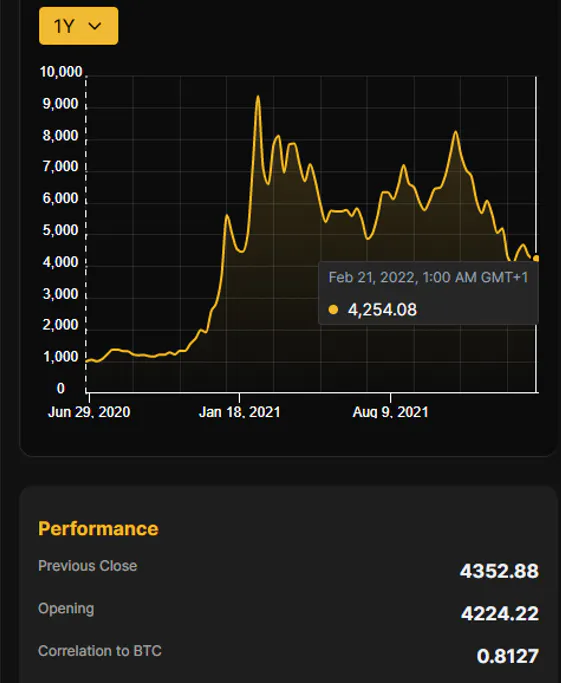
This shows the power of operating leverage that gold miners also enjoy during bull markets. Operating leverage measures the proportion of a company's cost structure that consists of fixed costs rather than variable costs.
In the case of Bitcoin mining, fixed costs are mainly the power and maintenance expenditures required to operate. When the fixed costs are high, Bitcoin miners will find it difficult to manage short-term revenue fluctuation, because expenses are incurred regardless of sales levels. Consequently, Bitcoin miners would see their profit margins shrink and their shares fall even harder than Bitcoin itself during bear markets.
Advertisement
Crypto mining trends over the next few years
Industries change and adapt constantly because of internal and external forces, and the crypto mining industry is no different. Here are three main trends that will affect the nascent industry over the next few years.
Hash rate to double
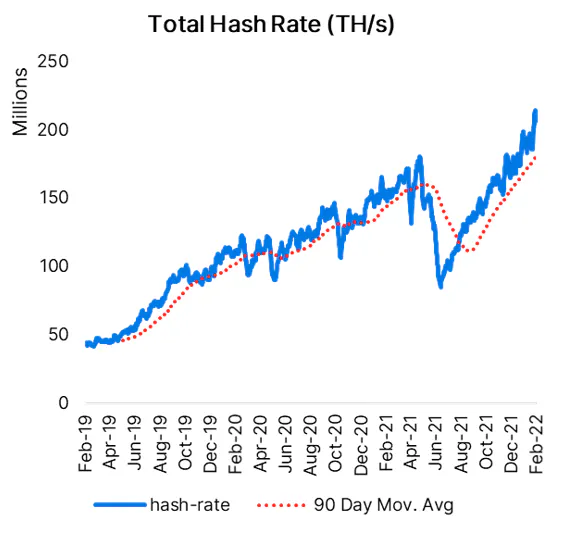
Hashrate is a measure of the computational power per second used when mining. More simply, it is the speed of mining that is measured in units of hash/second. As the industry can flourish and receive more investments, miners will continue to expand their operations and improve the efficiency of their mining machines, and in turn, increase their hash rate. Moreover, Chinese miners who left anti-crypto China are setting up new operations elsewhere and are coming back online. This will also push the hash rate higher and as a result, increase the network difficulty, according to April Luo, an institutional sales representative for Asia at BlockFi.
Margin squeeze and consolidation
As the hash rate and difficulty rise amid growing competition, miners will have to adjust to remain profitable, especially if Bitcoin’s price stagnates. Eventually, the industry will see its margins shrink, leading to mergers and acquisitions. Consolidation will help the industry acquire a more mature status, promote more efficient mining operations, and incentivize the use of renewable sources of power. Several established miners have already loaded up with cash to expand organic growth and explore acquisition options, such as Hut 8 Mining, which recently closed a $173 million public offering of common shares, and Marathon Digital, which raised nearly $700 million.
Focusing on the "E" of ESG
Crypto miners often face scrutiny about their energy-intensive operation and large carbon footprint, especially since a large majority of miners in emerging or developing nations power their mining rigs with relatively cheap electricity from dirty oil- or coal-fired plants. As they try to appeal to a large institutional audience, crypto miners will eventually focus on utilizing renewable energy to run their rigs. Many of the established miners have already installed their mining platforms in regions powered by hydroelectric or geothermal plants to decarbonize their operations. Others have creatively found a way to hook wasted "flared" gas near oil rigs into generators to power the crypto mining equipment.
The energy mix has changed since Chinese miners — who mainly depended on power from coal-fired plants, went offline after China's ban. According to the Bitcoin Mining Council, which comprises a global forum of Bitcoin mining companies and other companies in the Bitcoin industry, the global mining industry's sustainable electricity mix had grown to approximately 58.5%, during Q4 2021, up 1% from Q3 2021, making it one of the most sustainable industries globally.
Investing in Crypto Mining ETFs
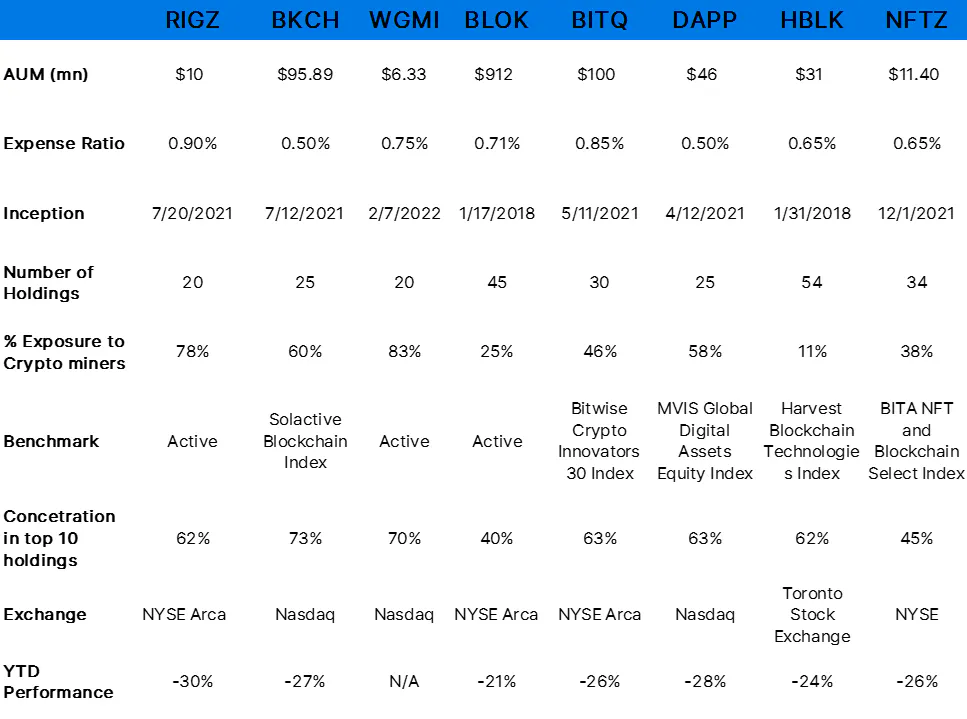
Due to the large list of crypto stocks available for trade, it would be difficult to assess which company will come out on top in a nascent and volatile industry. Exchange-traded funds can offer exposure to a basket of crypto miners and other companies involved in the crypto and blockchain circle. The advantage of diversification can act as a safety net in the event of a crypto industry downturn. Below is a list of ETFs that have large allocations to crypto mining stocks.
List of America-domiciled ETFs with exposure to crypto mining stocks
- Viridi Cleaner Energy Crypto-Mining & Semiconductor ETF (RIGZ)
- Global X Blockchain ETF (BKCH)
- Valkyrie Bitcoin Miners ETF (WGMI)
- Amplify Transformational Data Sharing ETF (BLOK)
- Bitwise Crypto Industry Innovators ETF (BITQ)
- VanEck Digital Transformation ETF (DAPP)
- Blockchain Technologies ETF (HBLK)
- Defiance Digital Revolution ETF (NFTZ)
Note: Please report any omitted ETF to rony.abboud@trackinsight.com
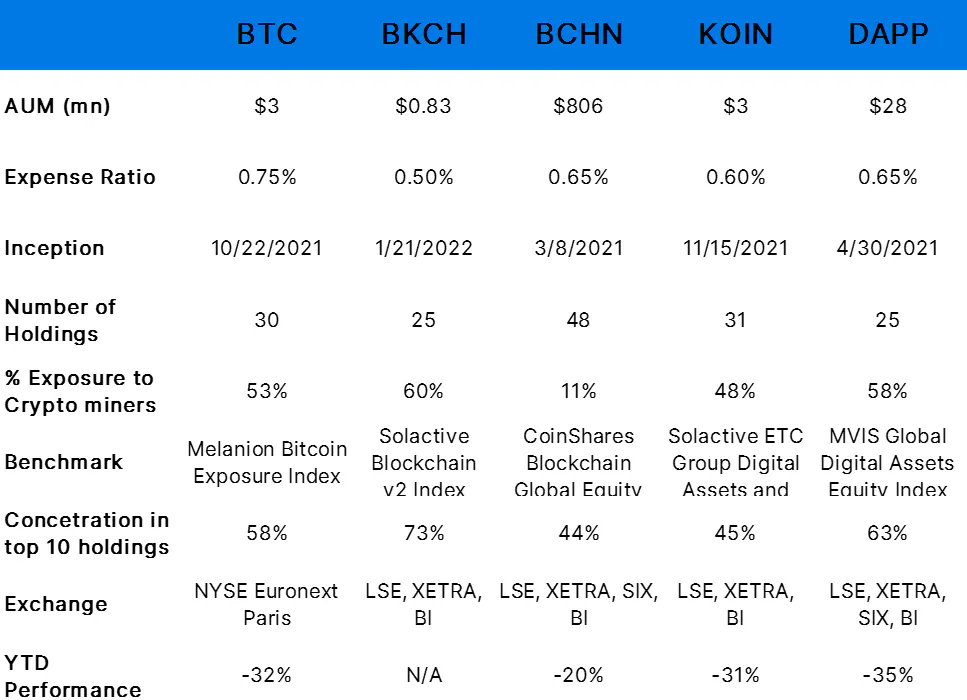
Europe-domiciled Crypto Mining ETFs
- Melanion BTC Equities Universe UCITS ETF (BTC)
- Global X Blockchain UCITS ETF (BKCH)
- Invesco CoinShares Global Blockchain UCITS ETF (BCHN)
- ETC Group Digital Assets and Blockchain Equity UCITS ETF (KOIN)
- VanEck Digital Assets Equity UCITS ETF (DAPP)
Note: Please report any omitted ETF to rony.abboud@trackinsight.com
Advertisement
More articles


About Trackinsight
Since our founding in 2016, we have been at the forefront of the industry, delivering accessible, comprehensive, and reliable tools to support the evolving needs of investors.
Over the past decade, Trackinsight has expanded its operations across six countries, serving thousands of professional investors. We’ve consistently innovated to provide cutting-edge solutions that meet the changing demands of the ETF market.
In 2024, Kepler Cheuvreux, a leading independent European financial services firm, acquired a majority stake in Trackinsight, becoming the company's principal shareholder.
This strategic partnership solidifies Trackinsight's position as a premier provider of ETF selection and analysis tools, while strengthening Kepler Cheuvreux’s commitment to becoming a leading player in the ETF sector.
Together, we are committed to offering advanced services that empower professional investors, advisors, institutions, and issuers. This new step enables us to deliver even more comprehensive and innovative technological solutions, driving ETF investing to new heights.
More about TrackinsightETF TOOLS
PLATFORM
ETF NEWS & RESEARCH
Privacy policy | Cookie policy | | Terms of use | Imprint