Trackinsight Enterprise, a unified platform for institutional ETF research, analytics, and compliance, is now live. Explore Trackinsight Enterprise →
Help us improve your experience. Please confirm your investor type:
Don’t Miss a Move in the ETF Market
Sign up and keep track of everything that moved the ETF industry this week. From new launches to regulatory shifts across the Atlantic.

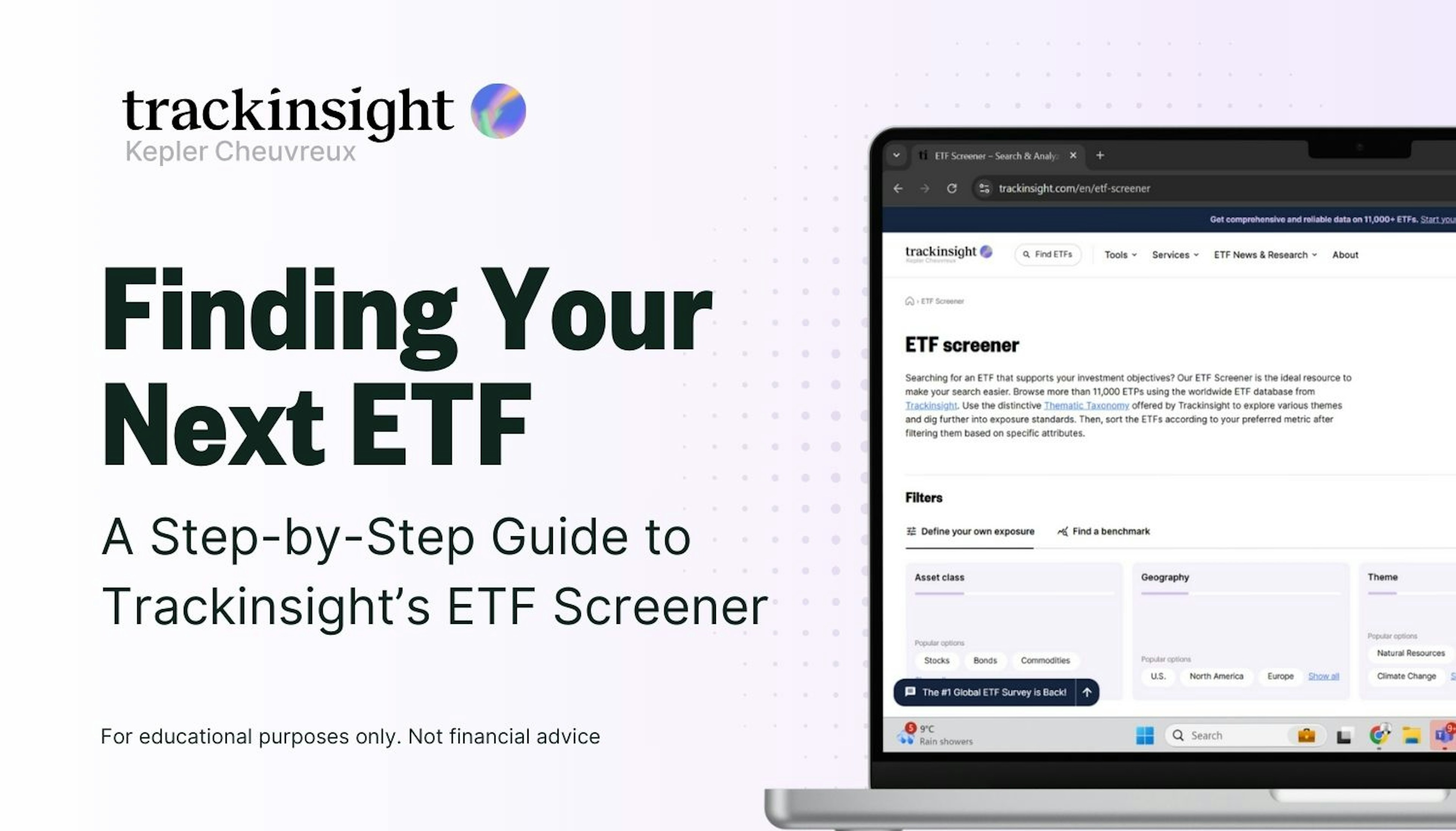
Finding Your Next ETF: A Step-by-Step Guide to Trackinsight’s ETF Screener
Ready to find your ideal ETF in mere minutes? Trackinsight’s powerful ETF screener makes it effortless.

By Trackinsight
February 25, 2025
- Trackinsight
- ETF Screener
Advertisement
If you’ve ever tried to pick an ETF (Exchange-Traded Fund) from the thousands available, you already know how challenging it can be. ETFs come in nearly endless varieties—some track the broad stock market, others laser-focus on niche corners of the economy, and some even dabble in cutting-edge assets like cryptocurrencies. In other words, there’s truly an ETF for everyone.
The real question is: How do you find the one that’s right for you?
ETF Data Built for Precision
Trackinsight delivers reliable and comprehensive coverage on 14,000+ ETFs
Enter the ETF screener. This handy tool helps you zero in on exactly what you need by filtering ETFs based on criteria like asset class, geography, sector, fees, and more. There are many solid screeners out there—Morningstar, ETF Database, and others—but Trackinsight’s ETF Screener goes above and beyond with its depth of filters and user-friendly approach.
Below, we’ll walk through each of these filters in detail, explain their significance, and show you why Trackinsight might become your one-stop shop for ETF discovery.
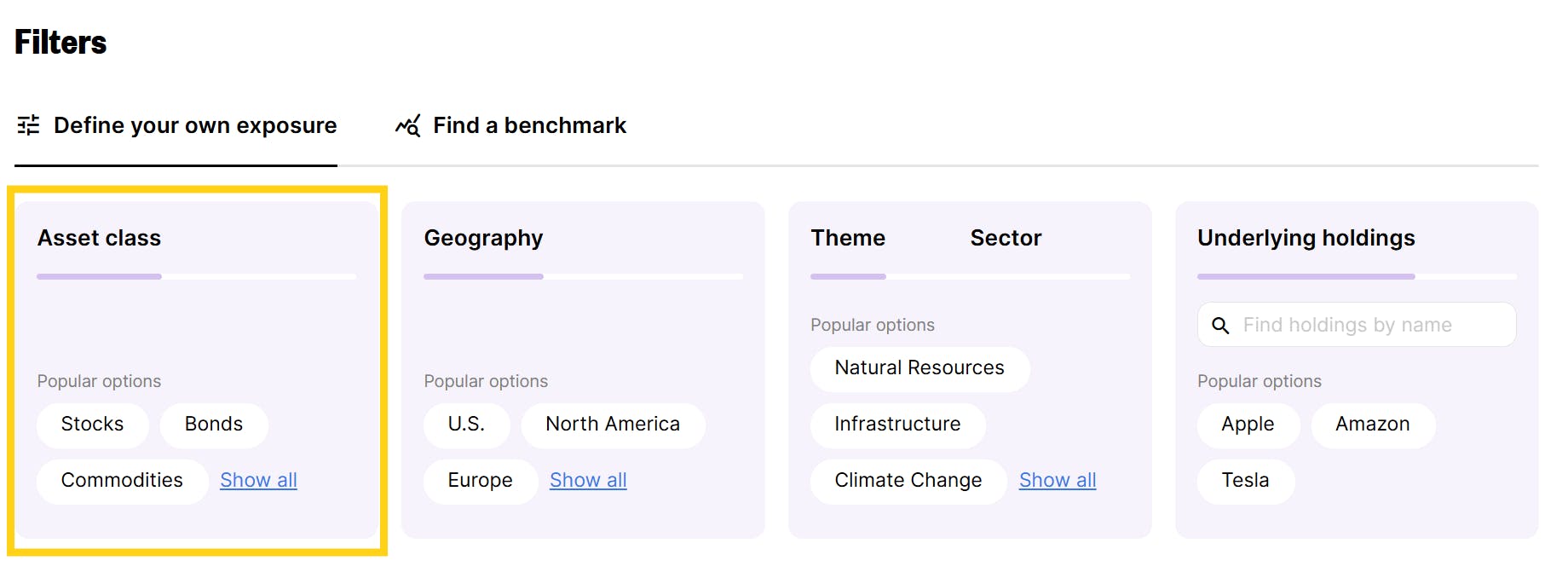
Asset Class
Your first big decision when narrowing down ETFs is which asset class you want to focus on. Think of this as your foundational choice: do you want to invest in stocks, bonds, commodities, or something else entirely?
Stocks: Type
- Common Stocks: The most common form of equity ownership. Holders may receive dividends and can vote on company matters. They’re prone to price fluctuations based on market conditions and company performance.
- Preferred Stocks: These often pay higher fixed dividends but usually don’t come with voting rights. Prices can be less volatile than common stocks.
Practical Use: If you’re looking for potential capital appreciation and want a voice in company decisions, ETFs holding common stocks might appeal to you. If you prefer more stable dividend income, ETFs with preferred stocks could be a fit.
Stocks: Size
- Small Cap: Smaller companies with higher growth potential but also higher volatility.
- Mid Cap: Companies in between small and large caps—generally more established than small caps but with potential for growth.
- Large Cap: Major market players, typically more stable with less explosive growth potential.
- All Caps or Blended Size: A mix that includes companies of all sizes, offering broad exposure.
Practical Use: Choosing by size can align your risk tolerance with market segments. Large caps can offer more stability, while small caps can spice up a portfolio with growth potential.
Stocks: Factor
- Value: Focuses on undervalued companies with strong fundamentals.
- Growth: Targets companies expected to grow sales/earnings faster than average.
- Momentum: Invests in stocks with upward-trending prices.
- Low Volatility: Seeks stocks that are less prone to large price swings.
- Quality: Screens for stocks with solid financial health (e.g., high return on equity, low debt).
- Size: Focuses on small-cap or mid-cap tilt.
- High Dividend: Aims for stocks paying above-average dividends.
- Multi Factor: Combines more than one factor (like value + momentum).
Practical Use: Factor investing can be a powerful way to tilt your portfolio toward specific risk/return profiles. For instance, “Low Volatility” might appeal to risk-averse investors, while “Momentum” might attract those aiming for higher returns.
Bonds: Type
- Fixed-Rate: Pays a set interest rate until maturity.
- Floating-Rate: Interest payments adjust with market rates—potentially beneficial when rates rise.
- Inflation-Linked: Payments adjust with inflation, offering a hedge against rising prices.
- Convertible: Can be exchanged for a certain number of stock shares—generally used by companies with growth potential.
- MBS (Mortgage-Backed Securities) and Asset-Backed: Bonds backed by mortgage or other asset pools—carry different risk profiles than standard corporate or government bonds.
Practical Use: Each bond type has a unique risk/return profile. Floating-rate bonds, for instance, might suit you if you think interest rates will climb. Inflation-linked bonds can protect purchasing power.
Bonds: Issuer Type
- Corporate: Issued by companies, typically offering higher yields than government bonds.
- Government: Often considered lower risk, but yields can be lower.
- Municipal: Issued by local governments; in the U.S., many are tax-free on interest.
- Government Agencies: Sponsored by government-related entities (e.g., Fannie Mae).
- Aggregate: Often includes a broad mix of government, corporate, and mortgage-backed bonds.
Practical Use: Government bonds can be a “safe haven” for more conservative investors, while corporates can boost yields. Munis might appeal if you’re in a high tax bracket.
Advertisement
Bonds: Maturity
- Less than a year: Typically the least risky, lowest yield.
- Short-term (1-5y): Lower interest rate risk.
- Intermediate (5-10y): Balanced approach between risk and yield.
- Long-term (>10y): More sensitive to rate changes, typically higher yields.
- Blended terms: A combination of different maturities to spread out interest rate risk.
- Fixed Maturity: The ETF matures at a specific date, providing a set timeline for investors.
Practical Use: If you’re worried about rising interest rates, short-term bonds might be safer. If you can handle volatility to chase bigger payouts, long-term could be your choice.
Bonds: Currency
Bonds can be denominated in multiple currencies. If you buy a bond ETF in a foreign currency, you’re exposed to exchange rate fluctuations.
Practical Use: Diversifying into various currencies can help spread risk but introduces forex volatility. Some investors seek out foreign currency bonds to potentially benefit from currency swings.
Bonds: Credit Rating
- High Yield (Junk): Offers higher interest rates but more default risk.
- Investment Grade: Lower risk, usually lower yields.
- Mixed Ratings: A blend of high-yield and investment-grade.
Practical Use: This filter is crucial if you’re aiming for yield vs. safety. High-yield bonds can be tempting for returns but come with bigger risks.
Commodities: Energy
- Crude Oil: A major global commodity affected by geopolitics, supply/demand balance, and OPEC decisions.
- Natural Gas: Demand often tied to weather and industrial use.
- Unleaded Gasoline: Influenced by driving habits, seasonal travel, and refinery output.
Practical Use: Commodity exposure can diversify a stock/bond-heavy portfolio. Energy, however, is notably volatile, so weigh your risk tolerance carefully.
Commodities: Metals
- Precious Metals (Gold, Silver, Platinum, Palladium): Commonly seen as “safe havens” during market stress.
- Base Metals (Copper, Aluminum, etc.): Prices often move with global economic activity.
Practical Use: Adding metals can serve as an inflation hedge or a safe store of value. However, these can also see big price swings.
Commodities: Agriculture
- Crops (Sugar, Wheat, Corn, Soybean): These crops can be heavily influenced by weather patterns, global trade policies, and shifts in consumer demand.
- Livestock (Lean Hogs, Live Cattle): Influenced by feed costs, consumer demand, and disease outbreaks.
- Blended Agriculture: Combines various agricultural products for broader exposure.
Practical Use: Agricultural commodities can provide non-correlated returns compared to stocks, helping with diversification.
Commodities: Other
- Carbon Emissions: Gaining popularity as climate policies intensify.
- Dry Freight: Tied to global shipping rates and trade activity.
Practical Use: These niche commodities might be used for specialized strategies or hedging within specific industries.
Advertisement
Currencies
Currency ETFs track a single currency or a basket of currencies relative to another (often the U.S. dollar). Investors use them to hedge currency risks or speculate on forex movements.
Practical Use: If you expect the euro to strengthen against the dollar, a euro-focused ETF could capitalize on that. Conversely, you might hedge if you hold many euro-denominated assets but live in a dollar-based economy.
Cryptocurrencies
Crypto ETFs (where available) provide exposure to digital currencies like Bitcoin or Ethereum without holding the assets directly. They can be highly volatile, making them a high-risk, potentially high-reward portion of a portfolio.
Practical Use: If you’re curious about crypto but hesitant to deal with private keys and wallets, a crypto ETF offers a more traditional brokerage format—still with the significant ups and downs.
Volatility
Volatility ETFs typically track indices like the VIX, which measures market expectations of near-term volatility. These ETFs can be used for hedging against sudden market drops or as a way to profit from anticipated spikes in market uncertainty.
Practical Use: Generally short-term trading vehicles, volatility ETFs are not typically buy-and-hold due to performance decay over time (from contango in futures).
Multi-Asset
Multi-asset ETFs mix equities, bonds, and sometimes commodities or alternative assets. They offer instant diversification in a single product, often appealing to investors who want a balanced approach without juggling multiple ETFs.
Practical Use: If you prefer a “one-stop” diversified solution, multi-asset ETFs can simplify your portfolio management.
Alternative
This category can encompass real estate (REITs), private equity, hedge-fund-like strategies, or other non-traditional assets. They can offer diversification benefits but often come with more complexity or higher fees.
Practical Use: Alternatives can help hedge against traditional market cycles but require due diligence to understand strategies and risks.
Geography
Where do you want your ETF to invest?
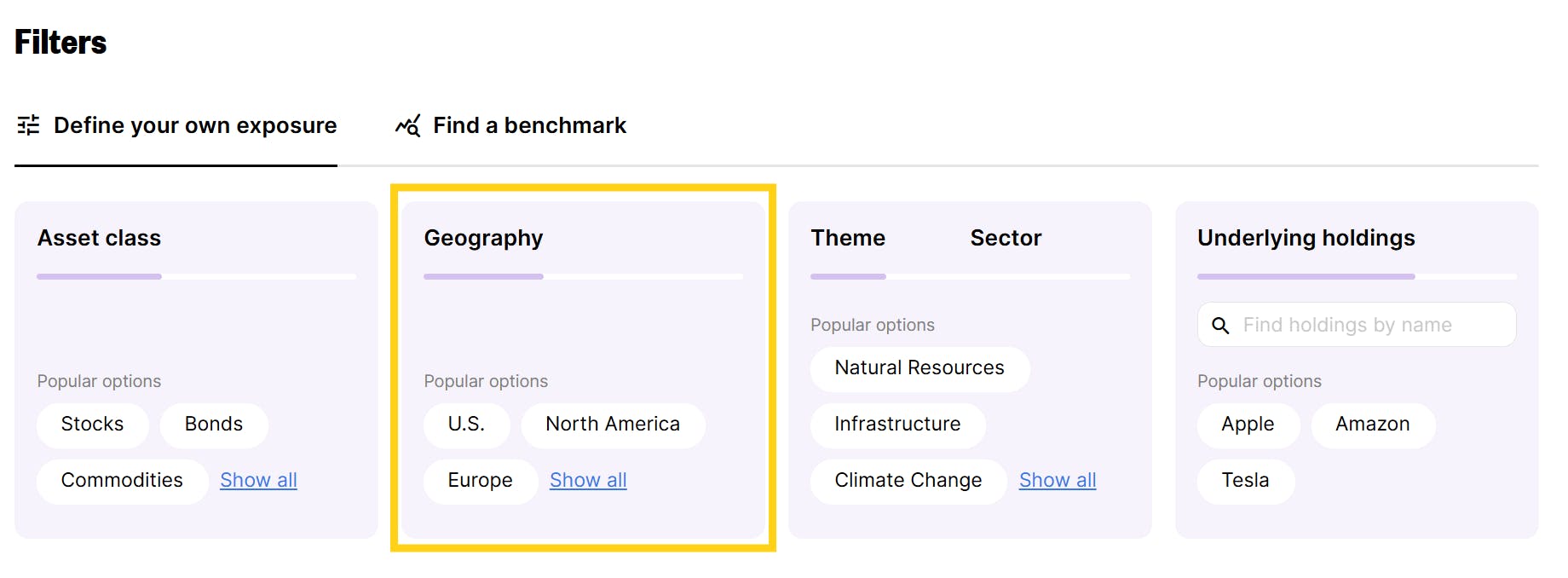
- Single Country: If you believe a specific country (e.g., Brazil, Japan, or Canada) has strong growth prospects or favorable policies, you can zero in on that market.
- Region (Europe, Asia, North America, etc.): Maybe you want broader regional coverage without focusing on a single nation.
- Economic Development (Developed, Emerging, Frontier): Developed markets (like the U.S., UK, Germany) are usually more stable. Emerging and frontier markets can offer higher growth potential with increased risk.
Why It Matters: Geography influences risk, currency exposure, and economic growth drivers. A single-country ETF could be more volatile than a broad regional ETF, but it might offer greater upside if your analysis is right.
Sectors & Themes
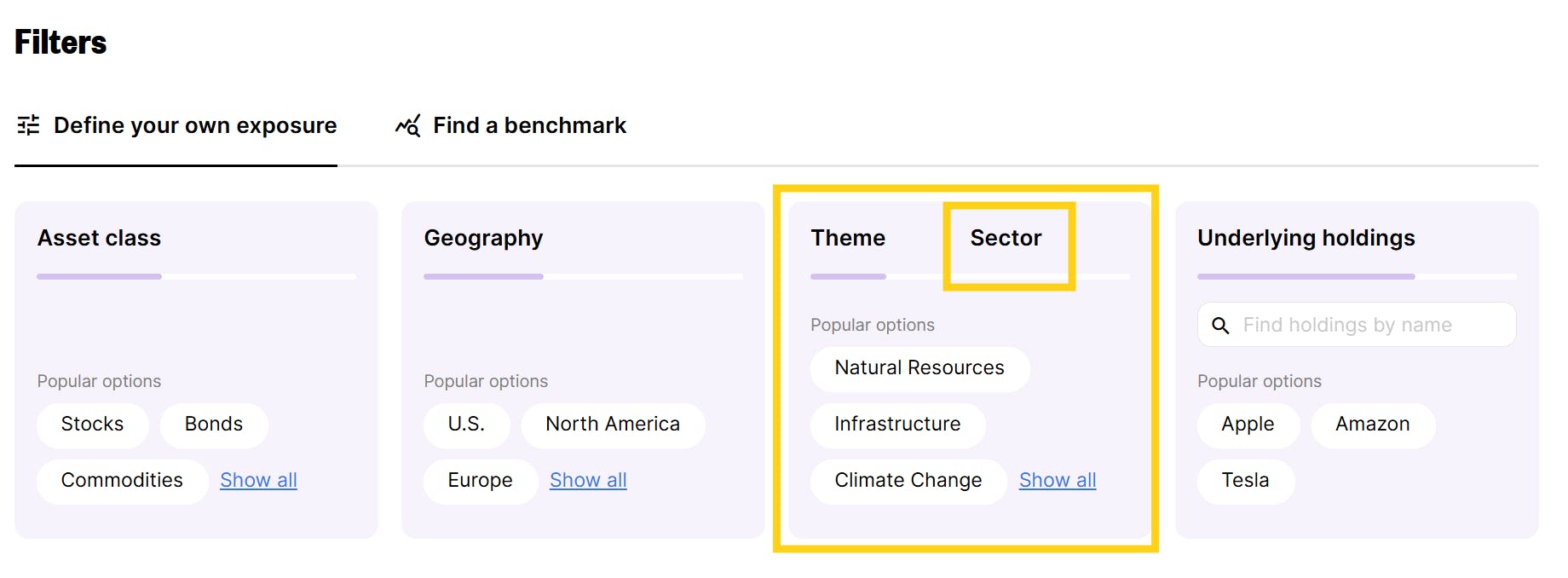
- Sectors (Healthcare, Energy, Financials, Materials, Tech, etc.): You invest in a specific industry segment.
- Themes (Alternative Energy, Climate Change, Digital Infrastructure, etc.): Thematic ETFs group companies that share a common trend or innovation.
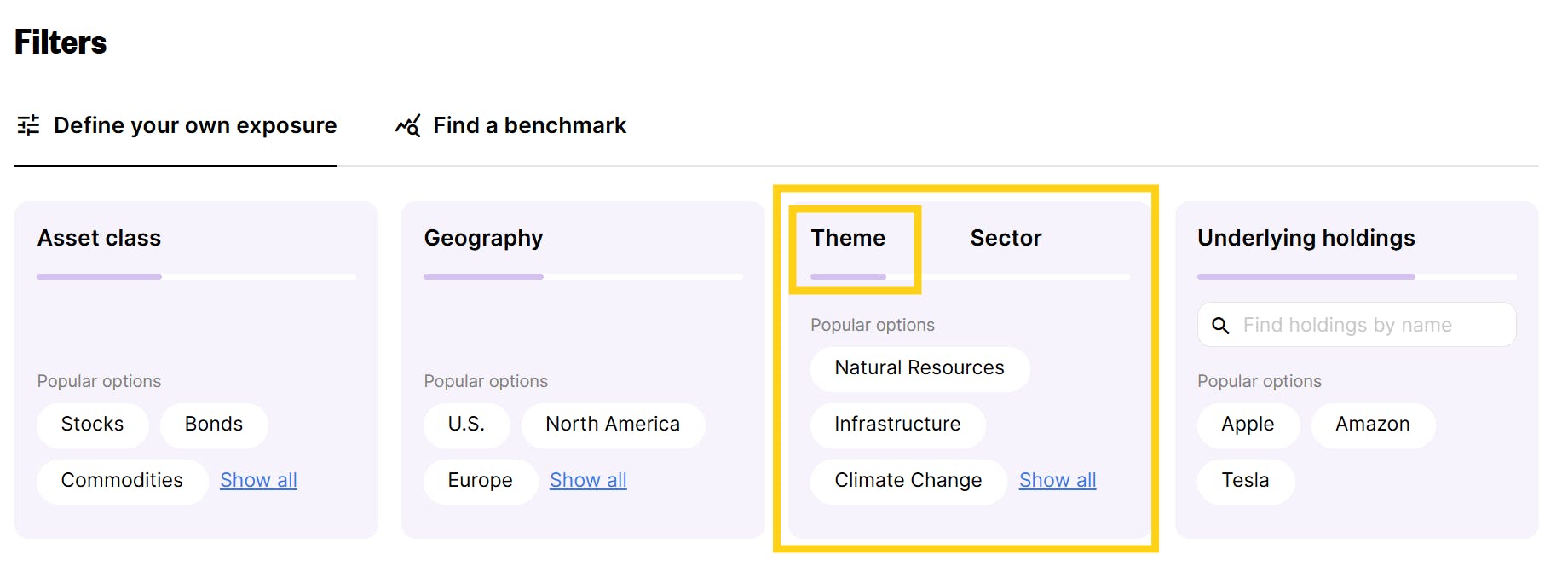
Practical Use: If you believe renewable energy is the future, a climate-focused ETF might be appealing. Or, if you think tech companies will keep dominating, a technology sector ETF aligns with that view.
Product Type
- ETF: The standard structure—funds that trade on an exchange, usually tracking an index or following an active strategy.
- ETN (Exchange-Traded Note): A debt instrument underwritten by a bank, carrying the issuer’s credit risk. Returns are linked to the performance of an index/asset.
- ETP (Exchange-Traded Product): A broad umbrella for exchange-traded vehicles, including commodity pools.
- ETC (Exchange-Traded Commodity): Typically tracks commodities directly or via futures/derivatives.
Practical Use: Understanding the structure helps you grasp nuances like credit risk (ETNs), tax implications, and how performance is replicated.
Active/Passive
- Active Transparent ETFs: Full disclosure of holdings daily. Managers try to beat the market.
- Active Semi-Transparent ETFs: Less frequent disclosure, aiming to protect proprietary strategies.
- Passive ETFs: Track an index, aiming to replicate its performance at low cost.
Practical Use: Active ETFs can offer outperformance potential—at a price. Passive ETFs often come with lower fees and simpler strategies. Your choice might depend on whether you believe in manager skill or prefer broad index exposure.
Replication Method
- Direct (Physical): The ETF buys the actual stocks/bonds in the index.
- Indirect (Synthetic): Uses swaps and derivatives to mimic index returns.
- Other: Sometimes a combination (often seen in complex strategies).
Practical Use: Physical replication is more transparent and straightforward. Synthetic ETFs can sometimes have tax efficiencies or lower tracking error, but they introduce counterparty risk. More on Physical vs. Synthetic Replication here→
Sustainability
- ESG Score: Rates how a fund’s holdings adhere to environmental, social, and governance best practices.
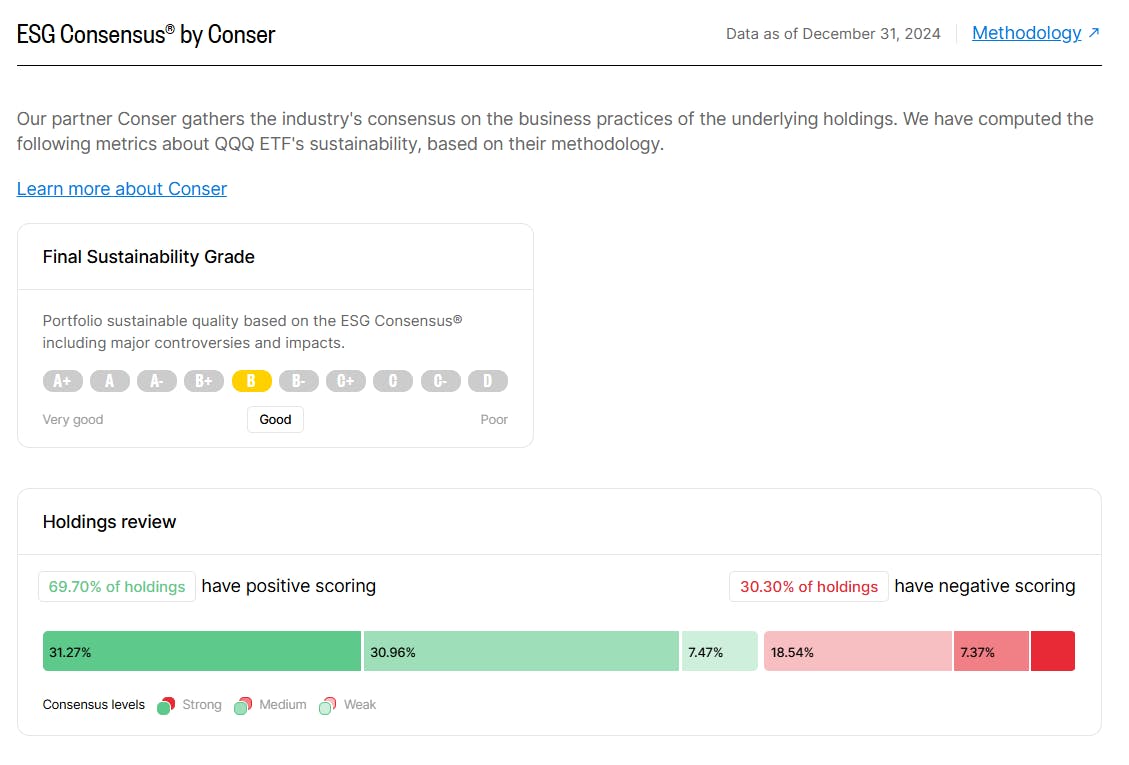
- ESG Strategy: Some ETFs exclude certain industries (tobacco, fossil fuels), others pick “best-in-class” ESG performers. More on ESG Strategies→
- SFDR: Under EU regulation, funds labeled as Article 8 or 9 must meet specific sustainability standards. More on SFDR here→
- SDG Exposure: Gauges how closely a fund’s holdings align with the U.N.’s Sustainable Development Goals. View all SDG ETFs here→

Practical Use: If you want your investments to reflect your personal values—like tackling climate change or promoting social fairness—ESG and SDG filters make it easy to find aligned ETFs.
Replication Rating
Some platforms (like ours) go the extra mile and provide a Replication Rating, indicating how closely an ETF tracks its underlying index. Low tracking error generally means more efficient management and fewer surprises.
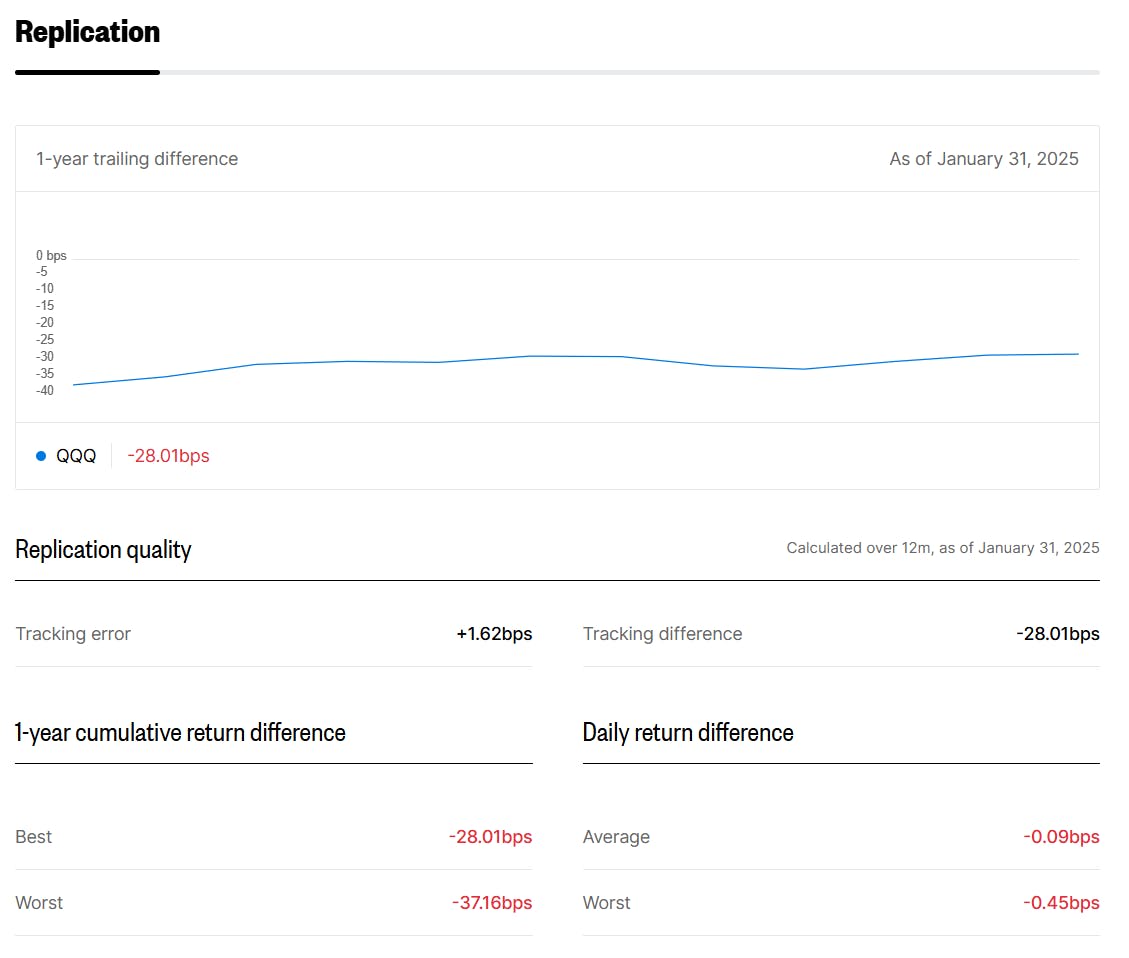
Practical Use: If you’re paying for an index fund, you probably want it to stay in sync with that index as closely as possible. A high Replication Rating signals minimal deviation.
Strategy
- Long Only: Buys and holds assets, profiting if prices rise.
- Leverage: Uses borrowed money or derivatives to amplify returns—and losses.
- Inverse: Moves in the opposite direction of the underlying index—useful for hedging or bearish plays.
- Options Strategies: Could involve covered calls, protective puts, etc.
- Other Strategies: Managed futures, event-driven, or other specialized approaches.
Practical Use: Some investors might use leveraged or inverse ETFs for short-term trades. Options strategies might appeal to income seekers. Choose carefully as complexity and risk can ramp up quickly.
Dividend Policy
- Distribution: The ETF pays out dividends periodically to shareholders.
- Capitalization (Accumulating): Dividends are reinvested, boosting your share value.
Practical Use: If you rely on income, distribution ETFs can help. If you’d rather automatically reinvest, choose an accumulation fund.
Providers/Issuers
Filters let you select from specific ETF brands: Vanguard, iShares, Invesco, etc. Some prefer large, well-known issuers for track record and liquidity; others might chase smaller issuers with niche focuses.
Practical Use: Familiarity, trust, and liquidity often drive the choice. Bigger providers may have lower expense ratios, while specialized issuers might offer unique strategies.
Base Currency & Trading Currency
- Base Currency: The currency in which the fund’s net asset value (NAV) is calculated.
- Trading Currency: The currency you use to buy/sell shares.
- Currency Hedging (Yes/No): Some ETFs hedge currency exposure, reducing volatility from exchange-rate swings.
Practical Use: If you’re investing outside your home country, currency fluctuations can significantly impact returns. A currency-hedged ETF might stabilize performance if your local currency is strong or volatile.
Listing Venue & Jurisdiction
- Listing Venue: Which stock exchange the ETF trades on (NYSE, LSE, etc.).
- Jurisdiction: The domicile of the ETF (e.g., Ireland, Luxembourg, U.S.). This affects taxes and regulations.
Practical Use: If you’re based in Europe, you might prefer UCITS ETFs domiciled in Ireland or Luxembourg for favorable tax and regulatory reasons. U.S. investors often stick with domestically listed ETFs for liquidity and ease.
Why Trackinsight’s ETF Screener?
Look around, and you’ll see various ETF screeners—Morningstar, ETF Database, Yahoo Finance, and so on. They can all help you filter out ETFs based on basic parameters.
So, what makes Trackinsight special?
- In-Depth Filtering: Trackinsight covers practically every criterion under the sun, from asset class to SFDR compliance. You can go broad or hyper-specific—perfect if you’re looking for a small-cap, high-dividend, emerging-market bond that’s currency-hedged and ESG-compliant (yep, you can get that granular).
- User-Friendly Interface: Some screeners feel like navigating a spreadsheet from the ’90s. Trackinsight’s layout is intuitive and visually engaging, making it easy to track what you’ve selected.
- Comprehensive Sustainability Insights: If ESG is high on your priority list, Trackinsight’s integrated data goes deeper than many alternatives, helping you match investments to your values.
- Replication Rating & Proprietary Data: Unique metrics like Replication Rating give you an edge in evaluating index-tracking quality.
- Global Coverage: Instead of focusing on just one market, Trackinsight brings together ETFs from all around the world—so you won’t miss out on anything.
Final Thoughts
Choosing the right ETF isn’t just about finding the biggest brand name or the lowest fee—it’s about matching an investment to your objectives, risk tolerance, and even personal values. ETF screeners empower you to do precisely that, giving you the tools to wade through countless options and zero in on the funds that truly fit your needs.
While there are several good screeners out there, Trackinsight’s ETF Screener stands out for its comprehensive filters, smooth user experience, and advanced features like ESG data and replication ratings. Give it a try—it might just become your go-to resource for discovering, analyzing, and comparing ETFs.
Ready to Find Your Perfect ETF?
Head over to Trackinsight.com, create a free account and start playing with Trackinsight’s ETF Screener. Whether you’re a brand-new investor or an experienced pro looking to refine your portfolio, having the right search tool at your fingertips can make all the difference in building a strategy you can stick with. Happy investing!
Disclaimer: The information provided in this article is for educational and informational purposes only and should not be construed as financial advice. Always do your own research and/or consult a qualified financial professional before making any investment decisions.
More articles


About Trackinsight
Since our founding in 2016, we have been at the forefront of the industry, delivering accessible, comprehensive, and reliable tools to support the evolving needs of investors.
Over the past decade, Trackinsight has expanded its operations across six countries, serving thousands of professional investors. We’ve consistently innovated to provide cutting-edge solutions that meet the changing demands of the ETF market.
In 2024, Kepler Cheuvreux, a leading independent European financial services firm, acquired a majority stake in Trackinsight, becoming the company's principal shareholder.
This strategic partnership solidifies Trackinsight's position as a premier provider of ETF selection and analysis tools, while strengthening Kepler Cheuvreux’s commitment to becoming a leading player in the ETF sector.
Together, we are committed to offering advanced services that empower professional investors, advisors, institutions, and issuers. This new step enables us to deliver even more comprehensive and innovative technological solutions, driving ETF investing to new heights.
More about TrackinsightETF TOOLS
PLATFORM
ETF NEWS & RESEARCH
Privacy policy | Cookie policy | | Terms of use | Imprint