Global ETF Survey 2026: Answer now →
Help us improve your experience. Please confirm your investor type:
The ETF Industry Is Evolving Fast
From AI infrastructure to active strategies, the ETF landscape is shifting. Share your perspective in the 7th Annual Global ETF Survey.
ETFs as a vaccine against inflation
Learn about inflation and the tools you need to protect your finances.


By Jean-Charles Senant
January 12, 2022
- Inflation
Advertisement
Inflation has become a google search superstar, racking up between 100K-1M monthly searches over the past year. The reason is simple - inflation has turned into an existential threat to our lifestyles and a virus that infects goods and services we cherish. In this article, we'll learn more about this rising enemy and the tools to deal with it.
What is inflation?
Simply put, inflation is the increase in the level of prices of the goods and services that households buy. When inflation rises, your money loses value, because it can buy less than it did before.
📊 Share your ETF outlook
From AI infrastructure to active strategies, the ETF landscape is shifting. Share your perspective in the 7th Annual Global ETF Survey and get exclusive early access to the final report.
How inflation is calculated?
Inflation is calculated based on an index made of a basket of selected goods and services. The Consumer Price Index (CPI) is the most used index to measure inflation. Inflation is calculated by comparing the CPI of a specific period with the one of a base year. As an example, let’s say we use 2020 as a base year. Then, the CPI was 100 and as of today the CPI is 105. This shows the economy has experienced an inflation of 5% (i.e., a 5% increase in the CPI).
Introducing the "Flation" family
Before we dive deeper into this, it's important to meet the "Flation" family:
- Deflation is the opposite of inflation. Prices drop during deflationary periods and it's an indication of low consumer confidence. Japan suffered from deflation for almost a decade in 1990s.
- Stagflation is a period of spiking inflation coupled with slow economic growth and high unemployment. Lebanon is a perfect example of that.
- Disinflation is when the inflation rate drops over time.
- Reflation is the act of combating deflation and stimulating a sluggish economy through a mix of fiscal and monetary policies.
- Creeping inflation is also known as “mild inflation” or “moderate inflation”n. This type of inflation occurs when the price level consistently rises over a period of time at a mild rate.
- Galloping inflation is an inflation in the double or triple-digit range of 20%, 100% or 200% a year. Latin American countries like Argentina and Brazil exhibited this type of inflation multiple times over the past few decades.
- Hyperinflation is when a galloping inflation is no longer controllable and the country sinks in a period of turbo-fast inflation (>1,000%). Countries like Venezuela and Zimbabwe are currently familiar with that.
What causes inflation?
There are two types of inflation according to economists: “Demand-Pull” Inflation and “Cost-Push” Inflation. Both types can trigger an increase in the overall price level within an economy.
- Demand-Pull inflation: when consumer demand increases beyond levels supply can handle. In this case, suppliers charge more for their scarce goods and services.
- Cost-Push Inflation: when the supply of goods or services is limited but demand remains the same, it pushes up prices.
Which inflation are we seeing today?
In November 2021, America witnessed its highest inflation rate in nearly 40 years, a jaw-dropping 6.8% that was far beyond most economists' expectations. The same story repeated across the Atlantic, with a 4.9% inflation rate in the Euro Area. This inflationary period we are living in is unique, exhibiting symptoms of both demand-pull and cost-push inflation.
During the peak of the Covid-19 pandemic, demand drastically decreased with the nationwide lockdowns, soothing the prices of goods and services. Then, with the vaccination rollouts and reopening of developed economies, demand spiked and left the supply side scrambling to keep up. The demand shock disrupted global supply chains and drove the inflation rate up. It's a classical symptom of a demand-pull inflation.
On other hand, prices of daily goods like coffee and grains went soared due to severe weather conditions in Brazil and other parts of the world which affected crop production. We didn't double our coffee intake nor eat more corn. Hence, a clear case of cost-push inflation.
Is inflation inflated?
A statistical phenomenon that may inflate inflation values is what mathematician call “the base effect”. In statistics, base effect refers to the effect the choice of the comparison has on the result. In 2020, prices dipped with fewer consumption, then went back up in 2021. If you calculate the changes between 2021 and 2020, the figures look scary. However, if you compare the 2021 prices with pre-Covid level prices, let's say of 2019, inflation values wouldn't look so awful.
Here's an example that illustrates the base effect in action. If the price for 1kg of apple in 2019 was $2 and decreased to $1.5 during the pandemic. In 2021 if the price goes up to $2.2. This represents a 47% increase in price compared with 2020 but only a 10% increase compared with 2019.
Advertisement
Is this inflation transitory?
For months, the Federal Reserve of the United States (the Fed) was stating that the period of high inflation is transitory and a direct consequence of the pandemic. The Fed expected higher inflation is normal as the economy was rebooting post-Covid. But contrary to their belief, inflation looked like a stubborn stain on the economy and was worsening over time. This led Fed’s chairman Jerome Powell to take a hawkish stance in late 2021, announcing that they would entirely wrap up their bond-buying in 2022 and potentially opening the door for multiple interest rate hikes. These drastic measures are clear indication of the Fed's volte-face on inflation, which in their minds is no longer transitory.
From its side, the European Central Bank has decided to discontinue its Pandemic Emergency Purchase Programme (PEPP) and to reduce the pace of its Asset Purchase Programme (APP). However, ECB key rates will remain the same for now.
How you can beat inflation?
So now you know how to calculate inflation, what drives it, and that Central Banks are going to fight it in 2022, what can you do to protect your finances?
Invest in commodities
There is more than one solution. First, investing in commodities is a good way to hedge against inflation. Indeed, commodities prices rise with inflation. Owning a basket of commodities can help reduce the impact of inflation on your finances. Some commodities even can be used as “inflation whistleblower”. Increases in prices of such commodities are an indicator that inflation is coming. This is explained because as the commodity price rises, so does the price of the good produced from this commodity. The graph below perfectly illustrates this. It shows the performance of the Bloomberg Commodity Index (BCOM) is positively correlated to inflation.
Find commodities ETFs with our ETF screener.
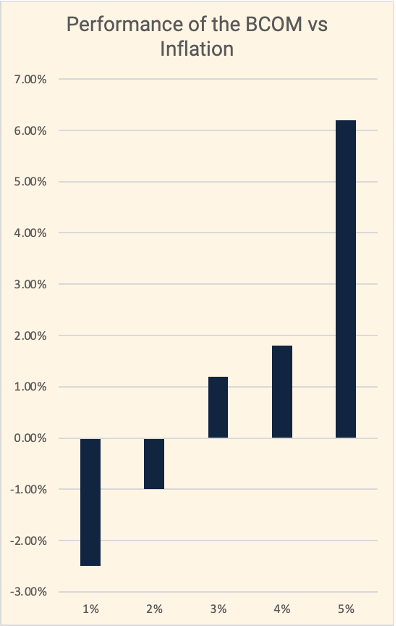
Source: Bloomberg
Invest in inflation protected products
Inflation Protected Bonds are the ultimate tool to hedge against inflation. They are issued by governments and have their coupon and principal linked to inflation. This means you earn money if inflation occurs. The iShares TIPS Bond ETF has experienced tremendous inflows over the last quarter of 2021. It is actually the most successful fixed income ETF to raise money during this quarter with $4.5 trillion, ahead of the Vanguard Total Bond Market ETF which collected $2.9 trillion over the same period. Moreover, if you look at the top 10 ETFs in terms of inflows for the last quarter of 2021, 4 of them are focused on inflation-protected instruments.
Find inflation-protected products with our ETF screener .
Advertisement
Invest in technology innovation ETFs
Investing in companies that do not require large amount of capital such as technology or communication services companies is also a way to earn money from inflation. Indeed, those companies are considered “inflation winners” as they don’t use raw materials to run their business.
Find technology innovation ETFs exploring our thematic investing page.
Don’t wait, act now
The truth behind the inflation figures is less alarming than it seems. First, inflation is pulled up by volatile goods and services, so core inflation is not as high as inflation. Moreover, Central Banks over the world are going to start fighting inflation using different policies such as rate hikes and decrease in asset repurchase programs. Inflationary environment is the best environment to start investing your money. If you have been longing for an opportunity to invest your money instead of letting it sleep and depreciate, now is the perfect time!
Look now at our ETF screener to find the best ETF for you.
Are you an ETF Investor? Your opinion matters: Answer the Trackinsight Global ETF Survey 2022.
Find and compare over 8,000 ETFs with our free tools:
Interested in seeing lists of top-performing ETFs? Check out our Investing Guides:
- Investing in Gold ETFs
- Investing in Silver ETFs
- Investing in Commodity ETFs
- Investing in Oil ETFs
- Investing in ESG ETFs
More articles


About Trackinsight
Since our founding in 2016, we have been at the forefront of the industry, delivering accessible, comprehensive, and reliable tools to support the evolving needs of investors.
Over the past decade, Trackinsight has expanded its operations across six countries, serving thousands of professional investors. We’ve consistently innovated to provide cutting-edge solutions that meet the changing demands of the ETF market.
In 2024, Kepler Cheuvreux, a leading independent European financial services firm, acquired a majority stake in Trackinsight, becoming the company's principal shareholder.
This strategic partnership solidifies Trackinsight's position as a premier provider of ETF selection and analysis tools, while strengthening Kepler Cheuvreux’s commitment to becoming a leading player in the ETF sector.
Together, we are committed to offering advanced services that empower professional investors, advisors, institutions, and issuers. This new step enables us to deliver even more comprehensive and innovative technological solutions, driving ETF investing to new heights.
More about TrackinsightETF TOOLS
PLATFORM
ETF NEWS & RESEARCH
Privacy policy | Cookie policy | | Terms of use | Imprint