Global ETF Survey 2026: Answer now →
Help us improve your experience. Please confirm your investor type:
The ETF Industry Is Evolving Fast
From AI infrastructure to active strategies, the ETF landscape is shifting. Share your perspective in the 7th Annual Global ETF Survey.
ETFs caught in US-Afghanistan crossfire
The US military has withdrawn its troops from Afghanistan. This has caused changes in the market outlook of the neighbouring countries, including ETFs.


By Rony Abboud
August 23, 2021
- United States
- Afghanistan
Advertisement
America’s longest war has finally come to end with the official withdrawal of U.S military and personnel from Afghanistan. With so little resistance from the Afghan government and national army, the Taliban did not skip a beat and took over swiftly in matter of days.
The change in leadership had certainly some on the spot market ramifications and may have more in the future as the new regime settles. Investors are contemplating the market outlook of neighbouring countries, major trade partners and sectors caught in the crossfire.
📊 Share your ETF outlook
From AI infrastructure to active strategies, the ETF landscape is shifting. Share your perspective in the 7th Annual Global ETF Survey and get exclusive early access to the final report.
Worried neighbours near Afghanistan
The longest border in Afghanistan, located to its southeast, is shared with Pakistan. Known as the Durand Line, it has a length of 1,510 miles (2,670 km). The border is a gateway for a multibillion-dollar trade flow between the two neighbours and other surrounding countries. With recent development, concerns about trade disruption may have impacted the Pakistani market.
Pakistan’s $8.8bn of dollar bonds have now fallen by about 4% since mid-June due to some longer dated issues, however the recent Taliban takeover and possible refugee crisis at the border added pressure on the bond market.
On Monday, Pakistan’s dollar-denominated bonds fell by about 1% to just above 100 cents on the dollar. The yield on a 10-year bond issued in April this year, which moves opposite to the price, climbed by about a 0.25%.
On the equities side, The KSE 100, a leading market index for the Pakistani market, fell by 1.52% between August 6 and 16 as the Taliban began its early advance despite the agreement it signed with the U.S. The fierce fighters took over Kabul and the presidential palace on August 15.
In the ETF space, Global X MSCI Pakistan ETF (PAK), which invests in Pakistani equities lost -0.67% between August 9 and 16 but witnessed minor outflows of USD 8,119. Similarly, Xtrackers MSCI Pakistan Swap UCITS ETF (XBAK) lost -0.30% with no outflows recorded.
India also has as much at stake in Afghanistan’s future. With Taliban in power, the country now finds many of its investments in human and physical infrastructure in Afghanistan in jeopardy with the new regime. Most recently, trades between the two countries were halted.
Uncertainty lies in the future relationship between the two countries, especially with Taliban’s history of harboring of anti-Indian terrorist organizations within Afghanistan. However, as India rises as a major economic power, it will certainly take part in the region’s game of thrones, even if it means dealing with the Taliban.
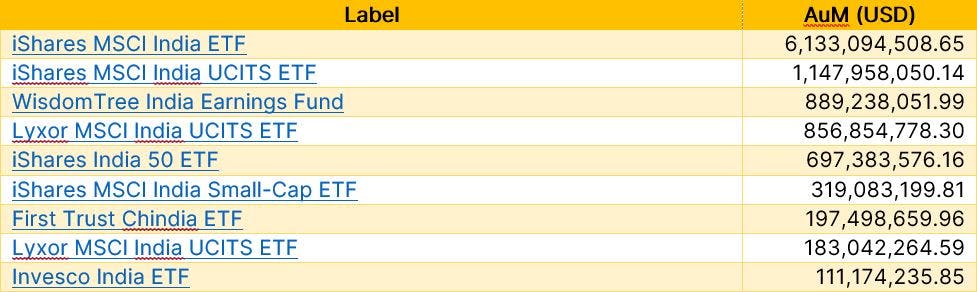
For investors intrigued in Indian ETFs, below is the list of the top 10 largest ETFs investing in Indian Equities.
Advertisement
Top 10 Largest ETFs Investing in Indian Equities
Will the defence sector take a hit?
The U.S government spent $2 trillion of taxpayers’ money attempting to establish law and order in Afghanistan in its 20-year tenure, with the biggest cut funnelled into multiple military and defence contractors.
Companies that enjoyed the spoils of war include top five biggest defence contractors Boeing, Raytheon, Lockheed Martin, Northrop Grumman, and General Dynamics.
Their long-term Investors could not be any happier too. A $10,000 investment of stock evenly divided among these big five on September 18, 2001 would be worth more than $90,000 on August 15, 2021, the day the Taliban took over. That’s at least +800% of returns with dividends reinvested.
As the U.S exits Afghanistan, military expenditure by the U.S Army could fall but may rise for neighbouring countries who will seek to reinforce their defence system against the freshly instated Taliban regime.
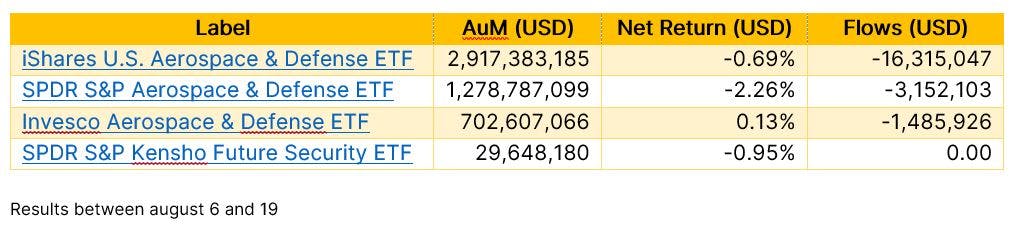
Large ETFs that have exposure to the top American defence contractors should be on the watch by the bulls and the bears. As events unfolded between August 9 and 16. Some of these ETFs took a downturn with major outflows and price drops recorded.
Aerospace & Defence ETF price drop
Afghanistan’s mineral wealth
Afghanistan has vast reserves of gold, platinum, silver, copper, iron, chromite, lithium, uranium, and aluminium, estimated to be worth between $1 trillion and $3 trillion. With the US gone, the Afghani mineral wealth is up for grabs.
According to Pentagon officials, their initial analysis at one location in Ghazni province showed the potential for lithium deposits as large as those of Bolivia, which has the world’s largest known lithium reserves.
Lithium is one of many materials leading the charge in electrification and the clean energy revolution. It is widely used in rechargeable batteries for electric vehicles, energy grid storage, mobile phones, laptops, digital cameras and other small electronic devices.
Advertisement
It’s hard to say what will happen to the lithium reserves in Afghanistan. But investors should expect some changes in the supply/demand dynamics if the mines fell in the hands of China, the world’s largest lithium consumer (~40% of World share).
There are several ETFs investing in Lithium miners, refiners and battery makers that investors can track. Most recently, there were some price and flow actions happening in some major ETFs in that space, notably in Global X Lithium & Battery ETF, the largest of them all.

The Middle East dilemma
The U.S retreat may worry some Middle Eastern (ME) countries that are considered major U.S allies. The retreat from Afghanistan, a neighbouring country to Iran, may not please Israel, Saudi Arabia and other gulf countries. What transpired during recent events could be interpreted as a weak move, especially with the nuclear deal in play.
A very senior Israeli defence sources said that the day of the retreat was a “black day,” one which will reflect how countries in the region feel about America’s promises.
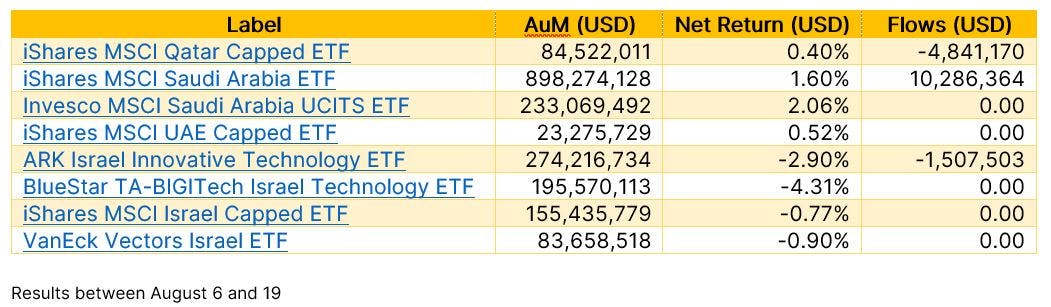
Investors with long term political vision and insights know it may have some negative ramifications for the ME markets. As for the ETFs in play, it is important to keep an eye on Emerging Market ETFs with large exposure to the Middle east and focus on Qatar, UAE, Saudi Arabia and Israel.
Here are some major Middle East ETFs and their performance between August 9 and 16.
Top Middle East ETF Performance
World events can change market dynamics and investors should reassess their portfolios and balance accordingly. ETFs can be the tool that give the exposure to the right market, sector or theme affected.
Find and compare over 7,000 ETFs with our free tools:
More articles


About Trackinsight
Since our founding in 2016, we have been at the forefront of the industry, delivering accessible, comprehensive, and reliable tools to support the evolving needs of investors.
Over the past decade, Trackinsight has expanded its operations across six countries, serving thousands of professional investors. We’ve consistently innovated to provide cutting-edge solutions that meet the changing demands of the ETF market.
In 2024, Kepler Cheuvreux, a leading independent European financial services firm, acquired a majority stake in Trackinsight, becoming the company's principal shareholder.
This strategic partnership solidifies Trackinsight's position as a premier provider of ETF selection and analysis tools, while strengthening Kepler Cheuvreux’s commitment to becoming a leading player in the ETF sector.
Together, we are committed to offering advanced services that empower professional investors, advisors, institutions, and issuers. This new step enables us to deliver even more comprehensive and innovative technological solutions, driving ETF investing to new heights.
More about TrackinsightETF TOOLS
PLATFORM
ETF NEWS & RESEARCH
Privacy policy | Cookie policy | | Terms of use | Imprint