All you need to get started with ETF selection and analysis. Create your account now →
Help us improve your experience. Please confirm your investor type:
Don’t Miss a Move in the ETF Market
Sign up and keep track of everything that moved the ETF industry this week. From new launches to regulatory shifts across the Atlantic.

ETFs caught in Russia-Ukraine crossfire
As the tension swings on the Russian-Ukrainian border, investments can be caught in the crossfire. We look at the impact of the crisis on various ETFs.


By Rony Abboud
February 16, 2022
- Russia
- Ukraine
- Equities
Advertisement
We often associate Russia's strength with its military prowess, but we tend to forget the well-oiled engine parts behind the economy of the world's largest nation. From energy and metals to agricultural commodities, Russia's natural resources and trade influence should not be taken lightly. As the tension pendulum swings on the Russian-Ukrainian border, investments can be caught in the crossfire. In this article, we look at the impact of the Russian-Ukrainian crisis on various Exchange-Traded Funds (ETFs).
Countries depend on Russia’s fossil fuel wealth
According to the central bank, Russia's total exports reached $490 billion in 2021. Of that, crude oil accounted for $110 billion, oil products for $68.7 billion, pipeline natural gas for $54 billion, and liquefied natural gas for $7.6 billion. This shows the importance of fossil fuels to the Russian economy and to the other nations that depend on them.
ETF Data Built for Precision
Trackinsight delivers reliable and comprehensive coverage on 13,000+ ETFs
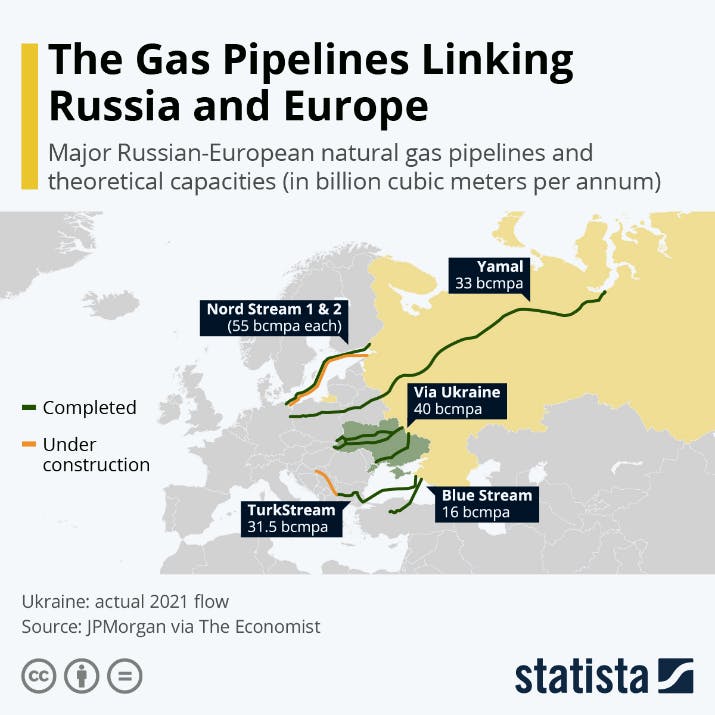
In fact, Russia is the second-largest natural gas producer worldwide after the United States and holds one-fifth of global natural gas reserves. The country also ranks first among gas exporters, primarily via pipelines. This huge advantage is used as leverage by Russia, which controls the natural gas flow taps to Europe and provides over a third of all gas used in the old continent. This fossil fuel is often regarded as a transition fuel and plays an important role in the energy mix of many European nations. According to the European Commission's Statistical Pocket Book 2021, natural gas accounts for 23% of the EU's energy mix, second to oil and petroleum products (35%). This high dependency on natural gas, and Russian specifically, could wreak havoc on European and global energy markets in case the crisis escalates. Russia may decide to shut off natural gas exports in retaliation for U.S. and European sanctions.
Russia’s influence on natural gas prices in Europe
As a sample of Russia's influence, EU Natural Gas. Dutch TTF Gas, a leading European benchmark price — rose to an all-time high of €187.79 per megawatt-hour in late 2021, as the standoff between Russia and the West began over a Russian troop buildup near Ukraine. In addition to that, a pipeline that usually sends gas from Russia to Europe was stuck in reverse for several weeks, exacerbating Europe's Energy crisis. Some European Union lawmakers accused Russia of restricting gas flows to Europe to secure approval to start up the newly built Nord Stream 2 pipeline, which will supply gas to Germany. With that in mind, any possible scenario of Russia playing the "Gas card" can affect investments with exposure to natural gas commodities and related equities.
Russia is the third-largest producer of oil worldwide
Secondly, Russia is the third-largest producer of oil worldwide, accounting for over 12% of global crude oil production (Statista, 2021). In 2021, Russia remained the largest supplier of petroleum oils to the EU (Eurostat, 2021) and became, in August 2021 — the second-highest exporter of oil to the United States (Energy Information Agency, 2021). Despite the sanctions enacted by the U.S. on Russia, imports of Russian oil hit the highest level in a decade last spring. In addition to Western powers, Russia was the second-largest supplier of crude oil to China, the world's biggest oil consumer.
Russia, as a member of the OPEC+, has a large influence on the oil markets. Brent oil futures have risen by +34% since November on tight supplies and fears of escalation at the Russian-Ukrainian border. While other OPEC+ nations increased their output to meet demands, Russia has failed to meet its quotas. According to analysts, Russia has its own reasons to want higher prices.
"Russia's foreign exchange reserves have swelled on the back of rising commodities prices, as well as key fiscal reforms such as raising the retirement age, potentially giving it more financial bandwidth to endure additional western sanctions," Helima Croft, the head of global commodity strategy at RBC Capital Markets.
Due to the importance of Russia's energy resources to global economies, any turmoil in the region could have a significant impact on related investments.
ETFs in Play: Oil & Gas
Impact on Russian Equities
Russian Equities have witnessed tremendous growth over the past year, supported by higher commodities prices on rebooting economies and logistical constraints. Russia's benchmark market index, the MOEX, reached an all-time high of 4,292 (Rubble-based) in October before slumping on rising tensions. Investors should keep in mind that further escalations may spark a local sell-off and foreign investment exodus, eventually dragging down Russian equities deeper into the red zone.
ETFs in Play: Russian Equities ETFs
Russia’s strong impact on palladium
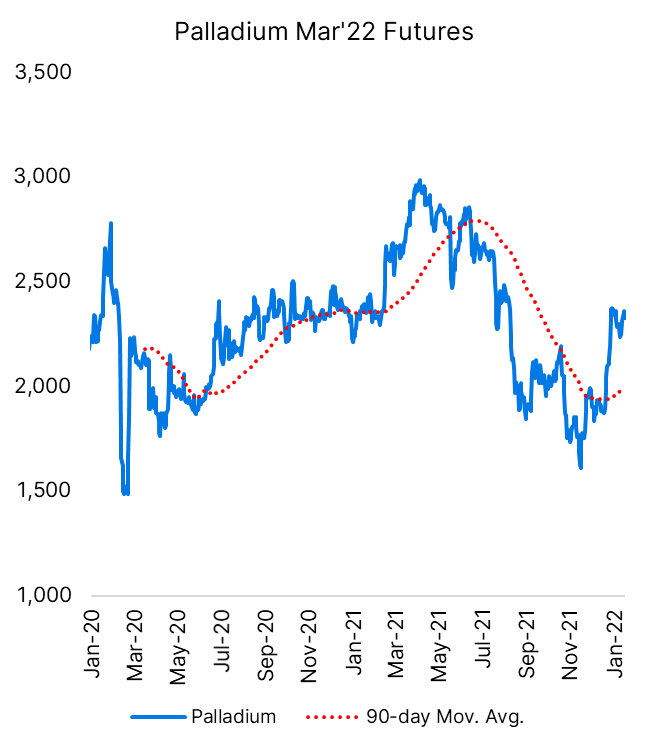
Russia is the largest producer of precious metal palladium, an important metal used in catalytic converters. About 85% of palladium ends up in catalytic converters in car exhausts, where it helps turn toxic pollutants into less-harmful carbon dioxide and water vapor. In 2021, a global chip shortage has hammered auto production, and in turn demand for palladium, which has weighed on prices. As the supply of chips starts to flow, palladium demand and price are expected to recover. However, a war could disrupt the supply of palladium and exacerbate the trade imbalance.
Advertisement
ETFs in Play: Palladium ETFs
Other metals produced by Russia
In addition to palladium, Russia is a major producer and exporter of semi-finished iron platinum, nickel ore, aluminium, copper, and gold. Any disruption of production and supply could affect related investments. Gold specifically is regarded as a safe-haven asset in uncertain times. Demand for the yellow metal could spike as investors flock to hedge against rising geopolitical risks.
ETFs in Play: Metals ETFs
The effect on agricultural goods
According to Food & Agricultural Data (FAOTSTAT), Russia and Ukraine account for nearly a third of wheat and barley exports, and about a fifth of the corn trade. Aggravated unrest in the region could add more pressure on the supply of agricultural goods, which have been already affected by last year's extreme weather events and the lingering global logistical hurdles. Moreover, in 2022, Russia has banned the export of ammonium nitrate (AN) from February 2 to April 1 as it focuses on guaranteeing enough supplies for its local farmers following the surge in global fertilizer prices. Prices for ammonium nitrate have increased between 2 to 3 times compared to last year amid a rise in gas prices and a decrease in supply. Russia represents around two-thirds of the world's annual 20 million mt ammonium nitrate production, most of which is used in fertilizers to improve yields for crops. The imposed ban could also impact the prices of agricultural commodities.
According to tradingeconomics.com, agricultural commodities prices have risen by double- and triple-digit percentage points over the past year. For instance, Oat: +111%, Coffee: +100%, Cotton: +40%, Wheat: +20%, Corn: +18%, Rice: +18%, and Soybeans: +15%.
Investors can gain access to specific or diversified exposure to certain agricultural commodities via ETFs, such as:
ETFs in Play: Wheat ETFs
- Teucrium Wheat Fund (WEAT)
- WisdomTree Wheat (WEAT)
- WisdomTree Wheat 2x Daily Leveraged (LWEA)
- WisdomTree Wheat 3x Daily Leveraged (3WHL)
ETFs in Play: Corn ETFs
- Teucrium Corn Fund (CORN)
- WisdomTree Corn (CORN)
- WisdomTree Corn 2x Daily Leveraged (LCOR)
ETFs in Play: Other agricultural commodities ETFs
- Teucrium Soybean Fund (SOYB)
- Teucrium Sugar Fund (CANE)
- Teucrium Agricultural Fund (TAGS)
- WisdomTree Grains (AIGG)
- WisdomTree Soybeans (SOYB)
- WisdomTree Soybean Oil (SOYO)
- WisdomTree Cocoa (COCO)
- WisdomTree Cotton (COTN)
- Invesco DB Agriculture Fund (P44A)
Bitcoin and the bitcoin mining industry is at stake
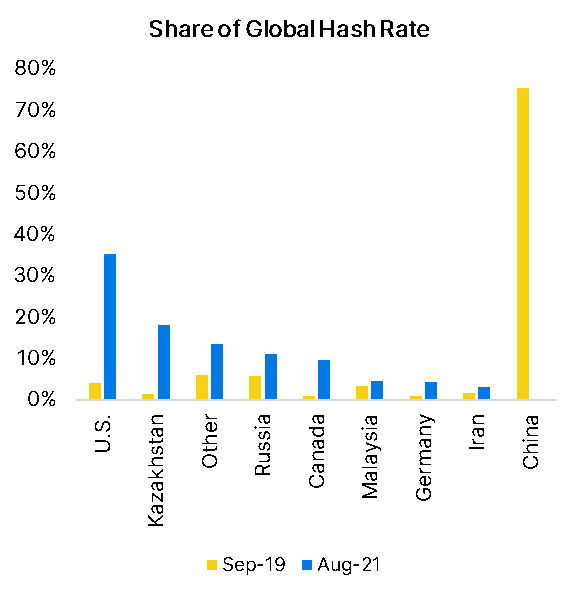
Bitcoin's global hash was historically dominated by China due to its cheap, coal-powered electricity. As of September 2019, China had owned 75% of the global share before everything went south last year. Doing it increments, the Chinese government banned all crypto mining and transactions in 2021, triggering what is called by Global X, “the great mining migration”. As of August 2021, the U.S. (35.4%), Kazakhstan (18.1%), and Russia (11.2%) snatched the lead from China, which now owns relatively close to zero shares in the global hash rates.
While there have been talks of Russia’s central bank banning the use and creation of all cryptocurrencies, President Putin and the Russian government were mostly against radical measures. Instead, they wish to promote a healthy bitcoin mining industry and improve regulations.
With recent events at the border, Russia's crypto mining infrastructure could eventually be compromised on escalated actions. This would potentially ripple across the crypto space, spiking volatility in Bitcoin and other cryptocurrencies, not to mention ETFs with exposure to such assets.
ETFs in Play: Cryptocurrency ETFs
And many more...
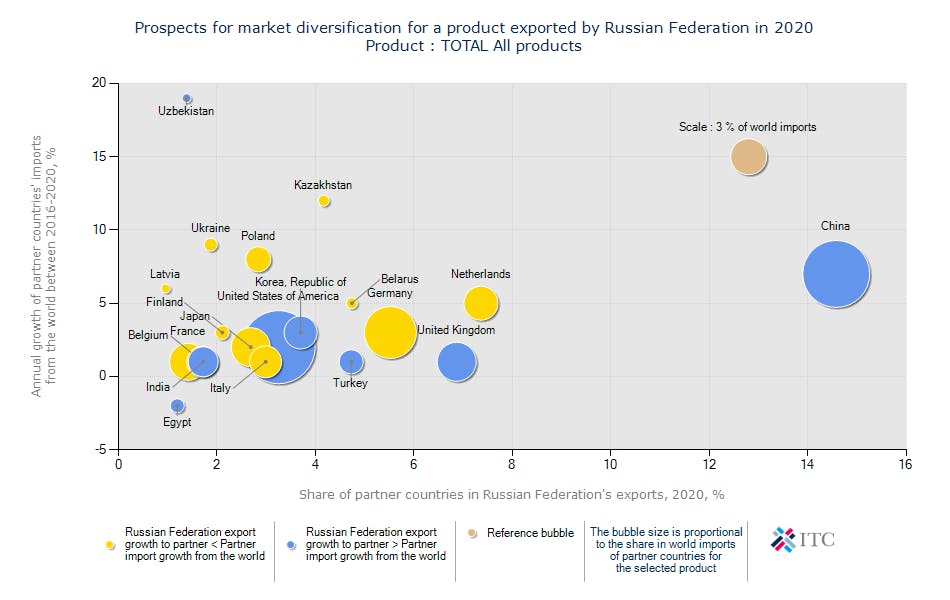
While it's hard to spot the impact levels of further escalation, investors should keep in mind that the repercussions could go beyond the above-stated segments and spill over different markets, sectors, and assets. One could start with a top-down approach by examining the flows of Russia's main traded goods and trade partners. In 2020, Russia‘s main trading partners were non-CIS countries, with the top 5 being China (15%), Netherlands (7.4%), the United Kingdom (7%), Germany (5.5%), and Belarus (4.7%).
Advertisement
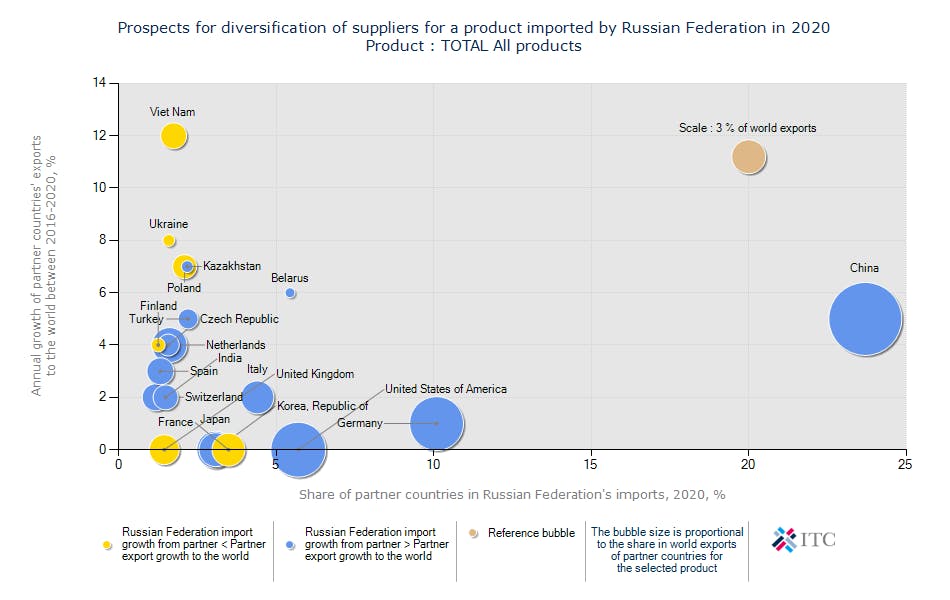
As for Russia's imports, China (24%), Germany (10.1%), the United States (6%), Belarus (5.5%), and Italy (4.5%) had the highest share in 2020.
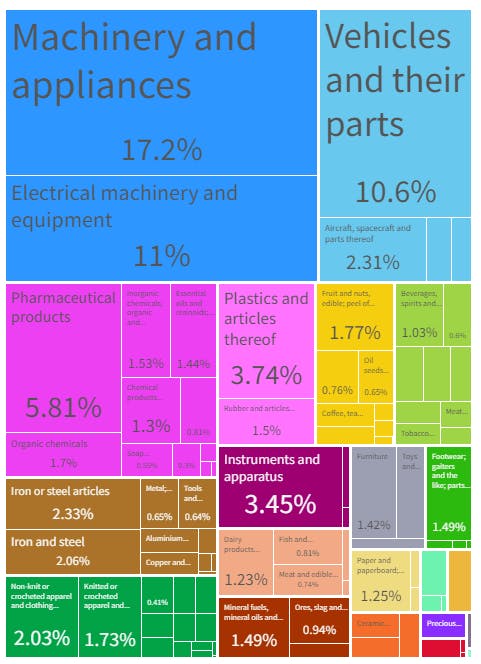
By connecting the dots, investors could end up with hundreds of bearish or bullish scenarios across all market segments. One could take a page out of historical market trends that have happened during times of geopolitical distress. And considering the messy track record we have as humans, there is plenty to look back on.
Find and compare over 8,000 ETFs with our free tools:
Interested in seeing lists of top-performing ETFs? Check out our new Investing Guides:
- Investing in Gold ETFs
- Investing in Silver ETFs
- Investing in Commodity ETFs
- Investing in Oil ETFs
- Investing in ESG ETFs
More articles


About Trackinsight
Since our founding in 2016, we have been at the forefront of the industry, delivering accessible, comprehensive, and reliable tools to support the evolving needs of investors.
Over the past decade, Trackinsight has expanded its operations across six countries, serving thousands of professional investors. We’ve consistently innovated to provide cutting-edge solutions that meet the changing demands of the ETF market.
In 2024, Kepler Cheuvreux, a leading independent European financial services firm, acquired a majority stake in Trackinsight, becoming the company's principal shareholder.
This strategic partnership solidifies Trackinsight's position as a premier provider of ETF selection and analysis tools, while strengthening Kepler Cheuvreux’s commitment to becoming a leading player in the ETF sector.
Together, we are committed to offering advanced services that empower professional investors, advisors, institutions, and issuers. This new step enables us to deliver even more comprehensive and innovative technological solutions, driving ETF investing to new heights.
More about TrackinsightETF TOOLS
PLATFORM
ETF NEWS & RESEARCH
Privacy policy | Cookie policy | | Terms of use | Imprint