Global ETF Survey 2026: Answer now →
Help us improve your experience. Please confirm your investor type:
The Ultimate ETF Comparison Tool - Try Now!
Analyze up to 5 ETFs side-by-side and gain instant insights on performance, fees, holdings, and more to make data-driven investment decisions.
Trackinsight’s 2024 Comprehensive Guide to Investing in Semiconductor ETFs
Here’s everything you need to know about the semiconductor industry in 2024. Plus, we ’ll will highlight some popular semiconductor ETF options to consider.

By Trackinsight
September 3, 2024
- Semiconductors
- Technology
Advertisement
In the digital age, semiconductors have become the lifeblood of our technology-driven world. From smartphones and laptops to cars and medical devices, these tiny chips power nearly every aspect of our daily livesthese tiny chips power everything we do. As demand for advanced technologies continues to soar, so too does the need for semiconductors.
Just as nations once competed for control of oil, today they are vying for dominance in the semiconductor industry. The race to develop and manufacture cutting-edge chips has become a key battleground in the era of artificial intelligence, where technological superiority is essential for economic growth and national security.
📊 Share your ETF outlook
From AI infrastructure to active strategies, the ETF landscape is shifting. Share your perspective in the 7th Annual Global ETF Survey and get exclusive early access to the final report.
Watch Johnny Harris mini documentary: USA vs China: The Microchip War
To understand why investing in this industry could be a smart move, let's explore the value chain and its growth prospects. We 'll will also highlight some popular ETF options to consider in your region. But first, let’s dive into the semiconductor market.
The Semiconductor Market
The World Semiconductor Trade Statistics (WSTS) and Semiconductor Industry Association (SIA) provide comprehensive data and forecasts for the global semiconductor industry. WSTS offers monthly shipment data and biannual forecasts, while SIA represents U.S. and global semiconductor companies.
Semiconductor Industry Revenue
Global semiconductor sales are projected to reach a record high of $611.2 billion in 2024, with further growth anticipated in 2025. Since 2021, the market has consistently surpassed half a trillion dollars annually, a significant increaseup from $300 billion in 2010 and $200 billion in 2000.
According to 2023 data from the World Semiconductor Trade Statistics (WSTS), Asia Pacific continues to lead the market, capturing 55% of global revenue. The Americas follow at 26%, followed by Europe (11%) and Japan (9%). Asia’s leadership is exemplified by Taiwan Semiconductor Manufacturing Company (TSMC), which produces an estimated 90% of the world's most advanced semiconductor chips. T
In 2023, smartphones and other communication devices accounted for 32% of semiconductor sales. Computers and data storage followed at 25%. The automotive industry used 17% of semiconductors, while industrial applications consumed 14%. Consumer electronics, like gaming consoles, made up 11%, and government and military applications used the remaining 1%.
2030 Semiconductor Industry Outlook
According to a McKinsey whitepaper, the semiconductor market is poised for remarkable growth, with projections indicating it could reach $1 trillion by 2030, fueled by innovations in AI, vehicle electrification, and autonomous driving.
To capitalize on this expanding demand, semiconductor companies are ramping up investments, with plansplanning to pour about $1 trillion into new fabs by 2030. These investments are heavily concentrated in Asia and the U.S., though Europe is also seeing increased funding.
Advertisement
Additionally, the industry remains one of the highest spenders on R&D, accounting for the second-highest amount globally, which drives the creation of highly skilled jobs and fosters innovation across the value chain.
As companies expand, they are increasingly prioritizing supply chain security, sustainability, and subsidies, which are becoming crucial factors in determining new locations for greenfield investments.
The Semiconductor Industry Value Chain
When discussing semiconductors today, NVIDIA, AMD, and TSMC often take center stage. However, beside alongside these well-known names is a vast ecosystem of companies working engaged in designing, sourcing, and manufacturing these intricate components.
Here’s a list of 100 publicly traded semiconductor companies
Quartr has created a visual map of the semiconductor value chain, highlighting key players at each stage. This chain is essential for producing efficient, innovative, and functional semiconductor devices. Let's explore each segment and its role in the semiconductor ecosystem.
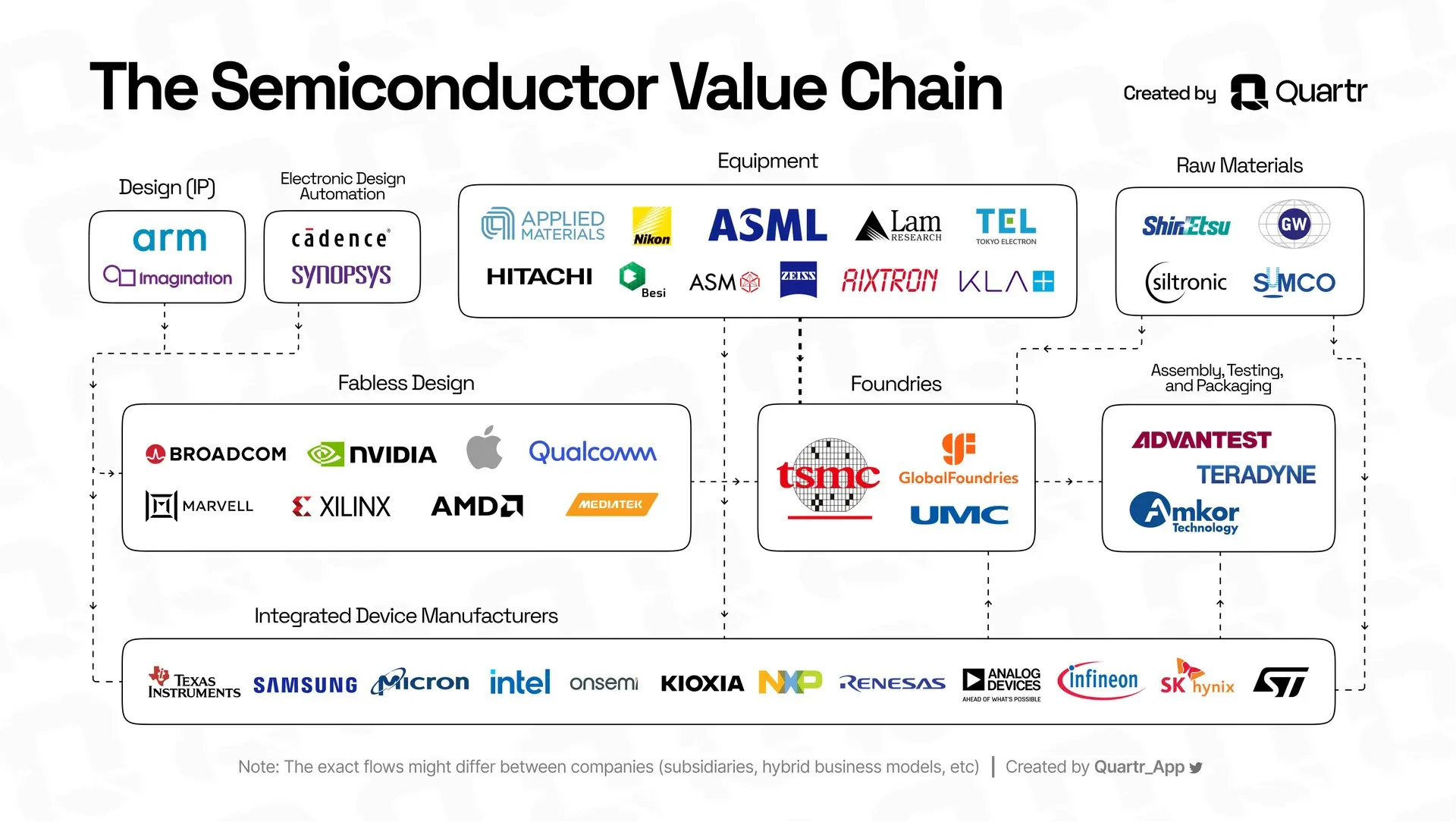
- Semiconductor Equipment Manufacturers: These companies design and produce the machinery and tools necessary for the fabrication and testing of semiconductor devices. Key players include Applied Materials, ASML, Lam Research, Tokyo Electron, and KLA.
- Electronic Design Automation (EDA) Companies: EDA companies provide software tools that enable engineers to design, simulate, and analyze electronic systems, ensuring their functionality before physical production. Major EDA companies are Cadence, Synopsys, Mentor Graphics, ANSYS, and Keysight Technologies.
- Fabless Semiconductor Companies: These companies focus on the design and innovation of semiconductor chips but outsource the manufacturing to foundries. Prominent fabless companies include NVIDIA, Qualcomm, Broadcom, AMD, and MediaTek.
- Foundry Companies: Foundries manufacture semiconductor chips based on the designs provided by fabless companies. They serve as the production factories for the semiconductor industry. Leading foundries include TSMC, Samsung Electronics, GlobalFoundries, UMC, and SMIC.
- Integrated Device Manufacturers (IDMs): IDMs manage both the design and production of chips in-house, overseeing the entire process from conception to fabrication. Key IDMs are Intel, Texas Instruments, Samsung Electronics, STMicroelectronics, and Infineon.
- Outsourced Semiconductor Assembly and Test (OSAT) Companies: OSAT firms handle the packaging and testing of semiconductor chips post-manufacturing. Leading companies in this segment include ASE Technology Holding, Amkor Technology, JCET Group, SPIL, and Tianshui Huatian Technology Co.
Investing in the Best Semiconductor ETFs
Given the vast number of semiconductor companies, investors can find it challenging to identify promising opportunities, particularly those without financial expertise or knowledge of how to begin.
That's where ETFs come in—they offer a simpler way to invest in the semiconductor industry.
Our data reveals that there are 47 ETFs specifically focused on companies within the semiconductor sector, making it easier to tap into this dynamic market. These ETFs enable investors to diversify their portfolios across the industry, potentially reducing risk through diversification.
Advertisement
If you’re new to ETFs, read our comprehensive guide: How to invest in ETFs.
If you're an ETF investor, our ETF screener can help you find semiconductor ETFs available in your region or that align with your preferences. You can also create a free account to access our advanced compare tool, which allows you to compare up to 5 semiconductor ETFs at once.
Here Are the Three Most Popular Semiconductor ETFs for U.S. Investors
(Keep scrolling to see the most popular funds for European investors)
VanEck Semiconductor ETF (SMH)
As of August 30, 2024, the VanEck Semiconductor ETF (SMH) was the largest semiconductor exchange-traded fund (ETF), boasting a substantial $23 billion in assets under management (AUM).
SMH employs a passive investment strategy, designed to track the MVIS US Listed Semiconductor 25 Index (MVSMHTR). This index offers exposure to a diverse group of companies engaged in semiconductor production and equipment manufacturing. It i's market cap weighted, meaning holdings are allocated based on the market capitalization of each company. However, it incorporates modifications to mitigate the risk of overconcentration in any single stock.
The fund's assets are primarily concentrated in the United States, with 77% allocated to U.S.-based companies. Taiwan and the Netherlands follow with 13% and 6.7%, respectively.
SMH is composed of 26 holdings, but due to its index nature, it i's heavily weighted towards its top 10 investments, which collectively represent 74% of its assets. Notable holdings include:
- Nvidia: 20%
- TSMC: 14%
- Broadcom: 8%
- Texas Instruments: 5.3%
- Advanced Micro Devices: 5.03%
- ASML Holding: 4.6%
The fund has garnered over $6 billion in fresh inflows and has delivered a remarkable return of over 40% this year. Investors who initially invested $10,000 in SMH shares at its inception in 2011 have witnessed seen their investment grow to a substantial $190,000. While thisit may not be enough for retirement, it is undoubtedly serves as a cause for celebration for those who have held onto this investment for so long.
SMH trades on the Nasdaq and has an expense ratio of 0.35%.
iShares Semiconductor ETF (SOXX)
SOXX is the second largest semiconductor ETF in the industry, boasting $15 billion in assets as of August 30th, 2024. The ETF tracks the NYSE Semiconductor Index and invests in US-listed companies that design, manufacture, and distribute semiconductors.
As of August 30th, SOXX has 30 holdings, with 60% concentration in the top 10 holdings which include:
- Broadcom: 9.9%
- Nvidia: 8.8%
- Advanced Micro Devices: 7.2%
- Applied Material: 5.9%
- Qualcomm: 5.5%
- Monolithic Power Systems: 4.7%
The fund has garnered over $2.85 billion in new inflows and delivered a solid 25% return this year. The Its underperformance relative to SMH can be explained by its lower exposure to Nvidia (9% vs 20% weight), which has delivered +1417% in returns this year.
Investors who bought $10,000 worth of shares in the fund at its inception in 2001 have seen their investment grow to a substantial $127,000.
SOXX, like SMH, trades on the Nasdaq and has a similar expense ratio of 0.35%.
SPDR S&P Semiconductor ETF (XSD)
XSD is another investor favorite, boasting $1.41 billion in AUM. This fund tracks the equally weighted S&P Semiconductor Select Industry Index, which represents the semiconductors segment of the S&P Total Market Index (S&P TMI).
The fund offers a slightly broader portfolio than SMH and SOXX, consisting of 39 holdings as of August 29, 2024. Its top 10 holdings account for 37% of its assets, making it less concentrated than its aforementioned peers.
The top names in the fund include:
- Semtech Corp.: 4.82%
- Credo Technology Group Holdings: 3.99%
- Cirrus Logic Inc.: 3.85%
- Monolithic Power Systems: 3.77%
- Impinj Inc.: 3.63%
- Texas Instruments Inc.: 3.56%
Although prominent names like Nvidia, Broadcom, and AMD are included in the fund, their weightings are relatively lower due to the index's design.
On recentRegarding recent investor interest, XSD has experienced net outflows of $168 million this year. Its underperformance, with a 10% year-to-date returns year-to-date, and lower exposure to high-flying semiconductor stocks like Nvidia, may have led investors to withdraw funds or shift their allocations, potentially to SMH and SOXX.
For investors seeking to mitigate concentration risk, XSD may be a more attractive option. Listed on the NYSE ARCA, XSD also offers a competitive expense ratio of 0.35%."
Finally, to better understand the differences between these fundsinvestment vehicles, here's a detailed comparison of the three mentioned funds using our compare tool:
Side-by-side comparison between SOXX, SMH and XSD.
Here are the Two Most Popular Semiconductor ETFs for European Investors
If you're based in Europe, you’re not left behind. There are several semiconductor ETFs available to consider for your portfolio. Here i's an overview of two of the most popular ETFs.
VanEck Semiconductor UCITS ETF (SMGB)
VanEck's SMH ETF has a European counterpart, the SMGB ETF. As the first semiconductor ETF in Europe, SMGB has gathered $2.6 billion in total assets. Unlike its U.S. counterpart, SMGB tracks the MVIS US Listed Semiconductor 10% Capped ESG Index.
This index excludes companies that severely violate UN Global Compact Principles or derive revenue from Controversial Weapons, according to ISS data. Additionally, it excludes companies that generate more than 5% of their revenue from sectors such as Thermal Coal, Fossil Fuels, Oil Sands, Nuclear Power, Civilian Firearms, Military Equipment, and Tobacco.
As of the end of July 2024, the top names in the fund includeThe top names in the fund as of end of July 2024 include:
- Broadcom: 11.5%
- TSMC: 10.26%
- Nvidia: 10%
- ASML: 9.4%
- Advanced Micro Devices: 7.5%
- Qualcomm: 6.4%
The fund trades on multiple European exchanges and has an expense ratio of 0.35%. For more information on the fund's performance, volatility, holdings, and other characteristics, please visit its dedicated page on our site.
iShares MSCI Global Semiconductors UCITS ETF (SEMI)
iShares also provides an option for European investors with the SEMI ETF. This fund tracks the MSCI ACWI IMI Semiconductors & Semiconductor Equipment Select ESG Screened Capped Index. It tracks is comprised of large, mid, and small-cap companies in developed (e.g. United States, Netherlands, Germany, Japan) and emerging markets (e.g. Taiwan, South Korea) focusing on semiconductors and semiconductor equipment. It only includes shares available to international investors, with caps on the weight of top entities. Companies involved in controversial industries or with poor ESG ratings are excluded.
As of end of August 2024, the fund’s top names include:
- Broadcom: 7.5%
- ASML: 7.5%
- TSMC: 7.4%
- Nvidia: 7.2%
- Advanced Micro Devices: 7%
- Texas Instruments: 4.9%
SEMI also trades on multiple exchange and has an expense ratio of 0.35%. You can learn more about the fund by visiting its dedicated page on our site.
To explore more semiconductor ETFs available in Europe, apply the region filter and type "semiconductor" in the search box as seen in the image below.
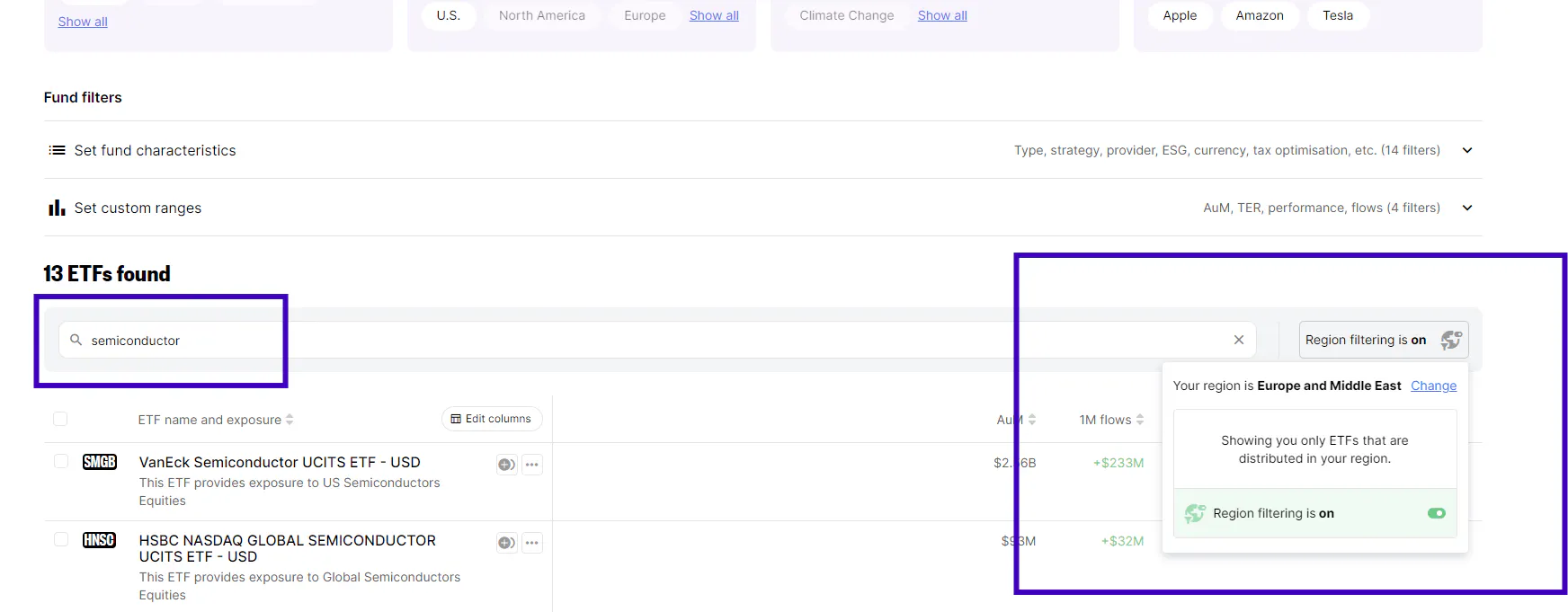
With over a dozen options available, use the compare tool to find the best match for your portfolio. Here's a quick comparison between VanEck's SMGB and iShares’s SEMI.
Bonus Tip: Finding Semiconductor ETFs with the Highest or Lowest Nvidia Stock Exposure
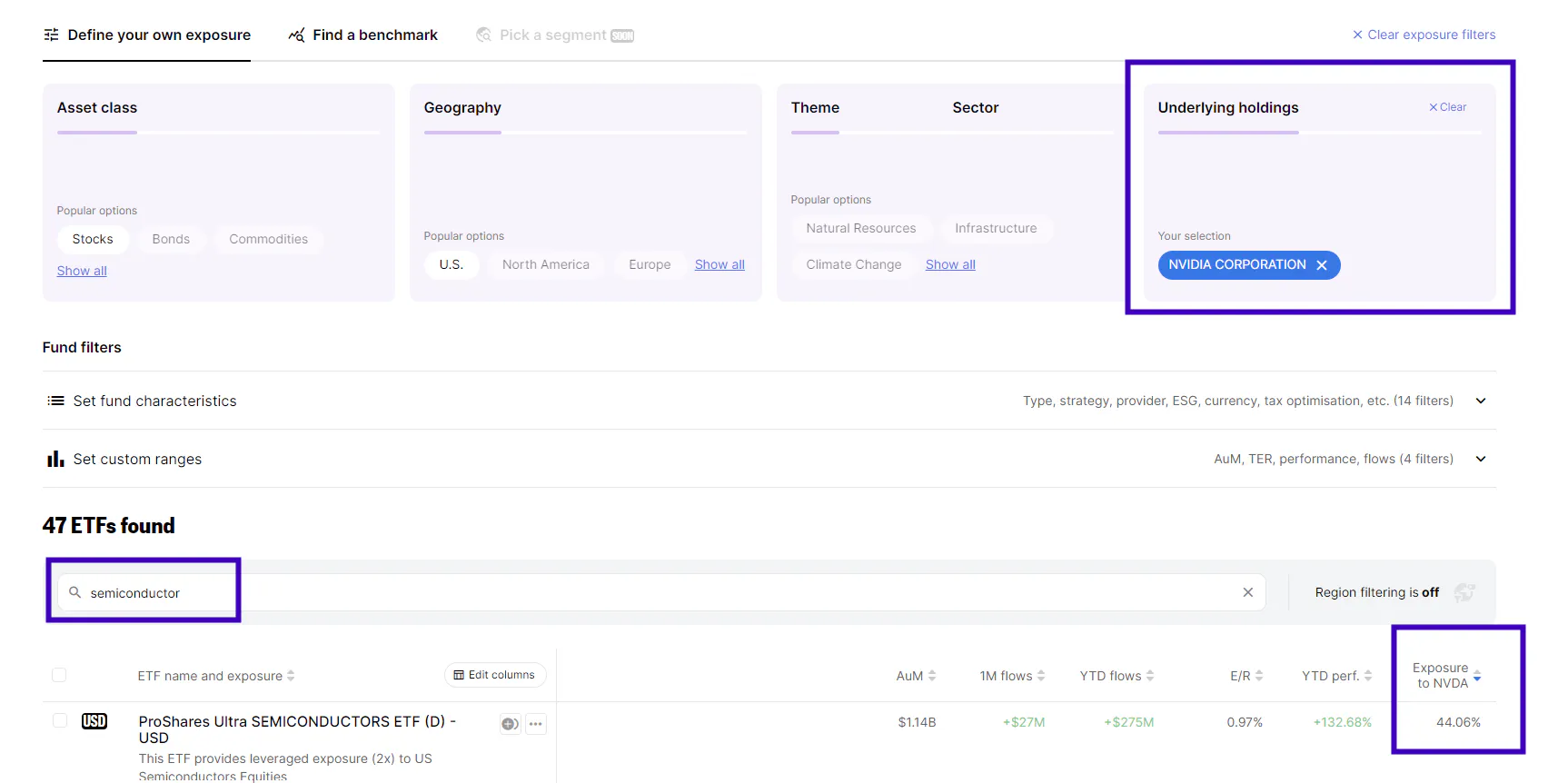
Investors looking for semiconductor ETFs with varying levels of exposure to Nvidia or other specific stocks can easily use our screener with its holdings filter. For instance, by entering 'NVDA' in the underlying holdings section, you can immediately view Nvidia's exposure in the table below, sorted by highest or lowest as needed.
Here's a link to a pre-filtered screen that shows semiconductor ETFs with their exposure to NVDA.
Please note this article is for information purposes only and does not in any way constitute investment advice. It is essential that you seek advice from a registered financial professional prior to making any investment decision.
More articles


About Trackinsight
Since our founding in 2016, we have been at the forefront of the industry, delivering accessible, comprehensive, and reliable tools to support the evolving needs of investors.
Over the past decade, Trackinsight has expanded its operations across six countries, serving thousands of professional investors. We’ve consistently innovated to provide cutting-edge solutions that meet the changing demands of the ETF market.
In 2024, Kepler Cheuvreux, a leading independent European financial services firm, acquired a majority stake in Trackinsight, becoming the company's principal shareholder.
This strategic partnership solidifies Trackinsight's position as a premier provider of ETF selection and analysis tools, while strengthening Kepler Cheuvreux’s commitment to becoming a leading player in the ETF sector.
Together, we are committed to offering advanced services that empower professional investors, advisors, institutions, and issuers. This new step enables us to deliver even more comprehensive and innovative technological solutions, driving ETF investing to new heights.
More about TrackinsightETF TOOLS
PLATFORM
ETF NEWS & RESEARCH
Privacy policy | Cookie policy | | Terms of use | Imprint