Global ETF Survey 2026: Answer now →
Help us improve your experience. Please confirm your investor type:
The ETF Industry Is Evolving Fast
From AI infrastructure to active strategies, the ETF landscape is shifting. Share your perspective in the 7th Annual Global ETF Survey.
ChatGPT ignites the AI industry: Discover how to invest in AI
You can’t stop what’s coming, but you can invest in it.


By Ben Taylor
February 1, 2023
- AI
Advertisement
ChatGPT launched on November 30th and garnered 1 million users in just five days. This level of adoption took about two years for Facebook and Instagram.
Many believe that this program marks the arrival of AI into mainstream work. While that is true, it is important to remember that the AI available today is called applied AI which means that the program can complete specific, narrow tasks rather than any problem we throw at it.
📊 Share your ETF outlook
From AI infrastructure to active strategies, the ETF landscape is shifting. Share your perspective in the 7th Annual Global ETF Survey and get exclusive early access to the final report.
For investors, this could mark an early opportunity to participate in a growing trend. Consider that Microsoft recently committed $10 billion to ChatGPT. This level of investment suggests that AI, in some form, will weave itself into the fabric of most industries. In fact, in many ways, it already has. Areas like marketing, supply chain management, product innovation, and customer experience are all beginning to leverage the power of AI. It seems likely that in the coming years, AI will be a major component to the engine of growth in the US and internationally.
Here we look at ways investors can capitalize on the growth of the technology. But first, let’s look at why AI is poised to become an economic powerhouse.
Why Invest in AI?
Versatility
The global AI adoption rate, as measured by IBM, has reached 35% meaning that 35% of the 7,502 businesses surveyed reported using AI in their businesses. Moreover, the same research determined that 44% of surveyed businesses are currently working to embed AI into their applications and processes.
This number is high, and growing, not only because AI is a powerful tool, but also because it is a versatile one. AI can be used for:
- Automation of IT processes
- Security and threat detection
- Marketing & sales
- Business analytics
- Fraud detection
- Sensor data analysis
- Financial planning & analysis
Specifically, AI has direct applicability to:
Healthcare
AI will be able to detect life-threatening diseases earlier and with greater accuracy than humans. It will also be able to accelerate drug discovery and clinical trials, which drives down costs and the time it takes to bring new drugs to the market.
Finance & Insurance
AI can assist in the evaluation of loan risk in corporate finance while also providing improved monitoring of anomalous, potentially fraudulent activity. AI can also better analyze the activity across an increasing range of connected devices allowing insurance carriers to use more data to write policies that are more individualized.
Manufacturing
AI can optimize manufacturing production and maintenance by identifying unusual patterns that enable manufacturers to perform predictive maintenance well before failure occurs.
Advertisement
Productivity
The worker shortage is real. Research from Korn Ferry found that “by 2030, there will be a global human talent shortage of more than 85 million people, or roughly equivalent to the population of Germany. Left unchecked, in 2030 that talent shortage could result in about $8.5 trillion in unrealized annual revenues.”
AI is beginning to fill the gap left by worker shortages. Data from IBM shows that 30% of global IT professionals state that their organization is using some kind of AI and automation software. AI can also boost productivity by creating jobs that make better use of what is available in the workforce. Research from the World Economic Forum suggests that “by 2025, technologies, such as Artificial Intelligence and automation, will create at least 12 million more jobs than they eliminate.” This possibility is important in the context of a global population decline. Consider that 2019 marked the first year in human history in which the planet had more people aged sixty-five and older than five and under. The generations that will emerge into the workforce are smaller than those exiting. AI will be needed to serve as a force multiplier.
Growth
AI will likely generate economic growth as the technology creates job opportunities as seen in job posting data from Stanford. Since 2016 the US, Canada, the UK, Singapore, Australia, and New Zealand have all seen an increase in AI job postings as a percentage of all job postings.
Additionally, global corporate investment has also been on the rise every year as activities such as M&A, private investment, public offering, and minority stake drive more AI adoption.
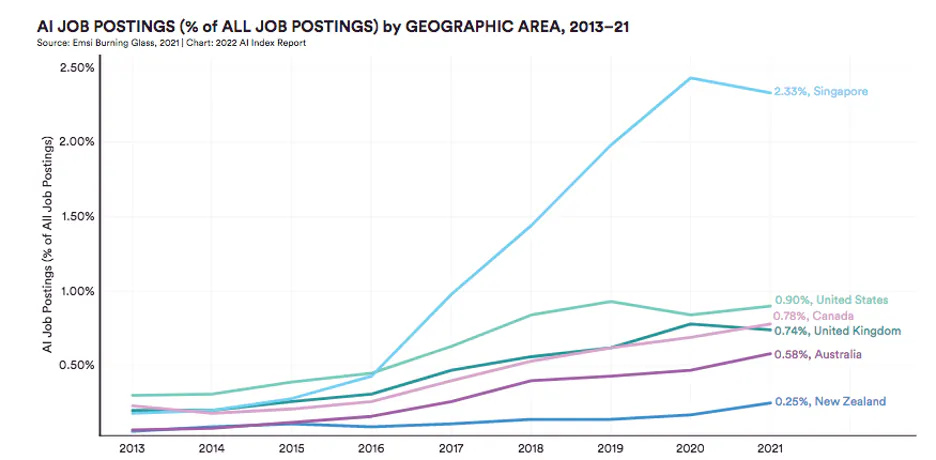
Source: Stanford
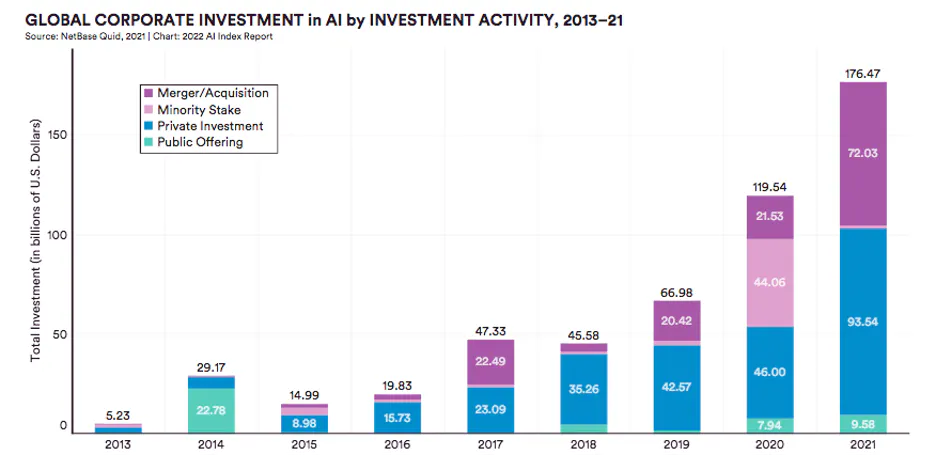
Source: Stanford
How to Invest in AI?
Investors have several good ways to gain early exposure to AI as it becomes a dominant force across industries.
Advertisement
L&G Artificial Intelligence UCITS ETF (AIAI)
The L&G Artificial Intelligence UCITS ETF is benchmarked to the ROBO Global® Artificial Intelligence Index. Some of the major holdings in the ETF include companies like Alteryx which brings advanced analytics to business decisions, database program company MongoDB, and Rapid7, a cyber security and network security software company.
WisdomTree Artificial Intelligence UCITS ETF (BATS:WTAI)
The WisdomTree Artificial Intelligence ETF is benchmarked to the NASDAQ CTA Artificial Intelligence Index. Some of the largest holdings include PROS Holdings Inc which is a SaaS AI company that generates shopping and selling interaction data for business decision-making. Workday, Inc. which offers cloud computing services, is the second largest holding followed by Ciena an optical connectivity company that transports and manages voice and data traffic on communication networks.
iShares Automation & Robotics UCITS ETF (XLON:RBOT)
The iShares Automation & Robotics ETF offers exposure to some of the technologies that are complementary to AI. Some of the larger holdings include Lattice Semiconductor Corp, which serves communication, automotive, and consumer markets, Intuitive Surgical Inc, a robotic surgery company, and Coupa, a supply chain management and financial management software company.
The views and opinions expressed herein are the views and opinions of the author and do not necessarily reflect those of Trackinsight. Past performance is not indicative of future results. Investors should undertake their own due diligence and carefully evaluate companies before investing. ADVICE FROM A FINANCE PROFESSIONAL IS STRONGLY ADVISED.
More articles


About Trackinsight
Since our founding in 2016, we have been at the forefront of the industry, delivering accessible, comprehensive, and reliable tools to support the evolving needs of investors.
Over the past decade, Trackinsight has expanded its operations across six countries, serving thousands of professional investors. We’ve consistently innovated to provide cutting-edge solutions that meet the changing demands of the ETF market.
In 2024, Kepler Cheuvreux, a leading independent European financial services firm, acquired a majority stake in Trackinsight, becoming the company's principal shareholder.
This strategic partnership solidifies Trackinsight's position as a premier provider of ETF selection and analysis tools, while strengthening Kepler Cheuvreux’s commitment to becoming a leading player in the ETF sector.
Together, we are committed to offering advanced services that empower professional investors, advisors, institutions, and issuers. This new step enables us to deliver even more comprehensive and innovative technological solutions, driving ETF investing to new heights.
More about TrackinsightETF TOOLS
PLATFORM
ETF NEWS & RESEARCH
Privacy policy | Cookie policy | | Terms of use | Imprint