Get your free ETF data sample from our comprehensive offerings. Start your free trial→
Help us improve your experience. Please confirm your investor type:
Don’t Miss a Move in the ETF Market
Sign up and keep track of everything that moved the ETF industry this week. From new launches to regulatory shifts across the Atlantic.

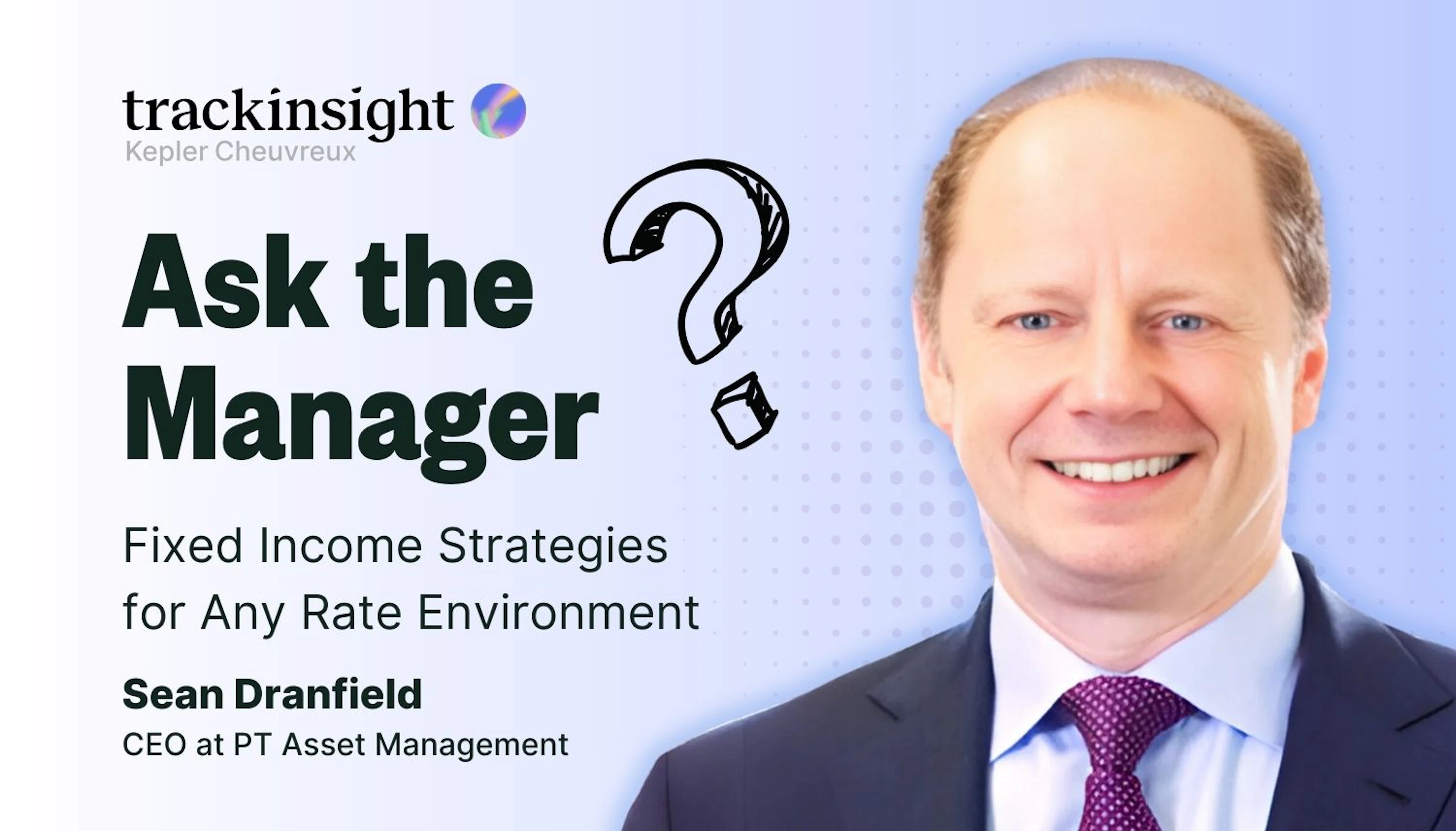
Ask the Manager: Sean Dranfield on Fixed Income Strategies for Any Rate Environment
PTAM's CEO Sean Dranfield shares his take on bond markets, rate predictions, and building resilient, math-driven portfolios for any rate environment.

By Trackinsight
January 27, 2025
- Thought Leadership
Advertisement
In this edition of "Ask the Manager," Sean Dranfield, CEO of PT Asset Management, shares his take on tackling unpredictable bond markets, avoiding rate-forecasting traps, and building resilient, math-driven portfolios for any rate environment.
Here are his insights...
ETF Data Built for Precision
Trackinsight delivers reliable and comprehensive coverage on 14,000+ ETFs
We are supposed to be seeing central bank’s bringing down short-term rates, but 10 year rates on many government bonds are still high – what’s going on?
This shows the trickiness of trying to predict rates. There is overwhelming evidence that no one can predict what either the Fed will do to short term rates or what the 10 year US Treasury rate will be, or even what will happen macroeconomically, with any degree of consistency.
Even if you had a crystal ball and you could predict what the fed was going to do, that means nothing about the rest of the yield curve.
So, even if you can predict one aspect, there are too may interlocking factors. Remember, the Fed raised rates 6 times in 2023 and the 10-year started year on 3.88% and ended the year at exactly same. So, despite rate rises, interest rates were unchanged at 10-year part of the curve.
What do you anticipate, if anything, for fixed income under a Trump administration?
Most pundits are anticipating that Trump’s policies may be inflationary. As a result, people are predicting that interest rates may go up at some point. That may be the case, but as discussed, predictions are fools’ errand.
If anything, Trump has consistently demonstrated that, if nothing else, he is unpredictable. If you can’t predict accurately what J Powell is going to do, you’ve got no hope of predicting what Trump will do.
Your philosophy is to not to anticipate or predict rate changes – why?
Over the last 20 years, Wall Street economists not only couldn’t predict what interest rates would be on a one year forward horizon, they were directionally wrong most of the time.
Even central bankers are not good at forecasting inflation. Powell, like all other global central bankers predicted inflation was transitory coming out of Covid. We now know with the benefit of hindsight that was a poor prediction. He and all other central bankers were wrong.
Central banks had to play catch up and forcefully reacted by aggressively increasing rates. They can’t predict, economists can’t predict, bond managers and traders can’t predict with any consistency.
Advertisement
Instead of predicting, we look to create an interest rate agnostic portfolio. That combines bonds that might help in an interest rate down world with bonds that would help if rates go up. This frees us from any need to do any interest rate predictions.
How do you think about bonds when investing? What is your process for identifying opportunities?
As discussed above, we do not rely on rate predictions or forecasts.
At the same time, we don’t believe that yield and duration are accurate proxies for total return or interest rate risk. Yet institutional sellers and buyers defer to these shorthand metrics when selecting bonds and building a portfolio.
Yield, for example, is not actually the return you’d get on bond. First, it presupposes you hold the bond to the maturity date, which may not be the case. Second, it presupposes the coupon income is reinvested at the yield at which you bought the bond, which is not the case as rates go and up and down.
In Performance Trust Total Return Bond UCITS ETF (PTAM), we use a process that was developed to overcome these flaws by doing the granular bond math on the real-world drivers of bond prices.
Every bond has different structural drivers of price, depending on its sector. For example, even a simple bond’s price, like a treasury or a gilt, could be impacted by yield curve roll, which neither duration or yield measure.
The beauty of bonds is that, unlike equities, the future price is all about math. In any rate environment, price is 100% knowable if you understand a bond’s price drivers. That’s what we do. We called our proprietary process shape management.
It was developed over 30 years ago and it does the go-forward bond math on every bond we own, and then we combine “shapes” to create a rate agnostic portfolio, embracing the idea that rates are unpredictable.
Advertisement
Which areas of fixed income look interesting to you right now?
We can break this up to offense and defense. By offence, I mean bonds to help if rates go down. But defense, I mean bonds that help if rates go up.
On the offence side, there are two sectors that are attractive right now. First, the 20-year part of the treasury market, which offers a lot of yield curve role. Second, 15-20 taxable municipal bonds, where spreads are nowhere near as tight as the corporate market.
Defensively, we still like AA and AAA interest only commercial mortgage-backed securities as well as short high-quality bonds in the corporate CLO and treasury sectors.
This is all driven by underlying bond math rather than any sector or macro-outlook.
What is your outlook on CLOs?
It is very interesting to us that CLO products seem to be very popular right now. We think that most of the CLO market is unattractive currently due to the pricing, negative convexity and spreads in the CLO market.
Convexity is a bond nerdy term but most people don’t realise that the vast majority of CLOs have embedded call features and the market is priced around par currently. These are horrible bonds.
Essentially, negative convexity means that these bonds will price like a short bond in a rates down environment and a long bond in a rates up environment. An investor would clearly want the exact opposite.
Does the working from home trend threaten commercial mortgage-backed securities?
My sense this is a question about the impact of working-from-home on the office sector. The office market has bifurcated after covid. So, older buildings that have not been refurbished and are on expiring financing are experiencing occupancy problems and may have refinancing risk. In contrast, newer buildings in attractive locations in major metro markets are experiencing occupancy levels higher than pre-covid, with no financing pressure. We as a firm, avoid credit risk because we want our differentiated mathematical approach to drive returns. So, we have no exposure to older offices in major metro markets like Chicago, LA, NYC for example.
As an illustration, using our own firm’s office space, we just reupped on a lease in Chicago. Our building was built in around 2016 and is attached to one of the two major train stations in Chicago. I had to sign an 11-year lease and the building occupancy is 100% - there is even a line of potential tenants to get in. But I could walk one block from my office and there are several buildings built in the 1960s that have 50-60% occupancy rates and are a ghost town.
Bonds containing these newer buildings are actually very attractive on a go-forward basis. Additionally, the commercial mortgage backed securities (CMBS) we own are only at the top of the capital structure, have low loan-to-value ratios, typically contain 50-70 underlying mortgages per bond and lastly have around 10% exposure to the metro office sector.
How hard/easy is going to be your job in 2025 vs 2024?
So, interest rates have increased over the last 18months. From the first of June 2023 to the end of 2024, rates went up 1%. Many would consider this a bad environment for bonds. But our total return over that period was 4.91%.
Rates are now higher than they were in June of 2023. So, if rates went 1% up over next 18months, which would be considered a bearish market for bonds, I would consider it a better environment because our starting yield is higher than it was in June of 2023.
As long as we stick to knitting, and we focus on the granular drivers of bond price in multiple rate environments, we believe we can deliver a solid single digit return for our clients, without reaching for either interest rate risk or credit risk.
About Sean Dranfield
Sean is responsible for the leadership of PTAM and its’ growing global mutual fund, active ETF and institutional businesses. As part of this role, he works closely with the portfolio managers on investment strategy and meets with global clients regularly to discuss the investment process and portfolio construction.
Prior to joining PTAM, Sean held a similar role at Henderson Global Funds for over 16 years. Initially he worked in London, and was responsible for the management of Henderson Global Investors’ international business.
He then relocated to Chicago to lead the growth of the U.S fund business from inception, to what is today one of the largest global fund families in the U.S. Before joining Henderson, Sean specialized in business strategy at Booz Allen. He has over 30 years of experience in the asset management industry.
Please note this article is for information purposes only and does not in any way constitute investment advice. It is essential that you seek advice from a registered financial professional prior to making any investment decision.
More articles


About Trackinsight
Since our founding in 2016, we have been at the forefront of the industry, delivering accessible, comprehensive, and reliable tools to support the evolving needs of investors.
Over the past decade, Trackinsight has expanded its operations across six countries, serving thousands of professional investors. We’ve consistently innovated to provide cutting-edge solutions that meet the changing demands of the ETF market.
In 2024, Kepler Cheuvreux, a leading independent European financial services firm, acquired a majority stake in Trackinsight, becoming the company's principal shareholder.
This strategic partnership solidifies Trackinsight's position as a premier provider of ETF selection and analysis tools, while strengthening Kepler Cheuvreux’s commitment to becoming a leading player in the ETF sector.
Together, we are committed to offering advanced services that empower professional investors, advisors, institutions, and issuers. This new step enables us to deliver even more comprehensive and innovative technological solutions, driving ETF investing to new heights.
More about TrackinsightETF TOOLS
PLATFORM
ETF NEWS & RESEARCH
Privacy policy | Cookie policy | | Terms of use | Imprint