Global ETF Survey 2026: Answer now →
Help us improve your experience. Please confirm your investor type:
Don’t Miss a Move in the ETF Market
Sign up and keep track of everything that moved the ETF industry this week. From new launches to regulatory shifts across the Atlantic.

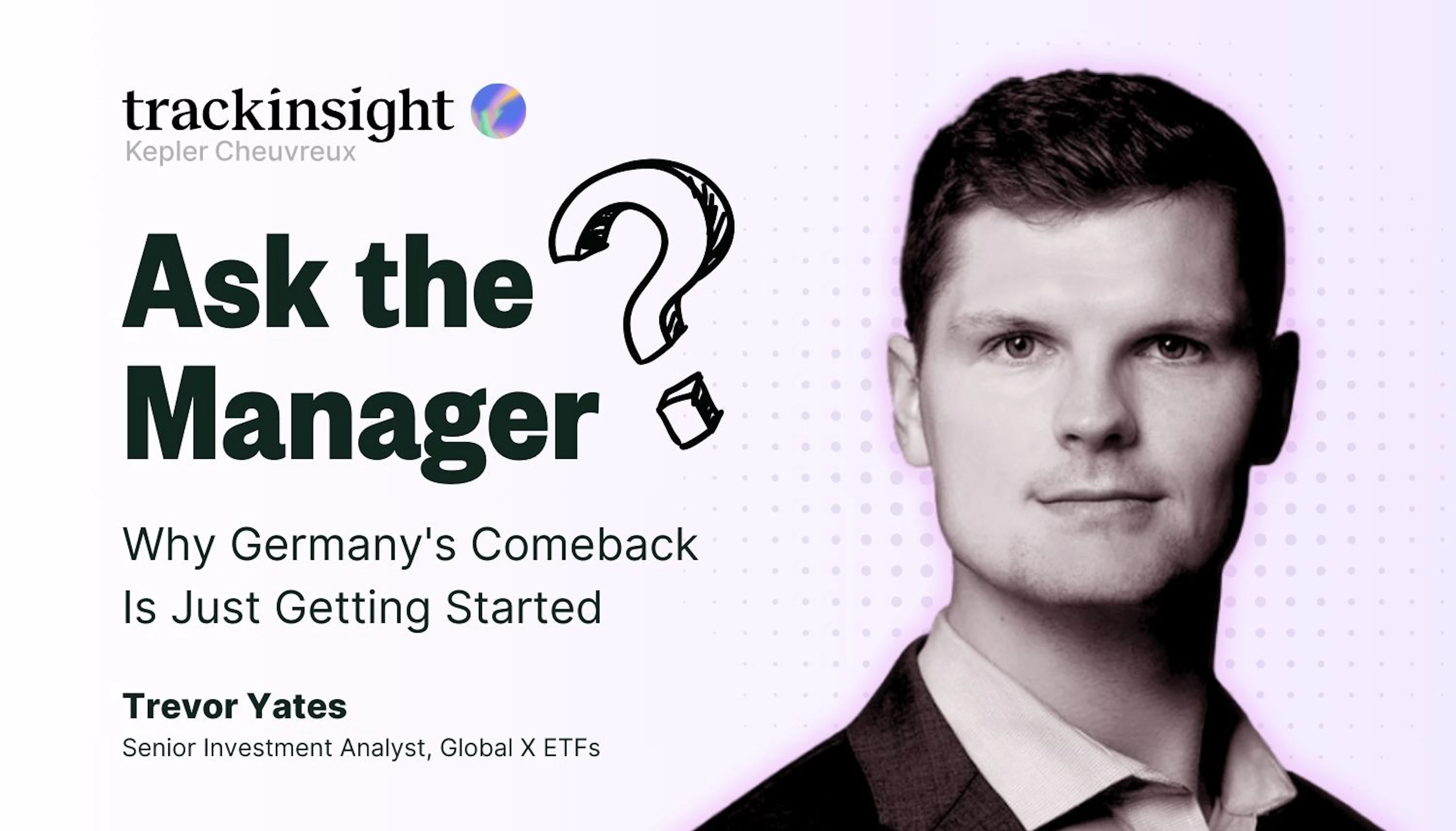
Ask the Manager: Why Germany's Comeback Is Just Getting Started
Germany’s economic playbook is being rewritten—here’s why Trevor Yates thinks it’s time for investors to pay attention.

By Trackinsight
April 10, 2025
- Germany
Advertisement
Trevor Yates, Senior Investment Analyst at Global X ETFs, joins our Ask the Manager series to unpack why Germany is back in the spotlight.
With a historic political shift, a bold fiscal stimulus package, and markets on the verge of a potential breakout, Trevor explains why now might be the perfect time to revisit German equities.
📊 Share your ETF outlook
From AI infrastructure to active strategies, the ETF landscape is shifting. Share your perspective in the 7th Annual Global ETF Survey and get exclusive early access to the final report.
From hidden sector strength to the drivers behind the DAX ETF’s outperformance, he shares where he sees momentum building—and what could push it even further.
What recent political and economic shifts has Germany experienced that make you bullish on the country’s economic outlook?
We view the recent election as a monumental shift for Germany’s outlook, while the new fiscal package is set to pull the economy out of recession.
Following his party’s election victory, Frederich Merz moved quickly to pass the fiscal package, securing government funding to drive more sustainable growth.
This is significant given the historic austerity mindset in Germany, with the country underinvesting over recent years.
The change in government could also allow them to make necessary reforms, in areas such as energy, in order to regain the country’s manufacturing sector competitiveness.
What makes now the right time to invest in Germany?
We view now as a compelling time to invest in German equities, with the market primed to see a “hockey stick” in earnings growth while multiples remain at attractive levels.
We expect this inflection, catalyzed by the recent fiscal package, to be very sharp given the recent domestic economic weakness, as Germany has been in recession for two years.
Positioning in German equities has also been very low, so flows could provide further support to the market and help drive a multiple rerating. As a result, our bullish view is underpinned by both higher earnings and multiple expansion.
Advertisement
Global X’s DAX Germany ETF (DAX) has demonstrated resilience. What factors make this ETF stand out from other investment opportunities focused on Germany?
Although Germany is known as the industrial hub of Europe, the country’s equity market is nothing but, with it offering significant exposure to many sectors beyond industrials such as financials, technology, and consumer discretionary.
This diversification can help explain the market’s resilience despite Germany’s economy being in a recession for more than two years, with DAX returning over 13% since the beginning of 2025, outperforming US equities by nearly 20% during that time period.
Although maintaining significant domestic exposure, DAX’s diversification has allowed the product to benefit from more global investment theses, such as artificial intelligence.
What investments make up the Global X DAX fund? How is it structured?
DAX is a passive product providing investors diversified exposure to the German economy. The fund aims to track the DAX Total Return Index, holding the largest forty names traded on the Frankfurt Stock Exchange across ten sectors.
The fund offers exposure to large multinational companies, such as SAP, a global software company, Siemens, a comprehensive and global engineering and manufacturing company, and Allianz, a global financial services firm. Dax also offers a very competitive 0.2% management fee.
What sectors do you think will spur the most growth for Germany?
Although Germany’s defense, manufacturing, and industrial sectors are set to be the direct beneficiaries from the proposed fiscal package, we see the spending trickling through the entire economy.
Financial firms should see a benefit, with the improving growth outlook not only driving credit growth for banks, but also steepening the yield curve and pushing profitability higher.
We also see this strong top-down momentum driving wage growth and improving domestic consumption. As a result, the fiscal package only further bolsters our view that investors should look for more broad-based exposure to German equities.
Advertisement
How do you think Germany’s economic stability compares to other major global economies
Germany is a well-established developed market and the largest economy within the European union. Germany has a strong track record of stability, helping reduce significant risks for investors.
This track record should provide investors with a level of comfort when compared to higher risk markets, with us seeing limited currency, governance, and political risk in Germany when compared to other global economies.
Do you think that Germany’s growth is sustainable?
We see the recently announced spending package driving more sustainable growth ahead. On the defense side of the fiscal package, Germany is set to spend a significant amount of capital on a recurring basis, ensuring the country will not only develop this industry domestically but also provide businesses with certainty and predictability required to ensure private sector investment.
On the infrastructure side, this will bring significant investment through the end of the decade but will also help improve inefficiencies within the economy, unlocking additional growth throughout the economy.
This is crucial given the fact that Germany has underinvested in itself over recent decades. As a result, these investments should translate into more sustainable growth, creating a virtuous cycle of investment for the domestic economy, and help reduce the country’s reliance to the global economic cycle.
What internal and external factors are you monitoring that could catalyze further tailwinds for Germany?
We believe the potential continued reallocation of flows from the United States to Europe presents a powerful tailwind for German equities moving forward. Since the beginning of 2020 nearly ten-billion dollars’ worth of foreign capital has been invested in US equities, bringing the net international investment position to over seven billion dollars.
Although warranted given the more than a decade of US growth outperformance, we believe the German fiscal package coupled with austerity measures in the United States could improve growth differentials and drive capital back to Germany, especially given the light positioning to begin with.
As a result, we see room for German equities to continue to outperform from an earnings growth perspective, with significant flows helping support further multiple expansion.
What are the risks associated with investment in Germany?
We see the main risks for the German investment thesis being on the execution side and on trade. Although some details have been released, the exact specifics of the spending package have yet to be determined. As a result, we see a risk that the exact timing and focus of the infrastructure spending could differ from market expectations.
However, this funding has been passed by parliament and will eventually be allocated, with this uncertainty further emphasizing our view that investors should consider taking a broader based approach to investing in Germany.
The situation on trade between the EU and the US remains fluid following the recent tariff announcements. However, we do see significant room for negotiation moving forward, with Germany being a beneficiary of any resolution on trade given its large export sector.
This uncertainty, along with positioning following the strong rally, could also be a potential risk, but our positive view on earnings growth and the potential for continued flows lead us to believe any potential pullback represents a compelling entry point for longer-term investors.
About Trevor Yates
Trevor Yates joined Global X in 2023 as an Investment Analyst on the Emerging Markets team. Trevor spent the previous two years working at Mirae Asset with the same team. Before breaking into finance, Trevor was a professional hockey player in the AHL and ECHL. He graduated from Cornell with a degree in Applied Economics and Management in 2018. Trevor was born in Germany and raised in Montreal, Canada.
Please note this article is for information purposes only and does not in any way constitute investment advice. It is essential that you seek advice from a registered financial professional prior to making any investment decision.
More articles


About Trackinsight
Since our founding in 2016, we have been at the forefront of the industry, delivering accessible, comprehensive, and reliable tools to support the evolving needs of investors.
Over the past decade, Trackinsight has expanded its operations across six countries, serving thousands of professional investors. We’ve consistently innovated to provide cutting-edge solutions that meet the changing demands of the ETF market.
In 2024, Kepler Cheuvreux, a leading independent European financial services firm, acquired a majority stake in Trackinsight, becoming the company's principal shareholder.
This strategic partnership solidifies Trackinsight's position as a premier provider of ETF selection and analysis tools, while strengthening Kepler Cheuvreux’s commitment to becoming a leading player in the ETF sector.
Together, we are committed to offering advanced services that empower professional investors, advisors, institutions, and issuers. This new step enables us to deliver even more comprehensive and innovative technological solutions, driving ETF investing to new heights.
More about TrackinsightETF TOOLS
PLATFORM
ETF NEWS & RESEARCH
Privacy policy | Cookie policy | | Terms of use | Imprint