Global ETF Survey 2026: Answer now →
Help us improve your experience. Please confirm your investor type:
The ETF Industry Is Evolving Fast
From AI infrastructure to active strategies, the ETF landscape is shifting. Share your perspective in the 7th Annual Global ETF Survey.
Crypto ETFs: 2021 Recap
Cryptocurrencies and Crypto ETFs took over mainstream media in 2021. Let’s look back to 2021 and find what we can expect for 2022.


By Rony Abboud
January 19, 2022
- Cryptocurrencies
Advertisement
Cryptocurrencies like Bitcoin, Ethereum, and Dogecoin have dominated headlines through most of 2021. To capture a growing audience, investing firms have launched a flock of crypto funds. They make it easier for investors to buy cryptocurrencies without the headaches, security risks, and complexity of setting up and managing crypto wallets and keys.
Regarded now as mainstream, cryptocurrencies have found a place in many personal and professional investors’ portfolios. In this article, we look back at the 2021 Crypto ETFs landscape and what to expect in 2022.
📊 Share your ETF outlook
From AI infrastructure to active strategies, the ETF landscape is shifting. Share your perspective in the 7th Annual Global ETF Survey and get exclusive early access to the final report.
The crypto market boomed in 2021, led by Bitcoin and Ethereum
The total market capitalization of the entire crypto space exploded in 2021, crossing the $3 trillion mark in November. Bitcoin and Ethereum, the two largest cryptocurrencies by market cap, led the charge with +60% and +400% gains and capped off the year with new all-time highs during the November rally.
Crypto ETFs: A dominant theme
Three ingredients doped the ascent: FOMO, institutional adoption, and the proliferation of Crypto ETFs. The latter has boomed in 2021, with over $8 billion in new capital injected and around new 55 launches. Today, there are 71 crypto ETFs covering a wide range of cryptocurrencies, including Bitcoin (24), Ethereum (12), Polkadot (3), Cardano (2), Solana (2), Tezos (2), Bitcoin Cash (2), Stellar (2), Avalanche (2), Litecoin (2), Ripple (2), Tron (1), Algorand (1), Binance Coin (1) and a basket of cryptocurrencies (12).
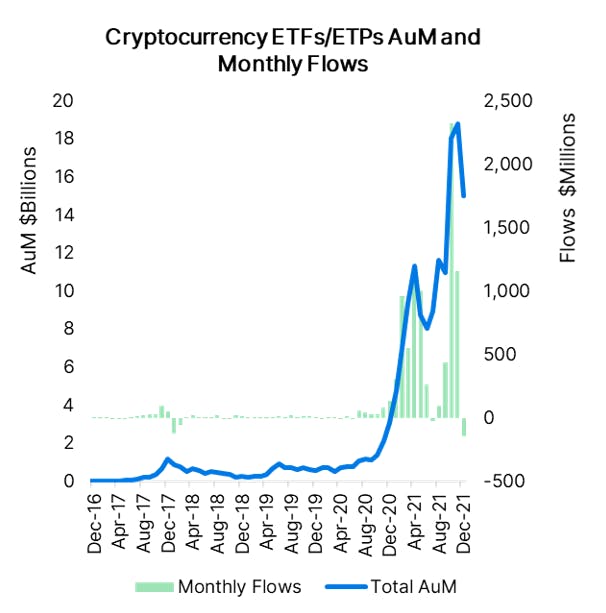
These investment vehicles snuck into both retail and institutional investors' portfolios, growing five-fold in 2021 and reaching $15 billion in assets under management (AuM). While the amount may be minuscule compared to ETFs with exposure to traditional assets such as equity, fixed income, and commodities, it is certainly sizeable in the Thematic ETF space. The Cryptocurrency theme was the third-largest theme in 2021 behind Clean Energy ($17 billion) and Cybersecurity ($15.1 billion).
Crypto ETFs providers' Overview
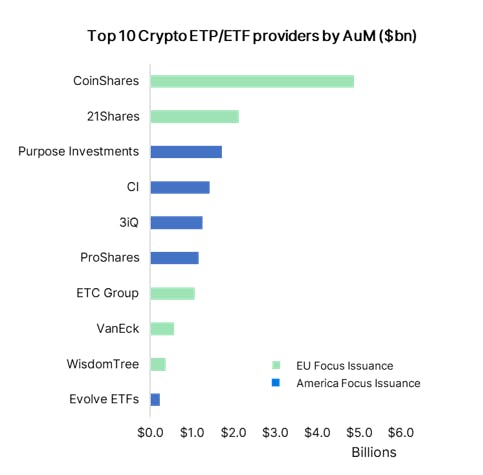
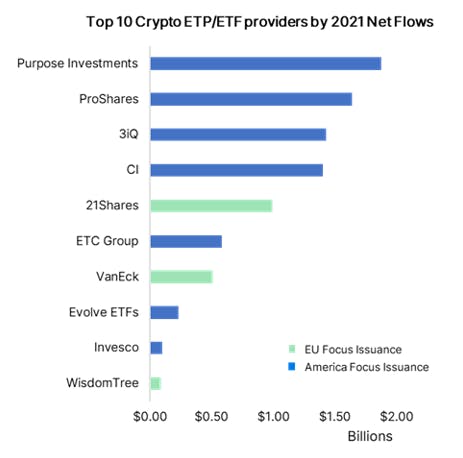
CoinShares (EU) remains the largest Crypto ETP provider with $4.88 billion in AuM, distantly followed by 21Shares (EU, $2.11 billion) and Purpose Investments (Canada, $1.71 billion). In terms of 2021 net flows, Canadian asset management firm Purpose Investments were among the top crypto ETF providers, launching 14 ETFs and luring in over $1.87 billion of investors' money. Meanwhile, ProShares (U.S.) hit the jackpot with their BITO ETF, the first Bitcoin-linked ETF that hit the U.S market. The fund amassed $1.2 billion in assets under management in just two days. BITO ETF was the second-most-traded ETF launch of all time behind BlackRock US Carbon Transition Readiness ETF, which launched in April 2021 and saw a one-day turnover of more than $1 billion, according to Bloomberg.
Europe reigns as the leader of Crypto ETPs but America is catching up
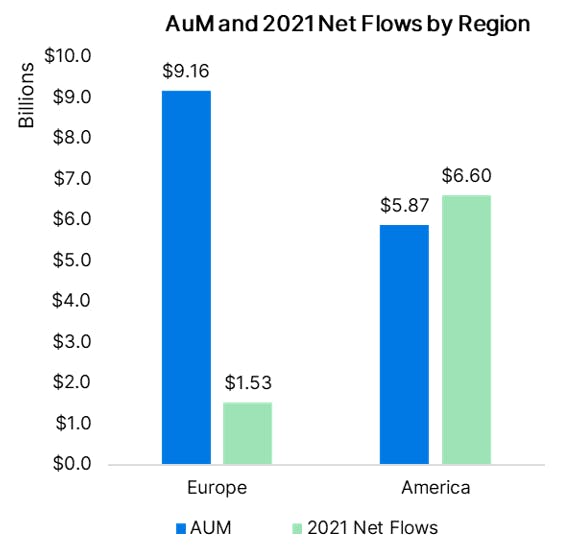
Europe remains the leader of Crypto ETPs with $9.14 billion in AuM. Yet, America is catching up, tailing the old continent with stronger inflows amounting to $6.6 billion in 2021 (Europe, $1.52 bn) and an AuM of $5.86 billion.
There are no Cryptocurrency ETFs or ETPs available to retail investors in Asia Pacific (APAC). Issuers in APAC are actively looking to explore opportunities and assessing the regulators' attitude towards these products will be an important consideration. Investors in the region have turned to private funds to gain exposure to crypto-assets. They are commonly domiciled in offshore jurisdictions and make use of alternative fund structures. However, rumors say it's about to change. Torus Kling Blockchain IFSC, a joint venture between Mumbai-based Cosmea Financial Holdings and Hyderabad-based Kling Trading India, has inked a Memorandum of Understanding (MOU) with the BSE's international arm India INX to develop digital asset-based ETFs in India. If things go as planned with regulators, the first APAC Crypto ETF will be live in India by late 2022.
The success of Crypto ETFs is mainly attributed to their convenience. They provide an easy and simple way of gaining exposure to the most popular cryptocurrencies. Investors can choose between physically-backed or synthetic crypto ETFs.
Physically Backed Crypto ETFs
The first type is physically backed or spot crypto ETFs. The firm managing the fund buys the cryptocurrencies (Bitcoin or Ether for example), and the ownership of the coins is indirectly transferred to investors via shares. Hence, when investors buy these ETFs, they are gaining exposure to cryptocurrencies, but minus the hassle of direct ownership, which involves setting up a digital wallet, keys, etc.
Advertisement
An example of that is the first Canadian Bitcoin ETF, the Purpose Bitcoin ETF (BTCC). Since its inception early in 2021, BTCC has attracted more than $1.54 billion in net inflows and accumulated around 29,500 Bitcoins. The fund has a management fee of 1% and trades on the Toronto Stock Exchange and the NEO Exchange.
Synthetic Crypto ETFs
The second type is a synthetic product that tracks cryptocurrencies indirectly using cryptocurrencies futures contracts or other derivatives (swaps, options, etc.). Just like physically-backed crypto ETFs, they enable investors to gain exposure to the digital currency without direct ownership of the crypto itself.
In the case of futures-based crypto ETFs, the investing firm does not buy and hold any physical cryptocurrency in the fund. Instead, they invest in crypto futures (e.g. Bitcoin Futures) that trade on an exchange and allow investors to speculate on cryptocurrencies prices. The first Bitcoin Futures began trading on the CBOE Exchange in December 2017 but were delisted in 2019. Currently, Bitcoin and Ether futures are traded on the Chicago Mercantile Exchange (CME) since January 2020 (Bitcoin) and February 2021 (Ether).
Bitcoin and Ether futures are liquid, safe and their prices are closely related to that of their spot price. For those reasons, they make a great tool for ETF issuers looking to replicate the cryptocurrency performance.
A good example of a Futures-based ETF is BITO, an actively managed ETF that buzzed the crypto world, and is the first-to-market Bitcoin-linked ETF to land in the U.S. The ProShares Bitcoin Strategy ETF (BITO) invests in cash-settled, Bitcoin futures contracts. It currently holds CME Bitcoin January 2022 Futures (BTCF2) and CME Bitcoin February 2022 Futures (BTCG2), along with other liquid assets (Cash and Treasury bills). When those futures contracts mature, the ETF will buy up contracts for the next month. BITO has an expense ratio of 0.95% and trades on the NYSE ARCA exchange.
After years of rejections and heartbreaks, BITO opened the door for issuers to finally cater to the U.S. market with crypto products, at least futures-based ones. While U.S. investors have now several Bitcoin-linked ETFs at their disposal, none of them are physically backed. The U.S. Securities and Exchange Commission (SEC) has yet to approve any physically-backed ETF filings, clinging to concerns about the risky nature of the crypto market.
A new type of crypto derivative-based ETF was made available this year — a yield-focused ETF. These ETFs provide investors with a new way to invest in cryptocurrency — by using a covered call strategy to earn yield and harvesting the volatility available from the underlying cryptocurrency. An example of that is the Purpose Bitcoin Yield ETF (BTCY). The fund buys the physically backed Purpose Bitcoin ETF (BTCC), then applies a covered call option on 10% - 50% of the portfolio. This strategy aims to generate double-digit yields in addition to long Bitcoin as a component of total return.
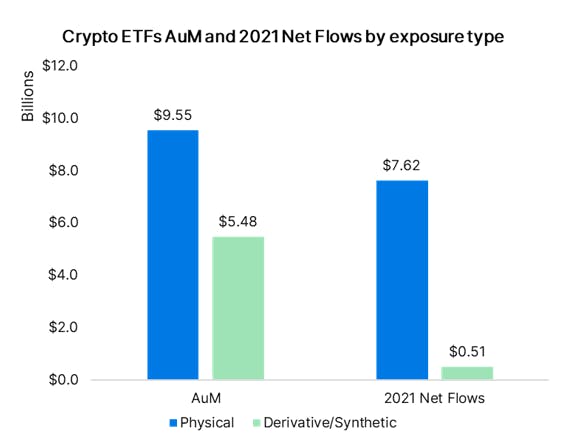
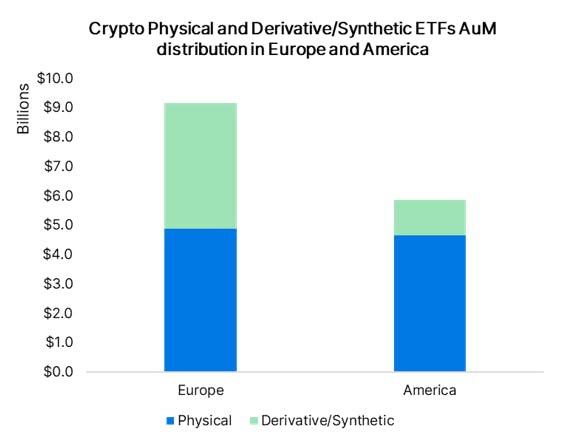
Physical-backed ETFs have the lions’ share with $9.55 billion in AuM and received $7.62 billion of net flows in 2021. They represent 53% of Europe's total Crypto ETFs AuM and 80% of America's. Derivative/Synthetic based ETFs on other hand — have a combined AuM of $5.48 billion and only received half a billion of net flows in 2021. The relatively small net flows of Derivative/Synthetic in 2021 are due to large outflows from some of CoinShares ETFs, which reduced BITO's positive impact.
Advertisement
Predictions for 2022
While it's hard to say what's in store for Crypto ETFs in 2022, the crystal ball hints that the appetite for the easy-to-trade crypto funds will remain resilient. Providers now have the arsenal to absorb hungry investors and will likely continue to innovate under the motto "an ETF for everything". One big catalyst to watch out for is a potential SEC volte-face on their stance on spot Bitcoin, and other crypto ETFs.
Keep reading:
FIND AND COMPARE OVER 7,000 ETFS WITH OUR FREE TOOLS:
INTERESTED IN TOP ETF LISTS? CHECK OUT OUR INVESTING GUIDES:
- Investing in Gold ETFs
- Investing in Silver ETFs
- Investing in Commodity ETFs
- Investing in Oil ETFs
- Investing in ESG ETFs
More articles


About Trackinsight
Since our founding in 2016, we have been at the forefront of the industry, delivering accessible, comprehensive, and reliable tools to support the evolving needs of investors.
Over the past decade, Trackinsight has expanded its operations across six countries, serving thousands of professional investors. We’ve consistently innovated to provide cutting-edge solutions that meet the changing demands of the ETF market.
In 2024, Kepler Cheuvreux, a leading independent European financial services firm, acquired a majority stake in Trackinsight, becoming the company's principal shareholder.
This strategic partnership solidifies Trackinsight's position as a premier provider of ETF selection and analysis tools, while strengthening Kepler Cheuvreux’s commitment to becoming a leading player in the ETF sector.
Together, we are committed to offering advanced services that empower professional investors, advisors, institutions, and issuers. This new step enables us to deliver even more comprehensive and innovative technological solutions, driving ETF investing to new heights.
More about TrackinsightETF TOOLS
PLATFORM
ETF NEWS & RESEARCH
Privacy policy | Cookie policy | | Terms of use | Imprint